Best RCA to XLR Female Cables for Studio and Live Sound
Whether you’re linking a DJ mixer to an audio interface, routing a microphone through a mixer to a recorder, or integrating home theater gear with pro audio equipment, the right RCA to XLR female cable can simplify connections and preserve signal quality. This guide highlights five reliable options, clarifying who each cable is best for, and why you might choose one over another. Use this overview to match your gear, setup, and environment to the most suitable interconnects.
Summary of selected products:
- Belipro Dual XLR Female to 2 RCA Male — best for professional studios needing dual channels with robust shielding.
- JOLGOO XLR to RCA Cable — best for budget-conscious setups requiring solid build and shielding.
- Disino Dual XLR Female to Dual RCA — best for versatile studio and live applications with simple split capability.
- SiYear XLR Female to 2 x Phono RCA — best for DJs integrating controllers with amplifiers and home theaters.
- Seefeful XLR Female to Dual RCA Y Splitter — best for reliable signal distribution with locking connectors.
Belipro Dual XLR to 2 RCA Cable

The Belipro cable provides two XLR female ends on one side and two RCA male ends on the other. This bidirectional interconnect is designed for connecting mixers and line outputs to recorders or amplifiers, and it can adapt to various setups, including DJ controllers and home theater equipment. It is ideal for recording studios and live performances that require dual-channel fidelity with minimal signal loss.
Best for: professional studios and live setups needing two clean, independent audio channels with strong durability. The 24K gold-plated connectors reduce corrosion and noise, while OFC conductors support clear signal transmission. Use this when you require robust unbalanced outputs from XLR inputs.
Caution: While highly capable, this cable is wider in profile due to dual channels, which may require extra space and careful routing in tight setups.
JOLGOO XLR to RCA Cable

The Jolgoo XLR to RCA cable uses 4N OFC wire with strong shielding and shielded JOLGOO construction. With dual XLR female to dual RCA male connectors, it supports professional-grade signal integrity and stable connections for long runs. Its rugged build and shielding help minimize RF/EMI interference, making it a solid pick for critical audio paths in both studio and live environments.
Best for: budget-conscious users who still need reliable dual-channel performance and good shielding. The cable’s sturdy design and gold-plated contacts help maintain signal quality in moderate environments.
Caution: The overall length is relatively short (3.3 feet), which may require additional adapters or extensions for larger setups.
Disino Dual XLR Female to Dual RCA

Disino’s cable pairs two XLR female connectors with two RCA male connectors, offering a versatile option for connecting mixers, amplifiers, or HiFi systems. It uses 4N Oxygen Free Copper with a metal braid shield to reduce interference and deliver a clean signal with minimal noise. The dual-channel configuration is especially helpful for studio setups that require parallel outputs or easy routing to separate devices.
Best for: users who prioritize a clear, noise-free signal and simple dual-channel splitting in both studio and live applications. It’s a practical choice for those who need flexible wiring without a lot of extra connectors.
Caution: As with many dual-end cables, the physical length and bend radius may affect routing in compact rigs; plan cable management accordingly.
SiYear XLR Female to 2 x Phono RCA Adapter

The SiYear adapter converts a single XLR female connection into two RCA male outputs, effectively creating a Y-split that can feed multiple receivers or amplifiers. It is compatible with mixers, microphones, and some home theater setups, making it a practical choice for flexible stage or home use. The shielded design helps minimize EMI and RF interference for clearer signals.
Best for: DJs and home theater enthusiasts needing a simple XLR-to-dual-RCA splitter that can integrate multiple sound systems. Choose this if you want a straightforward, low-cost path from XLR to RCA in mixed environments.
Caution: This cable uses an unbalanced design, so channel separation may be limited; use where mono-to-two-mro outputs are sufficient.
Seefeful Female XLR to Dual RCA Y Splitter
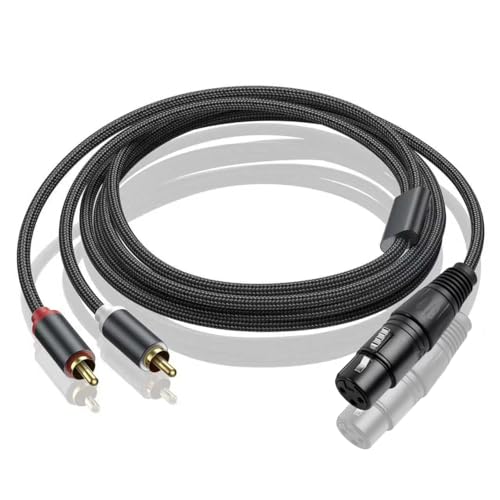
The Seefeful Y splitter cable channels a female XLR signal into two RCA male connectors, distributing the signal evenly to two devices. It features premium 21/0.10 OFC copper, multi-layer shielding, and 24K gold-plated RCA connectors to improve conductivity and reduce oxidation over time. This unbalanced design is useful when splitting signals to two amplifiers or receivers that do not require phase-synchronized outputs.
Best for: setups needing reliable signal distribution with secure locking and robust shielding. The locking design helps maintain stable connections in mobile or stage environments.
Caution: The unbalanced RCA setup means potential channel crosstalk if used in complex, multi-device networks; plan routing to minimize interference.
Buying Guide: Key Purchase Considerations
- Channel needs: Do you need dual channels or a simple single-path splitter? If you require two separate outputs, choose a dual XLR to RCA cable rather than a single-channel variant.
- Shielding and conductor quality: Look for OFC copper and multi-layer shielding to minimize EMI/RFI and preserve signal clarity in crowded cable environments.
- Connector quality: Gold-plated contacts resist oxidation and help maintain connection quality over time. Consider the durability of XLR female ends for frequent connections and disconnections.
- Length and routing: Short runs reduce signal loss and noise, but long cables may introduce latency or interference. Plan cable length according to your setup footprint.
- Installation flexibility: If you need to split one XLR into two RCA feeds, ensure the design supports easy detachment or re-routing without compromising shielding.
Frequently Asked Questions
- What is the main use for RCA to XLR cables? – They adapt consumer-grade RCA outputs or inputs to pro-audio XLR devices, bridging home theater gear, mixers, and recorders.
- Are dual XLR to RCA cables better for studio use? – Yes, when you need two independent channels with separate outputs for a mixer or interface, dual cables provide better routing options.
- Will these cables work with all XLR devices? – They fit standard 3-pin XLR female connectors; verify compatibility with your specific equipment if you have uncommon pin configurations.
- Do I need shielding for live performances? – Shielding helps minimize interference in venues with RF traffic or stage lighting, improving signal integrity.
- Should I choose unbalanced RCA or balanced XLR in a studio? – For long cable runs or high-noise environments, balanced XLR paths are generally more resistant to noise; RCA splits are more common for consumer gear or short runs.