
A six-channel receiver or amplifier can power a six-speaker setup when its outputs, speaker impedance, and power ratings match the speakers. The Donner MAMP6 is best for buyers who want six independently controlled channels and optical or coaxial inputs; the Pyle 750-watt model suits buyers seeking a simpler Bluetooth and karaoke setup; and the Pyle 2000-watt model offers more listed input types, including HDMI. Compare the specifications carefully: advertised peak power is not the same as continuous output, and a six-channel amplifier is not automatically a surround-sound AV receiver.
| Product | Best for | Notable listed features |
|---|---|---|
| Donner MAMP6 | Independent channel control | Optical, coaxial, Bluetooth 5.3 |
| Pyle 750W | Everyday playback and karaoke | Bluetooth, USB, microSD, two mic inputs |
| Pyle 2000W | Many connection options | HDMI, optical, coaxial, dual 10-band EQ |
| Pyle PTA66BT.5 | Home or commercial applications | Bluetooth, USB, SD, subwoofer output |
| Pyle 600W receiver | Basic multi-speaker playback | Bluetooth, USB, SD, FM radio |
Donner MAMP6 Six-Channel Receiver
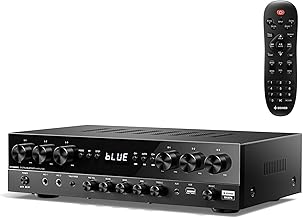
Best for: Buyers who want channel-by-channel control and digital audio inputs for a multi-speaker home or karaoke system. The Donner MAMP6 is listed with six independently controlled channels and support for up to six groups of 12 speakers at 4–16 ohms, subject to the product’s speaker-connection requirements.
Its listed inputs include Bluetooth 5.3, USB drives up to 64 GB, two pairs of RCA, AUX, FM radio, optical, and coaxial. Two microphone inputs and echo and talkover controls add karaoke and announcement functions. The supplied remote can adjust treble, midrange, bass, echo, and talkover across input modes.
Why it stands out: Among these options, it provides the clearest listed support for independently controlled channels and a broad 4–16-ohm speaker range. Its stated output is 25 watts × 6 RMS, with 1000 watts peak; use the RMS figure for a more meaningful power comparison. Limitation: It has no HDMI input, so a TV that requires HDMI audio connection will need another connection method or equipment.
Pyle 750W Six-Channel Bluetooth Amplifier

Best for: Buyers who want a six-channel amplifier with Bluetooth, portable-media playback, and microphone inputs without prioritizing optical or HDMI connections. Pyle lists 750 watts peak power and support for multiple speakers with 4–8-ohm impedance.
Playback options include Bluetooth, USB, microSD, AUX, and built-in FM radio with an LCD display. The amplifier also has two ¼-inch microphone inputs, a headphone connection, RCA audio inputs, recording output, and a subwoofer output. Those features make it a practical choice for music playback, karaoke, or a basic PA-style arrangement.
Why it was selected: It combines six-channel amplification with several convenient source options and a stated speaker impedance range. Choose it if Bluetooth and USB or microSD playback matter more than digital TV inputs. Limitation: The listed features do not specify independent volume control for each channel or optical, coaxial, or HDMI input. Its 750-watt figure is peak power, so do not treat it as continuous per-channel output.
Pyle 2000W Rack-Mount Six-Channel Amplifier

Best for: Buyers who need a wide range of listed connections and want an amplifier described as rack-mountable. Pyle lists 2000 watts peak power and use with multiple speakers at 4 ohms.
The listed nine input options include Bluetooth, USB, AUX, two microphone inputs, headphone, optical, coaxial, HDMI, AC-3, and DVD input. It also includes FM radio and a dual 10-band equalizer. These connections make it the most input-focused option in this selection, particularly for shoppers comparing digital audio and HDMI availability.
Why it was selected: It is a six-channel model with an unusually broad listed connection set, including HDMI, optical, and coaxial inputs. Choose it if those connection types and equalizer controls are important to your source setup. Limitation: Its listed speaker impedance is 4 ohms, so check the impedance and wiring plan for all six speakers before buying. The 2000-watt figure is peak power, not a stated continuous output rating.
Pyle PTA66BT.5 Six-Channel Amplifier

Best for: Buyers setting up home entertainment or a commercial-style audio system who need six channels, microphone features, and common analog connections. The listed output is 600 watts peak, and the amplifier supports multiple speaker channels at 4–8 ohms.
Features include Bluetooth, USB-A and SD playback for MP3 or WMA files, a front AUX input, RCA inputs and outputs, and a subwoofer output. It also has two ¼-inch microphone inputs, echo, talkover, and FM radio with a digital LCD channel display.
Why it was selected: It offers a useful mix of speaker amplification, media playback, microphone controls, and RCA connections for buyers who do not need the digital TV inputs found on some alternatives. Choose it if karaoke, announcements, or subwoofer connectivity are part of the plan. Limitation: The listed features do not include optical, coaxial, or HDMI inputs, and the stated 600 watts is peak power.
Pyle 600W Bluetooth Six-Channel Receiver

Best for: Buyers looking for a straightforward six-channel amplifier for compatible 4–8-ohm speakers, with wireless streaming and basic media inputs. Pyle lists 600 watts peak power and a frequency response of 20 Hz–20 kHz.
It supports Bluetooth and includes USB and SD card playback for MP3 or WMA files, AUX, dual ¼-inch microphone inputs, RCA connections, and FM radio with a digital LCD display. A headphone jack supports audio monitoring, and the listed Bluetooth range is more than 40 feet.
Why it was selected: It covers common playback needs without requiring a more extensive set of digital inputs. Choose it if Bluetooth, USB or SD playback, radio, and microphone inputs are sufficient for your system. Limitation: Its listed connections do not include optical, coaxial, or HDMI inputs. The 600-watt rating is peak power, and the product information does not state per-channel continuous output.
Buying Guide: How to Choose a Receiver for Six Speakers
Does a six-channel receiver power six speakers?
A six-channel amplifier is designed around six audio channels, but confirm how its speaker terminals and channel assignments work before connecting six speakers. The phrase “six speakers” can mean one speaker per channel, several speakers grouped on outputs, or a multi-room setup. Those arrangements place different demands on the amplifier. Do not assume that six channel labels automatically mean six independently adjustable listening zones.
The Donner listing specifically describes independent control for its six channels and gives support for up to six groups of 12 speakers at 4–16 ohms. The other product descriptions identify six-channel amplification but do not provide the same detail about independent channel adjustment. If separate control by room or speaker group matters, verify that capability in the manufacturer’s instructions.
How should speaker impedance affect your choice?
Match the amplifier’s supported impedance to the speakers and the wiring arrangement. The Donner is listed for 4–16 ohms, the Pyle 750W and PTA66BT.5 models for 4–8 ohms, and the Pyle 2000W model for 4-ohm speakers. The Pyle 600W listing also specifies 4–8 ohms.
Connecting multiple speakers to one output can change the load seen by the amplifier. Check the receiver’s instructions before wiring speakers in series or parallel, and do not assume that a model’s supported impedance applies to every possible combination.
What does peak power tell you?
Peak power is not the same as continuous RMS power. In these listings, most power figures are described as peak ratings, so they should not be compared as if they were equivalent continuous output measurements. The Donner listing gives both 1000 watts peak and 25 watts × 6 RMS, making its continuous rating clearer than the others in this selection.
When comparing amplifiers, look for output power per channel, the conditions used to measure it, and whether the figure applies across all channels at once. If those details are not listed, avoid estimating them from the peak number.
Which inputs do you need for a TV or music player?
List your sources before choosing. Bluetooth is convenient for phones and computers, while USB or SD inputs can play supported files from removable media. RCA and AUX connections suit compatible analog sources. Optical and coaxial inputs can connect supported digital audio sources, and the Donner and Pyle 2000W models list both.
The Pyle 2000W model is the only product here that lists HDMI input. The Donner specifically states that it has no HDMI input. Check the TV’s audio outputs and the receiver’s supported inputs; do not assume that a product described as a home theater amplifier has the same video and surround-processing features as an AV receiver.
Are microphone and karaoke features important?
For karaoke or announcements, check the number and type of microphone inputs and whether echo or talkover controls are included. The Donner, Pyle 750W, and Pyle PTA66BT.5 list two microphone inputs. The PTA66BT.5 includes echo and talkover, while the Donner lists echo and talkover adjustment. The Pyle 2000W model also lists two microphone inputs.
If microphones are not part of the setup, prioritize speaker compatibility and the audio connections you actually plan to use. Extra features do not compensate for an impedance mismatch or an unsuitable input arrangement.
How should you compare these five models?
- Choose the Donner when independent channel control, optical or coaxial inputs, Bluetooth 5.3, and its stated RMS rating fit your needs.
- Choose the Pyle 750W for Bluetooth, USB and microSD playback, FM radio, and two microphone inputs.
- Compare the Pyle 2000W when HDMI, optical, coaxial, and a dual 10-band EQ are priorities, while checking its listed 4-ohm speaker requirement.
- Consider the Pyle PTA66BT.5 for USB and SD playback, RCA connections, a subwoofer output, and microphone controls.
- Consider the Pyle 600W when basic Bluetooth, USB or SD playback, FM radio, and 4–8-ohm speaker support cover the planned setup.
Frequently Asked Questions
Can I connect six speakers to any six-channel receiver?
Not necessarily. Confirm the number and purpose of the speaker outputs, supported impedance, and permitted wiring configurations in the product instructions. Some models describe channel control or speaker-group support more clearly than others.
Is a six-channel amplifier the same as a 5.1 AV receiver?
No. A six-channel amplifier provides multiple amplification channels, but that description alone does not establish surround-sound decoding, HDMI video switching, or a standard 5.1 speaker configuration. Check the specific inputs and processing features required for your system.
Which option lists optical and coaxial inputs?
The Donner MAMP6 and Pyle 2000W six-channel amplifier list optical and coaxial inputs. The Donner listing also specifies that it has no HDMI input.
Which receiver is best for karaoke microphones?
The Donner and Pyle PTA66BT.5 list two microphone inputs and echo and talkover controls. The Pyle 750W and Pyle 2000W models also list two microphone inputs; compare their other connections and speaker requirements before choosing.
Should I use the peak-watt figure to match an amplifier to speakers?
No. Peak power does not establish continuous output per channel. Compare RMS or continuous ratings when available, and check the speaker’s power and impedance requirements against the amplifier’s specifications.