
The best recording machine for music depends on whether you want to capture rehearsals, save song ideas, record spoken notes, or add a recorded message to a plush toy. The Tallkcoder 64GB recorder is the clearest choice here for flexible MP3 and WAV voice recording, while the 128GB model is aimed at buyers who prioritize storage. These listed products are portable recorders and message devices, not dedicated multitrack music studios; check the recording format and input options before choosing one for instruments or full-band sessions.
| Product | Best suited to | Key distinction |
|---|---|---|
| Tallkcoder 64GB Magnetic Recorder | Voice notes and simple audio capture | MP3/WAV, voice activation, noise reduction |
| 128GB Audio Recorder | Buyers prioritizing listed storage capacity | 128GB capacity stated in product name |
| 16GB Digital Voice Recorder | Basic recording and playback | 16GB and playback stated in product name |
| Pocket AI Voice Recorder | Audio notes with transcription needs | Auto-transcription stated in product name |
| USB Downloadable Sound Music Box | Custom recorded messages in plush toys | Designed for playback in stuffed animals |
Tallkcoder 64GB Magnetic Voice Recorder

Best for: Musicians who want a portable device for spoken song ideas, rehearsal comments, or other voice-focused notes. It is the most clearly described general-purpose recorder in this selection because its features specify file formats, recording controls, storage, and battery life.
The recorder has 64GB of internal storage and supports MP3 and WAV recording. Its listed settings include an adjustable bitrate up to 1536Kbps, voice activation, DSP 5.0 processing, and triple noise reduction. The description says it is preset to MP3 at 128kbps with noise reduction enabled. It also lists up to 100 hours of continuous recording and automatic saving when the battery runs low.
Choose this if you value format options and voice-activated recording. Limitation: the supplied details do not identify instrument inputs or multitrack recording, so do not assume it can record a full music setup directly.
128GB Portable Audio Recorder

Best for: Buyers who want a high-capacity portable recorder for saving many audio files. The product name states 128GB of storage, a 1300-hour capacity, three-day battery life, crystal-clear sound, portability, and MP3-player functionality.
Those listed claims make it a possible option for collecting long-running voice notes or other recordings without frequently clearing storage. The name also describes it as a digital voice recorder and MP3 player, which may suit someone who wants recording and playback in one device.
Choose this if stated storage capacity is your main priority. Limitation: no detailed feature list was provided, so supported recording formats, inputs, and how its stated recording capacity is measured cannot be confirmed from the supplied information. It is not identified as a multitrack recorder.
16GB Digital Voice Recorder
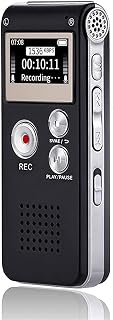
Best for: Someone seeking a basic, rechargeable recorder for spoken notes, lecture-style audio, or simple playback. The product name lists 16GB storage, playback, USB recharging, and a compact digital voice recorder design.
For a musician, a straightforward recorder can help preserve lyric ideas, spoken reminders, or practice observations without needing a more complex recording setup. Its stated playback feature is useful for listening back to saved material, while USB recharging avoids reliance on disposable batteries according to the product description.
Choose this if you want a simple device and do not need the specifically listed WAV/MP3 flexibility of the Tallkcoder. Limitation: the supplied details do not specify audio formats, noise controls, battery runtime, or instrument connections.
Pocket AI Voice Recorder

Best for: Buyers who want a recorder described as an AI note taker with automatic transcription. A musician may find transcription useful for turning spoken planning notes or lyric discussions into text, but that is separate from recording a finished music track.
The supplied product name identifies a pocket voice recorder, auto-transcription, and AI note-taking functions. Those details make it a distinct option for people whose priority is searchable written notes alongside audio capture, rather than simply maximizing storage or selecting a recording format.
Choose this if converting spoken notes into text is central to your workflow. Limitation: no storage capacity, file formats, battery information, transcription conditions, or music-specific recording features were provided, so verify those details before relying on it for music sessions.
USB Downloadable Plush Sound Recorder

Best for: Creating a custom recorded message or sound for a stuffed animal, doll, or pillow. This product is included because its description explicitly says users can record custom messages and download audio by USB for a sound music box.
It is a specialized playback and message device, not a general-purpose machine for recording music practice. Its intended use is adding recorded content to a plush toy, with remote control mentioned in the product name.
Choose this if your goal is a personalized audio message gift or plush-toy project. Avoid this if you need to capture instruments, rehearsals, or songs as standalone recordings; the supplied details describe a sound box for stuffed animals rather than a music recorder.
Buying Guide: How To Choose A Music Recording Machine
First identify what you mean by “recording music.” A device for saving a quick melody idea has different needs from one for recording a band, connecting microphones, or producing multitrack songs. The products above are primarily described as voice recorders, a transcription device, and a plush-toy sound module. None is explicitly identified in the supplied information as a multitrack music recorder.
Are you recording ideas, voice notes, or finished songs?
For spoken lyric reminders or practice observations, a portable voice recorder may be sufficient. If you want to record a finished vocal or instrumental performance, look for clear information about microphone quality, instrument inputs, recording levels, supported file formats, and whether the device records multiple tracks. Do not infer those capabilities from a large storage figure or the phrase “crystal-clear sound.”
Which recording format and audio quality matter?
MP3 files are typically smaller than uncompressed or higher-quality formats, while WAV is often chosen when a less-compressed recording is useful for later editing. In this selection, the Tallkcoder description specifically lists MP3 and WAV and an adjustable bitrate. For the other products, the supplied information does not confirm formats. Check the device listing for the exact formats and recording settings you need.
How much storage and battery life do you need?
Storage and runtime affect how long you can record before transferring files or recharging. The listed capacities include 64GB for the Tallkcoder, 128GB for the high-capacity recorder, and 16GB for the basic voice recorder. Only the Tallkcoder description gives detailed battery claims; the 128GB model’s name states a three-day battery life. Treat stated recording-hour figures as dependent on recording settings, and confirm how capacity estimates are calculated.
Will you record in a noisy room or during rehearsal?
Noise reduction and voice activation can be useful for speech-focused recordings, but they do not automatically guarantee accurate music capture. The Tallkcoder lists noise reduction and voice activation. Voice activation is designed to respond to sound and pause during quiet periods, which may not suit music with soft passages or pauses. For music, check whether these features can be adjusted or disabled and test the intended setup before an important session.
Do you need transcription, playback, or USB transfer?
Choose features that match your workflow. The Pocket AI model is named as an auto-transcription note taker, while the 16GB model lists playback and USB recharging. The 128GB device is described as an MP3 player. The plush sound recorder is intended for downloadable custom messages. Confirm how recordings transfer to your computer or phone and what software, if any, is required; those details are not provided for every product here.
What should you check before recording instruments?
Look for specified microphone inputs, line inputs, external microphone support, manual gain controls, monitoring options, and multitrack capability. These details matter if you intend to connect a guitar, keyboard, mixer, or external microphone. The supplied product descriptions do not confirm these features for the voice recorders. If a product page does not clearly list the connections and recording workflow you need, consider a dedicated portable field recorder or audio interface instead.
Frequently Asked Questions
Can a voice recorder capture music?
A voice recorder may capture sound, but the supplied details do not establish that these models are designed for high-quality instrument recording. Check microphone specifications, inputs, formats, and recording controls before using one for music.
Which option lists both MP3 and WAV recording?
The Tallkcoder 64GB Magnetic Voice Recorder is the product in this selection whose supplied features explicitly list both MP3 and WAV recording.
Which recorder has the largest stated storage?
The 128GB Audio Recorder has the largest stated capacity in its product name. Its detailed feature list was not supplied, so confirm its actual recording settings and storage details before buying.
Is voice activation suitable for recording a song?
It may be less suitable for music with quiet passages, soft notes, or pauses because voice activation can pause recording during silence. Check whether the feature can be disabled or adjusted.
Is the plush sound recorder a music recorder?
It is described as a USB-downloadable sound box for custom messages in stuffed animals, dolls, and pillows. The supplied information does not describe it as a general-purpose music recording device.