
The best recording mic for a PC depends on your setup: the FIFINE AM8 suits creators who want USB now and XLR later, while the ZealSound K66 is a convenient pick for USB recording and device flexibility. The TONOR TC310+ includes a boom arm and RGB lighting, the MAONO PD200W adds wireless recording, and the Blue Yeti offers four pickup patterns for varied recording needs.
| Microphone | Best For | Connection Or Standout Feature |
|---|---|---|
| FIFINE AmpliGame AM8 | USB beginners planning an XLR upgrade | USB and XLR |
| ZealSound K66 | Plug-and-play and mobile-device flexibility | USB, noise reduction mode |
| TONOR TC310+ | Gaming and streaming desk setups | Boom arm and RGB |
| MAONO PD200W | Wireless and two-person podcast recording | Wireless, USB, and XLR |
| Logitech Blue Yeti | Different recording arrangements | Four pickup patterns |
FIFINE AmpliGame AM8: Best USB And XLR Upgrade Path

The FIFINE AmpliGame AM8 is a dynamic microphone with USB and XLR connections. Its 50 Hz–16 kHz frequency response and cardioid pickup pattern are intended for voice recording, streaming, and podcasting. FIFINE recommends positioning the microphone’s end toward the sound source and recording from about 2 to 6 inches away.
Best for: PC users who want a straightforward USB setup now but may move to an audio interface or mixer later. USB operation includes a tap-to-mute control and mute indicator, which can help creators manage live recording without opening computer controls.
Choose this model if you prefer a dynamic mic and want a listed option to move from USB to XLR. The XLR connection requires a separate XLR cable and an audio interface or mixer. RGB lighting and the microphone’s function key are inactive in XLR mode, so avoid choosing it for XLR use if those USB controls are essential.
ZealSound K66: Best Plug-And-Play Flexibility

The ZealSound K66 is a USB condenser microphone with a cardioid pickup pattern, 40 Hz–18 kHz frequency response, and listed 46 kHz sampling rate. It offers a default mode for a warm, natural vocal tone and a noise reduction mode intended to reduce sounds such as keyboard clicks, computer fan noise, and background chatter.
Best for: Beginners who want USB setup without driver or app installation, or creators who record across a computer and mobile devices. The listed compatibility includes Windows PCs, Macs, laptops, PS4, PS5, and tablets. Included USB-C and Lightning adapters support use with listed mobile devices.
The microphone also has gain, volume, mute, monitoring, and echo controls. Choose it if onboard controls and the option to switch recording devices matter more than an XLR upgrade path. Its noise reduction mode is designed to help with background sound, but it is not described as eliminating all room noise; a quiet recording space can still be useful.
TONOR TC310+: Best Boom Arm And RGB Set
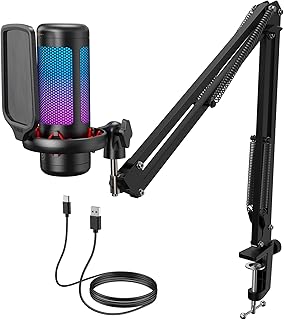
The TONOR TC310+ is a USB condenser microphone set described for gaming and content creation. The product listing highlights a boom arm, a stand, tap-to-mute, gain control, and four RGB lighting modes. The lighting options include static colors, gradients, breathing effects, and a mixed-color gradient, with brightness adjustment available through a long tap.
Best for: PC gamers and streamers who want a microphone set with a boom arm and visible lighting controls. Its listed features emphasize clean sound for communication and a desk setup with adjustable RGB, rather than multiple connection types or detailed recording specifications.
Choose this set if the included boom arm and lighting are useful parts of your recording setup. The product information provided does not specify a frequency response, pickup pattern, or XLR connection, so buyers who need those details should compare the specifications before choosing. Its feature list is more focused on gaming controls and appearance than advanced audio routing.
MAONO PD200W: Best Wireless And Multi-Mic Recording

The MAONO PD200W is a hybrid dynamic microphone offering wireless, USB, and XLR recording. Its listed features include a 30 mm dynamic capsule, cardioid pickup, an 82 dB signal-to-noise ratio, and the ability to handle up to 128 dB SPL without distortion. The listing describes it for podcasting, streaming, and vocal recording.
Best for: Creators who want more than one connection option or need to record a conversation with two wireless desktop microphones. A single receiver can connect two wireless mics, and the product supports recording each microphone to its own track for separate editing.
Choose this model if mobility or two-person podcast recording is a priority. USB is described as a plug-and-play option for phones, tablets, and computers, while XLR supports use with an audio interface. The product notes that camera and Lightning accessories are sold separately, so avoid assuming those accessories are included when planning a camera-based setup.
Logitech Blue Yeti: Best For Multiple Pickup Patterns

The Logitech Blue Yeti is a USB condenser microphone for PC and Mac. Its three-capsule array and four pickup patterns—cardioid, omnidirectional, bidirectional, and stereo—allow different recording arrangements. The listed uses include streaming, podcasting, meetings, videos, and music recording.
Best for: Creators who record more than a single voice in front of a microphone and want to select a pickup pattern for the task. Cardioid is suited to a voice in front of the mic, while omnidirectional, bidirectional, and stereo patterns give the user other listed ways to capture sound.
The product also lists Blue VO!CE software effects for enhancing recordings and streams. Choose the Blue Yeti if pattern selection is more important than wireless operation or XLR connectivity. Its listed connection is USB, so buyers who specifically need a microphone that connects to an XLR interface should consider a different option in this guide.
Buying Guide: How To Choose A PC Recording Microphone
Should you choose USB, XLR, or a hybrid mic?
USB microphones connect directly to a computer or another listed compatible device, making them a practical choice for a simple recording setup. The ZealSound K66 and Blue Yeti are USB options in this list. FIFINE’s AM8 and MAONO’s PD200W also offer USB, with an XLR connection available for setups that use an audio interface or mixer.
XLR gives you a connection option for audio equipment, but it generally requires additional gear. For the AM8, the listing specifically states that an XLR cable is not included and that an interface or mixer is needed. Compare the complete setup you intend to use, not just the microphone’s connection label.
Which pickup pattern fits your recording?
A pickup pattern describes how a microphone captures sound around it. The AM8, K66, and PD200W are listed with cardioid pickup, which focuses on sound in front of the mic. The Blue Yeti is the most flexible listed option for pickup patterns because it offers cardioid, omnidirectional, bidirectional, and stereo modes.
If you usually record one person speaking near a PC, a single voice-focused pattern may be enough. If you plan to capture sound from several directions or change recording arrangements, compare pattern options before buying. Do not assume that a microphone has a particular pattern unless the product specifications list it.
How much background noise do you need to manage?
Room noise can affect recordings regardless of microphone type. The K66 lists a noise reduction mode intended to reduce sounds such as keyboard clicks and PC fans. The AM8’s cardioid dynamic design is described as rejecting unwanted off-axis noise. These features may suit voice-focused recording, but neither description means every source of background noise will disappear.
Consider where you will place the microphone and how close you can speak to it. FIFINE recommends a 2-to-6-inch recording range for the AM8. Follow the manufacturer’s positioning advice for the model you choose, and consider whether the desk environment is quiet enough for your intended use.
Do you need onboard controls or included desk hardware?
Controls can make live recording easier. The AM8 has USB tap-to-mute and a mute indicator, while the K66 lists gain, volume, and mute controls. The TONOR TC310+ includes tap-to-mute and gain control, along with a boom arm and stand. Compare these features with your actual desk needs; included hardware may matter more than lighting if positioning is your main concern.
RGB is a visual feature, not a measure of recording quality. The TONOR’s listing emphasizes multiple lighting modes, and the AM8 offers RGB in USB mode. For the AM8, RGB and the function key are inactive when connected through XLR.
Are you recording alone or with another person?
For individual voice recording, compare connection type, pickup pattern, and convenient controls. For a two-person wireless podcast, the MAONO PD200W has a specifically listed option to connect two wireless desktop microphones to one receiver and record each mic to its own track. Check accessory requirements for your planned setup, especially if you intend to record with a camera.
Frequently Asked Questions
What is a good type of mic for recording voice on a PC?
A USB microphone is a straightforward choice for a PC recording setup. For voice-focused use, compare pickup pattern, onboard controls, and the manufacturer’s connection requirements. The K66 and Blue Yeti are listed as USB microphones, while the AM8 and PD200W also offer XLR.
Is a dynamic or condenser microphone better for PC recording?
Neither type is automatically better for every setup. The AM8 and PD200W are dynamic microphones, while the K66, TONOR TC310+, and Blue Yeti are described as condenser microphones. Compare each model’s listed pickup pattern, intended use, controls, and connection options.
Which microphone in this list offers XLR?
The FIFINE AM8 and MAONO PD200W list XLR connections. The AM8 requires a separate XLR cable and an audio interface or mixer for XLR use. The PD200W also lists wireless and USB connections.
Which option is listed for two-person wireless podcast recording?
The MAONO PD200W supports connecting two wireless desktop microphones to one receiver. Its listing says each microphone can record to its own track for editing.
Which microphone has the most pickup patterns?
The Logitech Blue Yeti lists four pickup patterns: cardioid, omnidirectional, bidirectional, and stereo. This makes it the most pattern-flexible option among the five products covered here.