
If you specifically need an audio recorder that saves to a removable SD card, none of the five products below can be confirmed as a match from the supplied product details: they advertise built-in storage, but do not list an SD card slot. They may still suit buyers who want a portable recorder with onboard memory. The 128GB EVIDA is best for buyers prioritizing listed capacity, the 136GB Tonfarb for a high-capacity option with playback and noise reduction, and the 32GB model for buyers who prefer a smaller stated storage capacity.
| Recorder | Listed storage | Best suited for |
|---|---|---|
| EVIDA digital voice recorder | 128GB | Buyers prioritizing onboard capacity |
| Tonfarb digital voice recorder | 136GB | Buyers seeking playback and recording tools |
| Tonfarb digital voice recorder | 64GB | Lecture and meeting recording |
| EVISTR digital voice recorder | 64GB | Buyers seeking a portable USB recorder |
| 32GB digital voice recorder | 32GB | Buyers looking for a small recorder |
EVIDA 128GB Voice Recorder

The EVIDA recorder is listed with 128GB of storage, voice-activated recording, playback, and password protection. Its product name also advertises up to 9,296 hours of recording. The stated capacity makes it a candidate for buyers who want substantial onboard storage for lectures, meetings, or other recordings.
Best for: Buyers who prioritize a high listed storage capacity and want voice activation and playback. It was selected because its stated storage is among the largest in this group, and the listing identifies features useful for recording and reviewing audio.
SD card note: The supplied product details do not say that this model has an SD card slot. Its 128GB designation should not be treated as proof of removable-card support. Avoid choosing it for an SD-card workflow unless the seller or manufacturer confirms the slot and supported card type.
Tonfarb 136GB Recorder With Playback
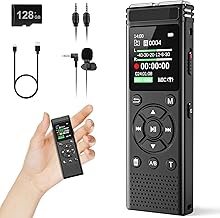
This Tonfarb digital voice recorder lists 136GB of storage and playback. Its advertised features include voice-activated recording, noise reduction, A-B repeat, MP3 playback, and password protection. The product name also states a recording capacity of up to 9,775 hours, though actual recording time can depend on recording settings and available storage.
Best for: Buyers who want a high-capacity recorder with several built-in recording and playback functions. It was selected for its listed storage and the combination of voice activation, noise reduction, and A-B repeat, which can support recording and reviewing spoken material.
SD card note: The supplied details describe 136GB of storage but do not confirm that it is removable or expandable. Choose this model for an SD-card setup only after verifying card-slot support directly with the seller or manufacturer.
Tonfarb 64GB Voice Recorder

The 64GB Tonfarb recorder is described as a playback-capable audio recorder for lectures, meetings, classes, and interviews. Its listed features include voice-activated recording, password protection, noise reduction, A-B repeat, and MP3 playback. These functions make it a practical comparison option for users who want to capture spoken content and review it on the device.
Best for: Students and meeting attendees looking for a recorder with 64GB of stated storage and a range of playback and recording tools. It was selected because its listed functions address common lecture and interview use cases without requiring buyers to prioritize the largest capacity in the group.
SD card note: The provided description does not mention an SD card slot or expandable memory. Do not assume that the 64GB is card-based. Buyers who need removable media should confirm the recorder’s storage design before purchasing.
EVISTR 64GB Portable Recorder

The EVISTR product is described as a portable mini digital voice recorder with 64GB of storage, playback, voice-activated recording, USB, and MP3 support. The product name positions it for lectures, meetings, and interviews. Those details make it relevant to buyers comparing straightforward portable recorders, although the supplied information does not specify an SD-card slot.
Best for: Buyers who want a portable recorder with 64GB of listed storage and USB mentioned in the product description. It was selected because the listing identifies common spoken-audio uses and adds USB and MP3 among its stated features.
SD card note: USB is listed, but USB support does not establish that a recorder accepts an SD card. If removable storage is essential, confirm whether this model has a card slot and whether recordings can be transferred in the way you need.
32GB Compact Digital Voice Recorder

This recorder is described as small and portable, with 32GB of built-in memory, voice-activated recording, playback, and A-B repeat. Its product name also lists 1536Kbps audio. Because it has less stated storage than the other options here, it may be a better fit for buyers with more limited recording needs or who are comparing compact devices rather than maximum capacity.
Best for: Buyers seeking a small recorder with built-in storage and playback functions. It was selected to represent a lower-capacity option for users who do not need the larger storage figures listed by the other models.
SD card note: The supplied information says “built-in memory” and does not identify removable-card support. Avoid assuming that storage can be expanded with an SD card. Confirm the slot and card specifications before relying on it for a card-based workflow.
Buying Guide: How to Choose an Audio Recorder
Do you need an SD card slot or built-in memory?
This distinction is the first thing to check when searching for an “SD card recorder audio” device. Built-in memory is storage inside the recorder; an SD card slot accepts a separate removable card. A capacity number such as 32GB, 64GB, or 128GB does not by itself indicate that the device accepts a card.
If you need removable storage to move files between devices, replace a full card, or keep recordings separate, look for an explicit specification such as “SD card slot” or “microSD card support.” Confirm the card format and maximum supported capacity as well. None of the five product descriptions provided for this comparison confirms those details.
How much storage should you choose?
Compare the stated storage with how often you plan to record and transfer files. The products here list capacities from 32GB to 136GB. More listed storage may provide room for more recordings, but the actual amount of audio that fits can vary with recording quality, file format, and settings. The product names alone do not provide enough information to calculate a dependable recording duration for every use.
Choose a lower-capacity device if your sessions are limited and you routinely move recordings off the recorder. Consider a higher-capacity model if you expect to keep many files on the device. If removable-card replacement is a requirement, prioritize confirmed card support rather than choosing by capacity alone.
Which recording features matter for spoken audio?
- Voice activation: Listed on several models, this feature is intended to start recording when sound is detected. Check the product’s instructions for how the feature is configured.
- Noise reduction: Listed on the two Tonfarb models. The supplied descriptions do not quantify its effect, so do not treat the label as a guarantee of noise-free audio.
- Playback: Useful when you want to review recordings on the recorder. Confirm the device’s playback controls and supported file formats if those details matter to your workflow.
- A-B repeat: Listed on several products and intended to repeat a selected portion during playback, which can help when reviewing a passage.
- Password protection: Listed on the Tonfarb 136GB and 64GB models and the EVIDA 128GB model. Verify how the feature works if access control is important.
How should you compare recording quality?
Look for specific audio-format, bitrate, microphone, and recording-setting details rather than relying on general terms such as “high quality.” One product name in this list states 1536Kbps audio, but the supplied details do not provide a complete, consistent audio-quality comparison across all five devices. For interviews or important meetings, check the full specification and consider whether the recording environment will be quiet or noisy.
Also consider how you will listen to and organize files. Playback on the recorder is listed for these products, while USB is specifically mentioned in the EVISTR product name. Do not infer particular transfer speeds, computer compatibility, or file-management features without checking the complete product specifications.
What should you verify before buying?
- Whether the recorder has a full-size SD or microSD slot, if required.
- The supported card format and maximum card capacity.
- Whether stated storage is built-in, removable, or expandable.
- Available recording formats, settings, and any limits on recording duration.
- How recordings transfer to your computer or other devices.
- Whether voice activation, playback, repeat, or password features meet your needs.
Frequently Asked Questions
Do these five recorders explicitly support SD cards?
No. The supplied descriptions list built-in or stated storage capacities but do not confirm an SD card slot for any of the five models. Verify card support with the seller or manufacturer before buying if removable storage is essential.
Is 128GB or 136GB proof that a recorder takes an SD card?
No. A capacity figure does not identify the storage type. It may refer to onboard memory, and the provided product information does not establish that either model accepts a removable card.
Which option has the largest listed storage?
The Tonfarb recorder is listed with 136GB, followed by the EVIDA recorder at 128GB. These figures describe the capacities in their product names; they do not confirm SD-card support.
Which recorder is listed for lectures and meetings?
The Tonfarb 64GB, EVISTR 64GB, EVIDA 128GB, and Tonfarb 136GB product names or descriptions identify lectures, meetings, classes, or interviews as intended uses. Compare their stated features and verify the full specifications before choosing.
Does voice activation guarantee that quiet speech will be recorded?
No. The listings identify voice-activated recording, but the supplied details do not specify activation sensitivity or performance in quiet environments. Check the manual or product specifications if this behavior is important.
What is the safest way to buy a recorder for a card-based workflow?
Choose a model whose official specifications explicitly name the card slot type, supported card formats, and maximum capacity. Confirm how recordings are saved and transferred. Do not rely on a storage-capacity number alone.