
Best Self-Tuning Guitar Tuners for Quick, Precise Tuning
For players who want accurate tuning in any environment, self-tuning guitar tuners deliver fast, reliable pitch detection without manual setup. This guide highlights five top options, each suited to different playing styles and stages—from loud venues to quiet practice rooms. The Fender FCT-2 is ideal for multi-instrument users; the Snark SN5X excels on the go; the Donner DT-1 suits pedalboard lovers; the BOSS TU-3 is a stage stalwart; and the LEKATO tuner pedal offers bright visibility and flexible calibration. The buyer types most likely to choose these devices include live performers, home recordists, and players who travel with gear regularly.
Buying quick-reference table:
| Product | Best For | Key Benefit |
|---|---|---|
| Fender FCT-2 | Multi-instrument players | Vibration sensing for reliable tuning |
| Snark SN5X | On-the-move tuners | Full-color display, guitar/bass/violin modes |
| Donner DT-1 | Pedalboard setups | Wide tuning range with strobe mode |
| BOSS TU-3 | Stage players | 21-segment LED meter, high visibility |
| LEKATO Tuner Pedal | Bright stage visuals | Color display, adjustable pitch ranges |
Fender FCT-2 Professional Multi-Instrument Clip-On Tuner

The Fender FCT-2 uses vibration sensing to stay accurate in loud venues or quiet rooms. It includes dedicated modes for guitar, bass, ukulele, violin, and chromatic tuning, making it a versatile choice for players who switch instruments often. Best for musicians who value stable tuning across multiple setups with minimal environmental interference.
Who this is best for: players who regularly perform or jam with various instruments and need one compact tuner to cover all bases.
Caution: tuner readings can occasionally lag in extreme stage noise if the instrument’s strings are unusually dampened.
Snark SN5X Clip-On Chromatic Tuner

The Snark SN5X features a full-color display and a frequency range tailored to guitar and bass. Its clip-on design provides quick, at-a-glance tuning, and its color interface helps players read pitch quickly on stage or in rehearsal spaces.
Who this is best for: players who value portability and an intuitive display for fast tuning during live performances or practice rounds.
Caution: while great for guitar and bass, users tuning non-standard instruments may require chromatic adjustments that aren’t as prominently labeled as dedicated modes.
Donner Tuner Pedal, DT-1 Chromatic Guitar Tuner Pedal
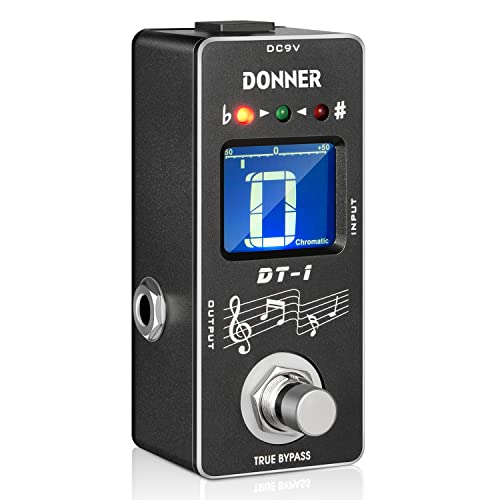
The Donner DT-1 offers a wide tuning range from A0 to C8, with a fast, precise strobe mode and two modes: tuning and bypass. It also emphasizes visibility through LED–LCD alignment, enabling reliable tuning on larger stages and outdoor venues.
Who this is best for: players who prefer a dedicated pedal on the pedalboard for quick, on-the-fly tuning during gigs or rehearsals.
Caution: the two-mode setup requires some familiarity to toggle efficiently during live performance.
BOSS TU-3 Compact Chromatic Tuner

The BOSS TU-3 stands out for on-stage reliability, with a tank-tough stompbox body and a 21-segment LED meter. A high-brightness mode cuts glare outdoors, and the meter brightness is adjustable to suit lighting conditions. Best for players who need a durable, front-of-amp tuner on stage.
Who this is best for: performers who require robust construction and clear visibility in bright stage environments.
Caution: its compact footprint means it may be less ideal for players who prefer large, high-detail displays from more recent models.
LEKATO Guitar Tuner Pedal with True Bypass

The LEKATO tuner pedal features a color LCD display with high brightness for visibility in bright or dim conditions. It supports a wide calibration range (430 Hz to 450 Hz) and offers pitch and flat-tuning options for micro-adjustments. Its compact size helps keep space for other pedalboard effects, and the tuning tolerance is tight for fast, accurate results.
Who this is best for: players who want precise, configurable calibration with clear, readable visuals on a small pedal layout.
Caution: the device’s color display requires a small learning curve to read quickly under rapid stage changes.
Buying Guide: Key Considerations When Choosing Self-Tuning Guitar Tuners
- Format and use-case: Clip-on tuners are great for practice and quick setups, while pedal tuners excel on stage and in pedalboards. Choose based on how you play and where you perform.
- Display visibility: Bright, color-rich displays help in daylight or under strong stage lighting. Look for adjustable brightness or backlighting features.
- Tuning range and modes: Chromatic tuners cover all notes; instrument-specific modes can speed up tuning, but ensure the tuner supports your primary instrument(s).
- Stability and environmental tolerance: Vibration sensing is strong in loud venues, while high-precision digital readouts help in studio settings.
- Durability: Stage gear should withstand gigging conditions. A rugged housing reduces the risk of damage from bumps or foot traffic.
- Calibration flexibility: Some units offer alternative reference pitches (e.g., 430–450 Hz). This is useful for certain tuning standards or ensemble requirements.
Frequently Asked Questions
- What is a self-tuning guitar tuner?
It is a tuning device that senses the instrument’s pitch to indicate whether strings are in tune, often designed to adapt across guitars and other instruments.
- Should I choose a clip-on or a pedal tuner?
Clip-ons are portable and quick for practice; pedal tuners are ideal for live performances and controlled pedalboard setups.
- Do these tuners require any special setup?
Most plug-and-go devices require minimal setup; some pedals may need calibration or initial calibration checks before first use.
- Can I tune multiple instruments with one device?
Yes, many multi-instrument tuners offer modes for guitar, bass, ukulele, and other instrument families.
- Are there tuners with high-visibility displays for outdoor gigs?
Yes, several options include high-brightness or adjustable displays designed to cut through sunlight glare.