
The best shielded RCA-to-3.5mm cable depends on the distance you need to cover and how much interference protection you want. The Monoprice cable is a straightforward, shielded 6-foot option; TODN’s 3-foot cable adds a ferrite bead and braided shielding; and its 1.64-foot version suits short connections. The YYTCG model offers multiple shielding layers, while UGREEN is a flexible general-purpose choice that describes interference reduction without listing a specific shielding construction.
| Product | Best For | Length | Notable Feature |
|---|---|---|---|
| Monoprice Premium | Shielded everyday connection | 6 feet | Shielded 22AWG conductors |
| TODN OFC | Short runs needing interference protection | 3 feet | Ferrite bead and tinned copper braid |
| TODN Compact OFC | Very short, tidy setups | 1.64 feet | Ferrite bead and braided shielding |
| YYTCG HiFi | Multi-layer shielding features | 3.28 feet | Tinned copper braid and double-layer PVC |
| UGREEN 3.5mm to RCA | Flexible general-purpose use | 6.6 feet | Flexible jacket and gold-plated connectors |
Monoprice Premium 3.5mm To RCA Cable

This 6-foot cable connects a device’s 3.5mm audio output to equipment with two RCA inputs. Monoprice specifies heavy-duty coaxial cable for each conductor, 22AWG conductors, and shielding intended to prevent electromagnetic interference (EMI) and radio-frequency interference (RFI) from entering the audio system.
Best for: Buyers who want a clearly described shielded cable for connecting a phone or MP3 player to a home audio system. It is a practical choice when the 6-foot length fits the setup and the priority is a simple stereo connection with stated shielding.
Limitation: The listed features do not specify a ferrite bead, braid type, or jacket flexibility. Choose another model if one of those details is essential to your setup.
TODN 3-Foot Shielded OFC Audio Cable

TODN’s 3-foot cable carries stereo audio from a device with a 3.5mm output to equipment with dual RCA inputs. Its listed construction includes 99.99% oxygen-free copper (OFC) in a four-core arrangement, tinned copper braided shielding, and a ferrite bead positioned near the 3.5mm end. The company says these features are designed to reduce EMI, RFI, crosstalk, and signal attenuation.
Best for: Buyers with a nearby source and receiver who want several explicitly described interference-control features. The 3-foot length can help keep a short connection less cumbersome than a longer cable.
Limitation: The short length may not reach across a room or around distant equipment. Measure the path, including the space needed to route the cable without pulling on the plugs.
TODN 1.64-Foot Compact Shielded Cable
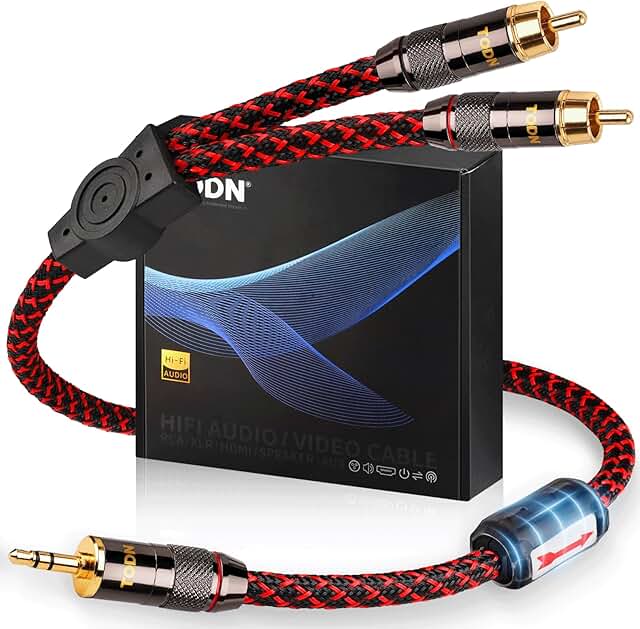
This compact TODN cable shares the listed design features of the brand’s longer model: a four-core 99.99% OFC conductor, tinned copper braided shielding, a ferrite bead, and a splitter intended to separate stereo output into left and right RCA connections. Its 1.64-foot length is aimed at equipment positioned close together.
Best for: A compact desktop or shelf arrangement where the 3.5mm source sits near an amplifier, receiver, or speaker system with RCA inputs. It is better suited to short, direct routing than to a setup that needs slack or a longer path.
Limitation: This is the shortest option in the comparison. Check the distance between the ports before buying, and leave room for bends so the cable is not under tension.
YYTCG HiFi Multi-Shielded Audio Cable

The 3.28-foot YYTCG cable is specified with 4N OFC conductors, a high-density tinned copper braid, double-layer PVC shielding, and ferrite cores. The listed design aims to limit EMI and RFI and reduce signal loss and distortion. It also has 24K gold-plated pure-copper connectors; the product description states that the plating is 5 microns thick.
Best for: Buyers comparing shielding materials and wanting a medium-short cable with multiple listed layers of protection. The 3.28-foot length may suit a nearby source and stereo system without excess cable.
Limitation: The product description does not state that the cable is balanced. Its 3.5mm-to-dual-RCA arrangement is a stereo connection, so it should not be selected as a replacement for a balanced audio cable.
UGREEN Flexible 6.6-Foot RCA Cable

UGREEN’s 6.6-foot cable connects a 3.5mm headphone jack to two RCA inputs. The listed features include gold-plated connectors, copper conductors, a flexible PVC jacket, and a tangle-free design. UGREEN describes the cable as intended to minimize signal loss and interference, though the provided specifications do not identify a particular shielding material or construction.
Best for: Buyers who need a longer cable with a flexible jacket for a home or professional audio connection. Its length gives more routing room than the short TODN options.
Limitation: Choose a model with explicitly specified shielding if documented shielding construction is a key requirement. UGREEN’s supplied feature list does not detail a braid or shielded coaxial conductors.
Buying Guide: How To Choose A Shielded RCA-To-3.5mm Cable
Which direction does the cable connect?
These products are listed as cables for sending stereo audio from a device’s 3.5mm output to equipment with two RCA inputs. For example, a phone or computer with a 3.5mm audio output can feed an amplifier or receiver with left and right RCA inputs. Check the ports on both devices before ordering: a cable cannot add a missing audio output or convert an incompatible signal type.
The cable’s connectors may physically work in either direction, but the intended setup depends on the source and destination. Confirm which device sends audio and which device receives it. Also check whether the source uses a standard 3.5mm stereo output and whether the destination has a pair of analog RCA inputs.
How much shielding do you need?
Shielding can help reduce interference picked up by an audio cable, especially when it runs near electronics or power equipment. The listed products describe different levels of construction detail. Monoprice specifies shielded conductors. TODN describes tinned copper braided shielding and a ferrite bead. YYTCG lists a braid, double-layer PVC shielding, and ferrite cores. UGREEN describes interference reduction but does not specify a shield material in the provided features.
These descriptions are useful for comparing construction, but they do not guarantee that a cable will eliminate every hum or noise problem. Interference can also come from connected equipment, power connections, or the way the system is arranged. If noise persists, try repositioning the audio cable away from power cords and other potential sources of interference.
What cable length fits your setup?
Choose a cable long enough to reach between the audio ports without stretching, but avoid unnecessary slack if you want a tidy installation. The 1.64-foot TODN model is for very close equipment. The 3-foot TODN and 3.28-foot YYTCG cables fit other short runs. Monoprice offers 6 feet, and UGREEN offers 6.6 feet for setups needing more routing distance.
Measure the actual route rather than the straight-line distance. Include space around furniture, the location of the jacks, and a little slack so the cable does not pull on the connectors. A cable that is too short can put strain on the ports; excess length may need to be arranged neatly.
Do conductor material and connector plating matter?
The product descriptions list copper or OFC conductors, and several models specify gold-plated connectors. These are construction details that may help buyers distinguish products, but they do not by themselves establish how a complete system will sound. For a practical comparison, prioritize correct connectors, suitable length, and clearly described shielding before choosing based on sound-quality language in a listing.
How do you match stereo channels?
A 3.5mm stereo plug carries left and right audio channels, while the two RCA plugs connect those channels separately. Match each RCA plug to the corresponding left or right input on the receiving equipment. If the system has only one RCA input, a standard stereo-to-dual-RCA cable may not provide the connection you need without an appropriate device or adapter.
These are analog audio cables, not digital converters. They do not convert USB, optical, or other digital outputs to RCA. Confirm the source provides an analog 3.5mm audio signal before choosing one of these cables.
Frequently Asked Questions
Can I connect a phone’s 3.5mm output to an RCA receiver?
Yes, if the phone has a 3.5mm analog audio output and the receiver has left and right RCA audio inputs. Connect the 3.5mm plug to the source and the two RCA plugs to the receiver’s corresponding inputs.
Does a shielded cable guarantee no audio hum?
No. Shielding is designed to help reduce EMI or RFI pickup, but it cannot guarantee that a system will be free of hum. Noise may originate from connected devices, power connections, or cable placement.
Is a 3.5mm-to-RCA cable balanced?
No. The products described here carry stereo audio through a 3.5mm connection and split it into two RCA channels. That is not the same as a balanced audio connection.
Which listed cable is shortest?
The TODN compact cable is 1.64 feet long. It is the best fit among these options when the source and RCA equipment are positioned very close together.
Which cable has the most detailed shielding description?
The TODN models list tinned copper braided shielding and a ferrite bead, while YYTCG lists a tinned copper braid, double-layer PVC shielding, and ferrite cores. These are product-description details, not a guarantee of noise-free performance.
Can these cables connect a digital output to RCA inputs?
No. A passive 3.5mm-to-RCA cable does not convert digital audio to analog. The source must provide an analog 3.5mm audio signal for the cable to carry.