
Short XLR patch cables help connect nearby microphones, mixers, preamps, and other audio equipment without leaving long cable loops. The Cable Matters 1-foot pair is best for very tight connections, while the 3-foot pair offers more routing room. For multiple color-coded leads, consider the EBXYA 4-pack; for frequent handling, the AA AUDIO ACCESSORY pair highlights a braided Kevlar construction. The VANDESAIL pair is another compact 1-foot option with double shielding.
| Product | Length | Pack | Best For |
|---|---|---|---|
| Cable Matters Premium XLR | 1 ft | 2 cables | Very short equipment runs |
| Cable Matters Premium XLR | 3 ft | 2 cables | Short runs with extra routing room |
| EBXYA XLR Cables | 3 ft | 4 cables | Multiple color-coded connections |
| AA AUDIO ACCESSORY XLR | 3.3 ft | 2 cables | Frequent handling and movement |
| VANDESAIL XLR Cables | 1 ft | 2 cables | Compact runs with double shielding |
Cable Matters 1-Foot Premium XLR Cable

This two-cable set is best for equipment positioned close together, such as a microphone and nearby audio device or neighboring components in a compact setup. Each cable is 1 foot long and uses a male-to-female, three-pin XLR connection.
Cable Matters lists 21 AWG oxygen-free copper conductors, a balanced design, and a soft PVC jacket. The short length can help keep a small rack or desktop setup tidy, and the two-pack provides a spare or a second connection. These features make it a practical choice when minimal cable slack is the priority.
Choose this if your connected devices are close enough for a 1-foot lead. Limitation: the short length leaves little room to reposition equipment or route around obstacles.
Cable Matters 3-Foot Premium XLR Cable

This two-pack is best for buyers who want a short XLR cable but need more routing flexibility than a 1-foot lead provides. Each male-to-female cable measures 3 feet, allowing some distance between connected equipment while still avoiding a long cable run.
The listed construction includes 21 AWG oxygen-free copper conductors, a balanced design, three-pin XLR connectors, and a soft PVC jacket. Cable Matters describes the cables for professional microphones and recording equipment, including studio and live recording environments. The two-cable bundle suits a pair of connections or a setup that benefits from having a spare.
Better for equipment separated by a modest gap or connections that need to route around a stand or desk edge. Limitation: three feet may still be too short when devices are farther apart or need extensive routing.
EBXYA 3-Foot XLR Cable Four-Pack

The EBXYA set is best for buyers who need several short connections at once. It includes four 3-foot male-to-female XLR cables, and the product listing says each cable has a different color connector to help identify leads in a multi-cable setup.
Listed features include 24 AWG oxygen-free copper conductors, copper braid, and double shielding with foil and copper-braided layers. The self-locking connector design is described as easy to insert and remove while locking into place. The connectors also have a zinc-alloy shell and nickel-plated pins.
Choose this if you need multiple short cables and want connector colors to help distinguish them. The shielding and conductor details may also suit setups where managing interference is a consideration. Limitation: the 3-foot length may not suit connections requiring a longer path, and a four-pack may be more than a one-connection setup needs.
AA AUDIO ACCESSORY 3.3-Foot XLR Pair
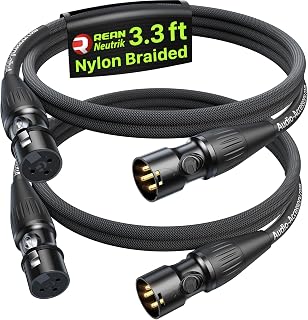
This 3.3-foot, two-cable set is best for short connections that may be handled, moved, or transported regularly. The manufacturer describes a Kevlar-reinforced construction and a tight nylon braid intended to resist wear from plugging, unplugging, movement, and transportation. The listing states that the cables withstand more than 50,000 bends.
The product features Rean connectors identified as RCX3F-M-012-1 and RCX3M-M-012-1, along with 3μm gold-plated pins. It is presented for use with equipment such as mixers, amplifiers, and DACs, as well as studio and home AV setups.
Best for buyers who prioritize the listed reinforced construction and a little more length than a 1-foot patch cable. Limitation: at 3.3 feet, it may not fit a setup with extremely tight space or a need for the shortest possible cable.
VANDESAIL 1-Foot XLR Cable Pair

This two-pack is best for compact setups that need a 1-foot balanced microphone connection. Its listed design combines 24 AWG oxygen-free copper conductors with foil and copper-braid shielding. The cable also has a flexible nylon-braided exterior, which the product listing says has passed more than 10,000 bend tests.
The connectors are described as heavy-duty metal with molded strain relief and grip treads. Tin-plated pins and a chuck-type strain relief are also listed. These details make the pair a compact option for users who want shielding and a braided outer covering in a short cable.
Choose this if the connection is very close and you want a nylon-braided cable with double shielding. Limitation: a 1-foot cable restricts device placement and may not reach around larger equipment or obstacles.
Buying Guide: How To Choose Short XLR Patch Cables
How short should an XLR patch cable be?
Measure the route between the connection points rather than the straight-line distance. Include room for connector bodies, equipment spacing, and any turns around a stand, rack, desk, or other gear. A cable that is exactly as long as the measured gap may be difficult to connect without pulling on the plugs.
A 1-foot cable is suited to adjacent equipment and very compact wiring. A 3-foot cable is a better choice when the devices are separated or the cable must follow a small routing path. The listed 3.3-foot option adds a little more length. If a cable must travel around several obstacles or across a larger area, these short models may not be long enough.
Do these cables have the right XLR connectors?
All five products are described as male-to-female XLR cables. Check the input and output on each device before ordering: the cable’s male and female ends must match the connections you need. The Cable Matters listings specify three-pin XLR connectors. The supplied information does not give the connector pin count for every other product, so verify the full product details if pin configuration is important to your setup.
Also check whether your equipment needs a standard XLR cable or a different cable type. A short XLR lead is not a substitute for a cable with a different connector or wiring arrangement.
How many cables should you buy?
Choose a two-pack when you need a pair of leads, want a spare, or are wiring two nearby connections. The Cable Matters options, VANDESAIL, and AA AUDIO ACCESSORY come as two-cable sets. The EBXYA listing offers four cables, which is more useful when several connections need to be made at once.
Consider where each cable will go before choosing a pack. A larger bundle can simplify multi-device wiring, but it may leave you with unused cables if your setup has only one connection.
What cable construction matters for a studio or live setup?
Conductor gauge and shielding are useful comparison points, but they do not replace checking the cable’s length, connector fit, and intended use. The Cable Matters listings specify 21 AWG oxygen-free copper conductors. EBXYA and VANDESAIL list 24 AWG oxygen-free copper, with double shielding details. The AA AUDIO ACCESSORY listing emphasizes Kevlar reinforcement and a nylon braid.
For a stationary desktop or rack, a flexible jacket and suitable length may be the main priorities. For cables that are frequently moved or coiled, the listed braided or reinforced construction may be relevant. Do not choose a cable solely by a durability claim; route it without sharp bends and avoid putting tension on the connectors.
Should you prioritize shielding or flexibility?
Shielding can be a useful consideration when cables run near other electronics or power connections. EBXYA and VANDESAIL explicitly list foil and copper-braid shielding. Cable Matters describes its cables as balanced and says the construction is intended to minimize interference. Compare the specific construction claims rather than assuming every cable has the same shielding design.
Flexibility matters when cables need to fit into a compact space or be repositioned. A short lead can reduce loose cable, but overly tight routing can strain connectors. Leave enough slack for the cable to sit naturally and keep the connection free from pulling force.
How can you keep short XLR cables organized?
Match cable length to each connection, label both ends when multiple leads look alike, and coil unused cable loosely. The EBXYA pack’s different connector colors may make individual cables easier to identify. Avoid tightly wrapping cables around equipment or leaving them where they can be stepped on or snagged. These basic habits can make a compact audio setup easier to troubleshoot and maintain.
Frequently Asked Questions
Are short XLR cables suitable for microphones?
Yes, these products are described as microphone cables with male-to-female XLR connectors. Confirm that the cable ends match the microphone and equipment connections before buying.
Is a 1-foot XLR cable long enough?
A 1-foot cable can work when the connected devices are very close together. Measure the actual route and leave enough slack to prevent tension at the connectors.
What is the difference between the 1-foot and 3-foot options?
The 1-foot options suit tight connections and minimize extra cable. The 3-foot options provide more room for spacing or routing around nearby equipment.
Do XLR cables in these listings include balanced wiring?
The Cable Matters 1-foot listing explicitly describes a balanced design. The other supplied product descriptions identify XLR cable features but do not all explicitly state balanced wiring, so check the full listing if that detail is essential.
Which option is best when I need several patch cables?
The EBXYA product is a four-pack of 3-foot cables. It is the clearest fit among these options when several short XLR connections are needed at once.