
The best silent disco house party setup starts with wireless headphones and a transmitter system that lets guests hear the music without filling the home with speaker sound. The Silent Disco in a Box is the clearest fit for hosting up to 50 listeners, while the listed party lights can add visual effects to a dance area. Choose the headphone system for the core experience; add lighting based on your room, music, and setup preferences.
| Product | Best For | Main Reason To Choose It |
|---|---|---|
| Silent Disco in a Box | Groups needing headphones and multiple channels | Includes 50 headphones and three transmitters |
| 2-in-1 Disco Ball Party Lights | Flexible room lighting | Combines projected patterns, beams, and remote modes |
| 4-Lens Party Lights | Blue-toned dance floor effects | Pairs cobalt-blue patterns with RGBW lighting |
| OIEZISRO Party Lights | Simple, multicolor party effects | Offers several beam combinations and sound activation |
| GdjRttk Moving Head Lights | More configurable indoor lighting | Supports sound-active, automatic, and DMX512 modes |
Silent Tech Store Silent Disco In A Box

Best for: Hosts who want to supply headphones for a larger house party and offer guests more than one music option. It is the most directly relevant product here because it is a complete silent disco audio system rather than a lighting accessory.
The kit includes 50 wireless headphones, three transmitters, a charging solution, and essential cables. Its three audio channels allow guests to switch between playlists or DJs using the headphones’ color-coded LEDs. That makes it useful when partygoers have different music preferences or when several hosts want to provide separate mixes.
The listed specifications state up to 10 hours of battery life and a wireless range of up to 500 yards. Those figures can help with planning, but actual performance can depend on the environment and setup. The all-in-one format is intended to make setup straightforward, though the host still needs to arrange the audio sources and test the system before guests arrive.
Choose this if your priority is the defining feature of a silent disco: guests listening through wireless headphones. Limitation: the package is sized for 50 headphones, so it may be more equipment than a very small gathering needs.
2-In-1 Disco Ball Party Lights

Best for: Hosts who want one compact visual effect option with both patterned light and colorful beams. This product does not provide silent disco audio, but it can complement a headphone party by giving the dance space a more festive look.
The light combines disco-ball-style kaleidoscopic patterns with moving colorful beams. Its sound-activated mode uses an internal sensor to respond to nearby music, while the remote offers Auto, Sound-Activated, and Strobe modes. The listed controls also include rotation speed and color-layer selection, giving the host choices without requiring a lighting console.
For a silent disco, the music may be played at a low level or through a transmitter, so check whether the light’s sound sensor can pick up enough audio in your intended setup. The product description does not specify a separate microphone or sensor placement method.
Choose this if you want several visual modes and remote control in a single party light. Limitation: sound synchronization depends on the sensor receiving audible music; headphone audio alone may not trigger it.
Four-Lens Party Lights With Blue Patterns

Best for: Hosts aiming for a cool-toned dance area with distinctive blue projections. The four-lens design is described as combining sharp pattern effects with an RGBW LED background, making it a more specific visual choice than a basic multicolor party light.
The product features cobalt-blue patterns as its signature effect and includes sound-activated synchronization through an internal sensor. That can suit a house party where the host wants the lighting to react to music rather than remain on a fixed setting. Its description specifically mentions use with rhythmic music, including house beats.
Because it is a lighting projector, it does not replace the headphones or transmitters needed for silent disco listening. Consider it an optional add-on for a room where the projected effects will be visible, and consider the room’s available space before choosing where to place it.
Choose this if blue patterns are a priority and you want a light with sound response. Limitation: the signature blue look may be less suitable for hosts seeking neutral or mostly warm-colored lighting.
OIEZISRO RGB Party Lights
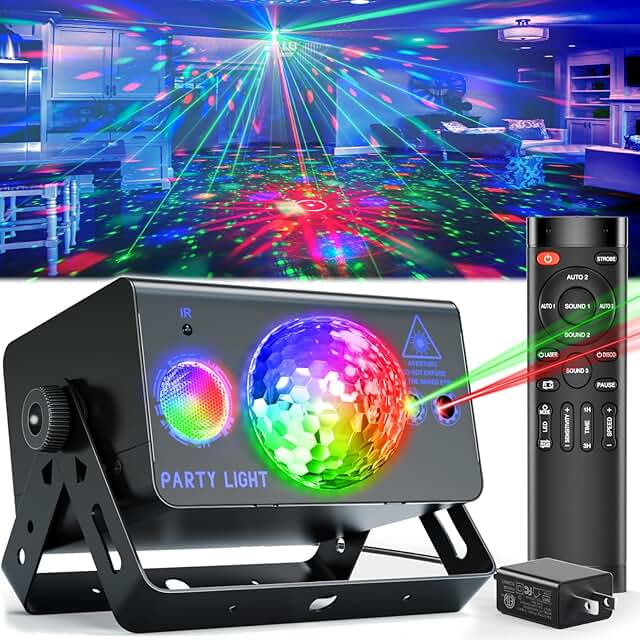
Best for: Hosts looking for a straightforward mix of colored beams and disco-ball-style effects. The listed beam combinations include red, green, and red-and-green, along with a colorful ball-light effect.
The product has Auto, Flash, and Sound Activated modes. Its remote can control the disco ball and stage lights, according to the provided features. This makes it a practical lighting add-on when the host wants to switch among basic effects without introducing a more involved control setup.
As with other sound-activated options, the light responds to sound in the room rather than directly to audio inside guests’ headphones. If the silent disco uses headphones at low room volume, the sound response may not match the music reliably. The product description also does not provide detailed room-coverage or placement specifications.
Choose this if you want a simple mix of multicolor effects and remote-selected modes. Limitation: its sound-activated feature may need audible music in the room to react as intended.
GdjRttk Moving Head Stage Lights

Best for: Hosts who want more lighting-control options and are comfortable planning a more configurable setup. The listed effects include an LED beam, pattern projections, green starry-sky effects, and colorful lighting.
Control options include Sound Active, Master/Slave, Auto-run, and DMX512 modes. The product description also lists a remote, 3-pin XLR ports, and a four-digit display. These features make it the most control-oriented lighting option in this selection, particularly for a host who wants to manage lighting behavior rather than rely only on a basic sound-triggered effect.
The listing describes the equipment as intended for indoor use and gives an IP20 rating. It also states a compact housing and includes operating details, but the product name and feature information differ on wattage. Verify the exact configuration and specifications on the listing before purchase.
Choose this if you want moving-head-style effects and multiple control modes. Limitation: DMX512 and Master/Slave options may involve more setup than a simple plug-in party light.
Buying Guide: How To Plan A Silent Disco House Party
What equipment is essential for a silent disco?
Wireless headphones and a compatible transmitter system are the essential components represented in this selection. The transmitter sends audio to the headphones, allowing guests to listen without relying on a room-filling speaker system. The Silent Disco in a Box is the only product listed here that supplies both headphones and transmitters as a system.
Lighting is optional. Party lights can help define the dance area, but they do not deliver music to the headphones. Plan the audio system first, then decide whether lighting adds value for your room and guests.
How many headphones should you plan for?
Estimate how many guests are likely to use headphones at the same time, then compare that number with the system’s stated capacity. The featured kit includes 50 headphones. For a smaller gathering, consider whether storing and charging a larger set is practical; for a bigger event, confirm that the available headphone count suits your attendance plan.
Are multiple audio channels useful?
Multiple channels are useful when guests may want different playlists or when more than one DJ or music source is part of the plan. The featured system provides three channels and color-coded headphone LEDs, so guests can identify and switch among options. If everyone will listen to the same playlist, one channel may be sufficient for the party’s needs.
How should you choose party lighting?
Start with the effect you want. The 2-in-1 light combines patterns and beams, the four-lens option emphasizes blue projections, the OIEZISRO light offers basic color combinations and modes, and the moving-head product lists more control choices. Check the product details for power, control, placement, and room suitability before deciding.
Sound-activated lights have a particular consideration at silent disco events: they typically react to sound reaching a sensor. If music is audible only through guests’ headphones, a light may not detect the beat. Consider whether you can provide enough audible music for the sensor or whether automatic lighting modes are a better fit.
What should you test before guests arrive?
Set up the transmitter and audio sources in advance, then test each channel and several headphones. Confirm that guests can identify the channel options and adjust headphone volume comfortably. Check the battery and charging arrangements against the planned party duration, using the product’s stated specifications as a guide.
Test lighting modes in the actual room. This helps you see whether projected effects are visible and whether sound-activated features respond to the music. Keep cables and equipment arranged so they do not obstruct the dance area, and follow the product instructions for operation and placement.
Silent Disco House Party FAQ
Can a silent disco work in a house?
Yes. A silent disco can work in a house when the host has a compatible transmitter and enough wireless headphones for participating guests. Check the system’s stated range and set up the transmitter where it can serve the intended listening area.
Do guests need separate music players?
Not necessarily. The listed Silent Disco in a Box includes three transmitters for multiple audio channels, but the provided features do not specify which audio sources are included. Check what sources and cables your chosen setup requires.
Will sound-activated lights sync to headphone music?
Not directly to audio heard only inside headphones. The listed lights use sound-sensitive sensors, so they need sound to reach the sensor. If the room is quiet, use an automatic mode where available or plan for audible music at an appropriate level.
How many music channels does the featured headphone system offer?
The Silent Disco in a Box is described as having three audio channels. Its color-coded LED headphones help guests distinguish between channel choices.
Are party lights required for a silent disco?
No. Headphones and a compatible audio transmitter are the core equipment. Lights are optional accessories for adding patterns, color, or movement to the party space.