
The best simple surround sound receiver depends on whether you need a true home-theater AV receiver or a basic multi-channel amplifier. The Denon AVR-S570BT is the clearest fit for a TV-and-video setup, with HDMI inputs and eARC. The Donner MAMP4 is best for buyers seeking a compact-featured 5.1-channel amplifier, while the Pyle PDA7BU suits listeners who want five-channel audio plus karaoke and media inputs. Compare channel layout and connection types before choosing.
| Product | Best For | Key Distinction |
|---|---|---|
| Denon AVR-S570BT | TV and video home theater | 5.2 channels, HDMI, eARC, and 8K support |
| Donner MAMP4 | Simple 5.1-channel audio amplification | Bluetooth 5.3, optical, coaxial, and AC-3 input |
| Pyle PDA7BU | Five-channel audio and karaoke | Subwoofer output, Bluetooth, and microphone inputs |
| Donner MAMP6 | Six-channel input and speaker setups | Bluetooth 5.3 and optical/coaxial inputs |
| Pyle 6-Channel Amplifier | Multi-speaker playback and PA-style use | Bluetooth, USB, microSD, and microphone features |
Denon AVR-S570BT 5.2-Channel AV Receiver

Best for: Buyers building a straightforward TV-based home theater who need video connections as well as surround sound. This is the most clearly specified AV receiver in this group, rather than a general-purpose stereo amplifier.
The listed features include 5.2-channel audio, four 8K HDMI inputs, eARC support, built-in Bluetooth streaming, and an HD setup assistant. Those connections make it a stronger choice for connecting a television and multiple video devices than models whose provided specifications focus on RCA, USB, or microphone inputs.
Why it was selected: It directly addresses common home-theater needs: connecting video sources, routing audio from a television, and setting up a surround speaker system. Its 5.2-channel designation also indicates support for a five-channel speaker arrangement and two subwoofer outputs.
Keep in mind: The supplied product details do not list speaker calibration, included accessories, or every supported audio format. Check the complete specifications against your sources and speakers before buying. Choose this if HDMI and eARC matter; avoid choosing solely by headline channel count if your main need is karaoke or microphone mixing.
Donner MAMP4 5.1-Channel Audio Amplifier

Best for: Buyers looking for a 5.1-channel amplifier with several ways to bring audio into the system. The listed connections include Bluetooth 5.3, optical, coaxial, USB, RCA, and AC-3 input.
The product name also lists FM radio, two microphone inputs, and echo controls, making it relevant for households that want music or karaoke functions alongside speaker amplification. Its listed RMS ratings are 60 watts at 4 ohms and 25 watts by three channels. Those figures are more useful for comparing stated output than the peak-power numbers used by some other products here.
Why it was selected: It combines a stated 5.1-channel layout with both digital inputs and practical extras. Choose this if you want optical or coaxial connectivity and Bluetooth in a receiver-style amplifier without prioritizing HDMI video switching.
Keep in mind: The provided details do not identify HDMI inputs or eARC. If you need one receiver to switch video sources or take TV audio over HDMI, verify the full connection list or consider an AV receiver that explicitly names those features.
Pyle PDA7BU Five-Channel Amplifier

Best for: Buyers who want five-channel speaker amplification with karaoke inputs and multiple music sources. Pyle lists 200 watts into five channels, covering front left, front right, center, surround left, and surround right, plus a subwoofer output.
Bluetooth streaming is listed for phones, tablets, and other Bluetooth-enabled devices. Connections include two 6.35 mm microphone inputs, a front-facing 3.5 mm auxiliary input, three RCA inputs, USB-A, and an SD slot. An FM radio and LCD display are also listed.
Why it was selected: Its channel description is specific, and the product combines a center and surround channels with subwoofer output. It is a better fit for buyers who value karaoke, removable-media playback, and straightforward audio sources than those looking for a video-focused receiver.
Keep in mind: The supplied feature list does not mention HDMI, optical, or coaxial inputs. Check your TV’s available audio outputs before choosing this model, especially if you expect to connect it directly to a newer television.
Donner MAMP6 Six-Channel Audio Amplifier
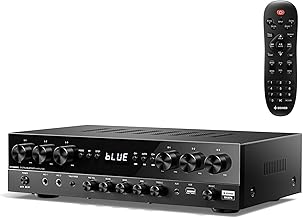
Best for: Buyers who need a six-channel amplifier and want wireless streaming, microphone inputs, and digital audio connections. The product name lists Bluetooth 5.3, USB, FM, two microphone inputs, echo, RCA, optical, and coaxial inputs.
The listing describes 1,000 watts of peak power. Treat that as a peak figure rather than a direct equivalent to continuous or RMS output when comparing amplifiers. The six-channel designation may suit a system that needs more amplified channels than a five-channel model, but buyers should confirm the exact channel assignment and speaker requirements in the full specifications.
Why it was selected: It provides a broader channel count than the Donner MAMP4 while retaining a range of named input options. Choose it if six channels are a priority and optical or coaxial connections are useful.
Keep in mind: The supplied information does not state HDMI or eARC support, and it does not provide an RMS output rating. Confirm the full specifications and match amplifier output and speaker impedance to your setup before purchase.
Pyle Six-Channel Bluetooth Home Amplifier

Best for: Buyers who want a multi-input six-channel amplifier for home audio, karaoke, or PA-style use. Pyle lists 750 watts of peak power and compatibility with speakers rated from 4 to 8 ohms.
Its listed playback options include Bluetooth, USB, microSD, and AUX, with built-in FM radio and a digital LCD display. The feature list also names two microphone inputs, echo, talkover, and RCA connections for audio input, recording output, and subwoofer output.
Why it was selected: It is a flexible option for buyers who care about media playback and microphone functions as much as speaker channels. Compared with the Pyle PDA7BU, it offers a six-channel layout and explicitly lists microSD, talkover, and a 4-to-8-ohm speaker range.
Keep in mind: The 750-watt figure is identified as peak power, not RMS output. HDMI, optical, and coaxial connections are not listed in the supplied features, so this model may not be the simplest choice for a TV-centered system that depends on those inputs.
Buying Guide: How to Choose a Simple Surround Sound Receiver
Do you need an AV receiver or an audio amplifier?
Start with the devices you plan to connect. An AV receiver is generally the more direct fit when a television, game console, streaming device, or disc player must connect through HDMI. In this group, the Denon explicitly lists HDMI inputs and eARC. The other products are described primarily as audio amplifiers and list connections such as Bluetooth, RCA, USB, optical, or coaxial.
A multi-channel amplifier can still be a practical choice when your sources already provide compatible audio connections or when the system is mainly for music, microphones, and speakers. Do not assume that a product called a receiver includes HDMI or television-focused processing; check its input list.
How many channels should your system have?
Match the channel count to the speaker arrangement you intend to use. Five main channels commonly correspond to front left and right, center, and two surround speakers. A 5.1 system adds a subwoofer channel, while a 5.2 designation identifies two subwoofer outputs. The product descriptions do not all explain channel assignments in the same level of detail, so verify the speaker layout before purchase.
A six-channel amplifier is not automatically a better match for a five-speaker home theater. More channels can be useful for a different speaker arrangement, but the receiver must support the configuration you actually plan to install. Count speakers and subwoofers separately, then compare that total with the manufacturer’s stated outputs.
Which inputs matter for your TV and sources?
Make a short list of the connections used by your television and each source. HDMI and eARC can simplify a video-focused setup when the receiver supports them. Optical and coaxial are digital audio connections, while RCA and 3.5 mm AUX are analog options. Bluetooth is useful for wireless music streaming, but it does not replace every wired connection.
Check both ends of the connection. A receiver having an input does not help if the TV or source lacks a compatible output. Also consider how many devices need to stay connected at the same time; a single audio input may require swapping cables more often than a receiver with several appropriate inputs.
How should you compare power ratings?
Read the type of power rating, not just the largest number on a product listing. The Donner MAMP4 name provides RMS figures, while the Donner MAMP6 and Pyle six-channel amplifier list peak power. Peak and RMS figures describe different measurement contexts and should not be treated as equal values.
Check the speaker impedance requirements as well. The Pyle six-channel model lists support for 4-to-8-ohm speakers. The other supplied product details do not provide the same impedance information, so consult their full specifications before connecting speakers. Proper matching matters more than selecting a product by its headline wattage alone.
Do you need microphone or karaoke features?
If karaoke, announcements, or microphone use is part of the plan, look for an explicit microphone-input count and relevant controls. The Donner models list two microphone inputs and echo, and the Pyle models also list two microphone inputs. The Pyle six-channel model additionally names talkover. These functions may make an amplifier more suitable for mixed entertainment use than an AV receiver focused on TV and video connections.
If you will not use microphones, those features may not be a useful reason to choose a model. Give more weight to the channel layout and source connections that your everyday setup needs.
What should you verify before ordering?
- Confirm the exact channel layout and whether the product supports your planned speaker arrangement.
- Match receiver inputs to the outputs on your TV and other sources.
- Check speaker impedance and compare stated RMS output where available.
- Confirm whether you need HDMI, eARC, optical, coaxial, RCA, USB, or wireless Bluetooth.
- Review the full product specifications for included connections and supported audio formats.
- Separate features you will use, such as radio or microphone inputs, from features that are not necessary for your setup.
Frequently Asked Questions
What is the simplest receiver choice for a TV-based surround system?
The Denon AVR-S570BT is the clearest match among these products for a TV-based setup because its listed features include HDMI inputs and eARC, along with 5.2-channel audio. Confirm that its full specifications meet your source and speaker requirements.
Can a Bluetooth amplifier replace an AV receiver?
It can work for compatible audio sources and speakers, but Bluetooth alone does not provide HDMI video switching or eARC. Choose an amplifier only after checking that its listed inputs match the devices you plan to connect.
Does a 5.1-channel amplifier always include a subwoofer?
No. A 5.1-channel label describes a channel arrangement, not whether a subwoofer is included. Check the product contents and output connections separately. Some listings name a subwoofer output, but that does not establish that a subwoofer comes with the amplifier.
Should I compare peak watts with RMS watts?
Not as if they were the same rating. Peak and RMS figures are different types of power specifications. Compare RMS ratings when available, and review the testing conditions and speaker impedance stated by the manufacturer.
Which features matter most for karaoke?
Look for microphone inputs and any controls you need, such as echo or talkover. The products listed here name two microphone inputs, while the Donner models list echo and the Pyle six-channel model lists talkover. Verify that the available inputs suit your microphones.