
The best single rack space power amplifier depends on how many speaker channels you need, the speakers’ impedance, and the amplifier’s rated RMS output. The Sound Town UPDM-Q3 is best for four-channel systems, while the UPDM-D3 suits high-output two-channel installations. The NIX-D4800 is a four-channel choice with clearly listed 1U rack space and multiple input-sensitivity settings. Two additional rack-mount options are included, but their supplied product details do not confirm a 1U height, so check dimensions before buying.
| Product | Best For | Key Listed Feature |
|---|---|---|
| Sound Town UPDM-Q3 | Four-channel installations | Four channels, 1,150W RMS each at 4 ohms |
| Sound Town UPDM-D3 | Two-channel PA and conference systems | Bridge mode and built-in LPF |
| Sound Town NIX-D4800 | Four-channel systems needing flexible signal routing | Explicit 1U design and input-sensitivity switch |
| Rockville RPA5 | Smaller two-channel setups | Stereo/mono switch and built-in crossover |
| Pyle PTA1000BT | Systems needing wireless music input | Bluetooth and several input types |
Sound Town UPDM-Q3 Four-Channel Class-D Amplifier

The Sound Town UPDM-Q3 is best for a PA, DJ, or conference installation that needs four amplified outputs in a lightweight 1U design. Its listed output is 4 x 1,150W RMS at 4 ohms and 4 x 600W RMS at 8 ohms. Class-D technology is intended to combine high output with energy-efficient operation.
Four XLR inputs and four Speakon outputs provide a direct connection layout for separate channels. Stereo, parallel, and bridge switching offers options for signal routing. The built-in low-pass filter (LPF) filters unwanted high frequencies when the amplifier is used for low-frequency applications.
- Best for: Installations that benefit from four channels and an integrated LPF.
- Why it stands out: The supplied details specify both 1U form factor and RMS output at 4- and 8-ohm loads.
- Limitation: Confirm that the speaker loads and intended bridge configuration match the amplifier’s operating requirements before connecting equipment.
Sound Town UPDM-D3 Two-Channel Amplifier

The UPDM-D3 is best for buyers who need a high-output two-channel amplifier for installation, conference, or PA use. It is described as a lightweight 1U Class-D model. Listed RMS output is 2 x 1,150W at 4 ohms and 2 x 600W at 8 ohms.
Its two XLR inputs and two Speakon outputs suit systems using those connection types. Stereo, parallel, and bridge modes support different signal-routing needs. An integrated LPF is included to filter higher frequencies for low-frequency speaker applications.
- Best for: Two-channel systems that need substantial rated output and flexible routing.
- Why it stands out: It combines an explicitly listed 1U design with bridge switching and a built-in LPF.
- Limitation: It has two channels, not four; choose another model if four independently amplified outputs are required.
Sound Town NIX-D4800 Four-Channel Amplifier

The Sound Town NIX-D4800 is best for buyers seeking a four-channel amplifier with explicitly listed 1U rack space. Its Class-D design is described as lightweight and energy efficient. The supplied RMS ratings are 4 x 480W at 8 ohms and 4 x 720W at 4 ohms.
A stereo/parallel switch changes signal routing, and a separate input-sensitivity switch offers 0.775V, 1V, and 1.4V settings. These controls can help match the amplifier’s input to the connected signal source. The product information also lists a 4,800W total peak output; compare the RMS ratings with speaker requirements when planning a system.
- Best for: Four-channel PA or DJ setups where selectable input sensitivity is useful.
- Why it stands out: The listing identifies its 1U size, four-channel ratings, and signal-management switches.
- Limitation: Its listed RMS output per channel differs from the UPDM-Q3, so check the power needs of the specific speakers before choosing.
Rockville RPA5 Two-Channel Rack Amplifier
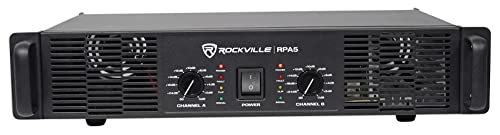
The Rockville RPA5 is best for buyers who need a two-channel rack-mount amplifier with a stereo/mono switch and built-in crossover. The listed output is 200W RMS per channel at 4 ohms or 400W RMS bridged at 8 ohms. Those figures make the model worth comparing for smaller setups where its stated output meets the speaker requirements.
A built-in crossover supports use with subwoofers or full-range speakers. The listed cooling and protection features include dual quiet cooling fans, IC-controlled protection circuitry, and clipping LEDs for channels A and B.
- Best for: Two-channel systems that need crossover functionality and a bridged mode.
- Why it stands out: Its stated controls and protection features make the configuration easy to compare with simpler rack amps.
- Limitation: The supplied product details call it rack-mount but do not specify 1U height. Verify its dimensions if a single rack space is essential.
Pyle PTA1000BT Bluetooth Rack Amplifier

The Pyle PTA1000BT is best for buyers who want a rack-mount amplifier with Bluetooth music streaming as well as wired connections. Its listed inputs include two 1/4-inch TRS jacks and two XLR jacks. It also has USB-A input with an MP3 player, according to the product name and supplied features.
The amplifier is described as bridgeable, with a maximum of 2,000W in bridged mode or 1,000W per channel in stereo. Listed outputs include three Speakon connectors and two pairs of speaker terminal or binding-post connectors. The product information says it can be used with multiple speakers at 4–8 ohms; confirm the required configuration before connecting a speaker system.
- Best for: Users who want Bluetooth and several wired input and output options.
- Why it stands out: Its listed connection choices are broader than those of a basic two-channel amplifier.
- Limitation: The supplied details do not confirm 1U rack height. Verify dimensions, and distinguish its stated maximum power from RMS ratings when comparing amplifiers.
Buying Guide: How To Choose A Single Rack Space Power Amp
A 1U power amplifier can help preserve rack space, but a low rack height alone does not determine whether an amp is right for a system. Compare channel count, speaker impedance, RMS output, signal connections, and cooling needs. Check the manufacturer’s current specifications and installation instructions before purchase, particularly when rack height or electrical requirements are critical.
How many amplifier channels do you need?
Choose the channel count based on how many speaker feeds need separate amplification. A four-channel model such as the UPDM-Q3 or NIX-D4800 may suit a system with four separate outputs. A two-channel model such as the UPDM-D3, RPA5, or PTA1000BT may fit a simpler stereo setup. Channel count is not the same as the number of speakers a system can support; the permitted speaker load and wiring arrangement matter too.
Does the amplifier have to be exactly 1U?
When rack space is limited, confirm the product’s height rather than relying on the phrase “rack-mount.” The UPDM-Q3, UPDM-D3, and NIX-D4800 product names explicitly identify a 1U design. The supplied details for the Rockville RPA5 and Pyle PTA1000BT do not state a rack-unit height. Check their dimensions and allow for any installation or ventilation clearances required by the manufacturer.
How should you compare RMS power ratings?
Use RMS output as a practical comparison point, not peak or maximum power alone. Match the amplifier’s output rating to the speaker manufacturer’s power guidance at the same impedance. Compare like with like: a rating at 4 ohms is not directly interchangeable with one at 8 ohms. The Sound Town models list RMS figures at both impedances, while the Pyle listing emphasizes maximum output figures. Avoid treating a peak rating as continuous RMS output.
What do stereo, parallel, and bridge modes do?
Stereo mode generally keeps left and right signals on separate channels. Parallel mode routes the input signal to multiple amplifier channels, while bridge mode combines channels into a single output when supported. These modes change how the amplifier and speakers are connected, so follow the model’s instructions. Confirm the minimum supported impedance and the correct wiring for the selected mode before use.
Which inputs and outputs should you look for?
Choose connections that match the rest of the system. XLR and TRS inputs are common options for audio signals, while Speakon connectors and binding posts are speaker-output formats represented among these products. The Pyle model adds Bluetooth, USB-A, and multiple connection types. A feature is useful only when it fits the source, speakers, and intended setup.
How important are cooling and protection features?
Power amplifiers generate heat, so follow the manufacturer’s rack ventilation guidance and do not obstruct cooling paths. The RPA5 lists dual cooling fans and protection circuitry; the Pyle listing names a cooling fan. The NIX-D4800 and UPDM models are identified as Class-D designs. These details can inform comparisons, but they do not replace checking the installation requirements for the specific amplifier.
Frequently Asked Questions
What does 1U mean for a power amplifier?
1U is a standard rack-height measurement used to describe one vertical rack unit. Confirm the amplifier’s stated dimensions and clearance requirements before buying, because rack fit also depends on the enclosure and installation.
Which listed amplifier has four channels in 1U?
The Sound Town UPDM-Q3 and NIX-D4800 are both described as four-channel, 1U amplifiers in their supplied product information. Compare their rated output, inputs, and included controls to determine which suits the system.
Is a higher wattage number always better?
No. The amplifier must suit the speakers’ impedance and power requirements. Compare RMS ratings at the relevant impedance, and do not use peak or maximum figures as if they were continuous RMS output.
Can a two-channel amplifier power a subwoofer?
Some two-channel amplifiers offer bridge mode or crossover features that may support particular subwoofer arrangements. Check the amplifier’s supported impedance, wiring instructions, and speaker requirements before using it this way.
Does Bluetooth replace a wired audio connection?
Bluetooth provides a wireless audio input on a compatible source, while wired inputs remain useful for other audio equipment. The Pyle PTA1000BT lists Bluetooth and wired inputs, but choose connections according to the sources in the intended system.
Should I choose an amplifier based on peak power?
Peak power alone is not a reliable basis for choosing an amplifier. Compare RMS output at the speaker’s impedance and verify that the amplifier’s operating modes and connections suit the complete system.