
The best small portable keyboard depends on whether you need a child-sized starter instrument, a compact travel piano, or a full-length keyboard that folds for storage. The Raimy 37-key model and Casio SA-51 are suited to young beginners; the Rhymo and AiJoy fold for transport, while the Casio CT-S200 offers 61 keys in a conventional portable design. Compare key count, portability, power details, and the features provided for each model before choosing.
| Keyboard | Best For | Key Count | Portability Detail |
|---|---|---|---|
| Raimy Electronic Keyboard | Children who want built-in play and learning functions | 37 | About 17 inches long; uses 3 AA batteries |
| Rhymo Folding Piano | Travelers who want a foldable 61-key layout | 61 | Folds to a compact profile and includes a gig bag |
| Casio Casiotone CT-S200 | Beginners seeking a conventional 61-key keyboard | 61 | Portable design; power supply and music rest included |
| AiJoy Magnetic Keyboard | Families wanting a separable, rechargeable keyboard | 88 when connected; 44-key halves | Under 7 pounds, with a stated 2000mAh battery |
| Casio Casiotone SA-51 | Young beginners with smaller hands | 32 | Compact keyboard with mini keys |
Raimy 37-Key Electronic Keyboard

The Raimy is best for children who need a small keyboard with playful built-in functions. Its 37 keys make it shorter than a standard 61-key beginner keyboard, and its listed dimensions are about 17 by 6.3 by 2.1 inches. That size can be easier to place on a small table or store between practice sessions.
Features include 11 demonstration songs, eight rhythms, eight tones, four percussion sounds, four samba sounds, tempo and volume controls, and record-and-playback. It also lists sustain, vibrato, one-key-one-note, and learn functions. The product information describes smooth edges and ABS plastic, as well as key dimensions intended for children’s fingers.
Choose this if a young learner is more likely to explore music through songs, rhythms, and simple learning functions than through a full-size keyboard. It is also a useful option when compact dimensions matter. Limitation: it requires three AA batteries, which are not included, and the 37-key range is more limited than a 61- or 88-key instrument.
Rhymo Folding 61-Key Piano
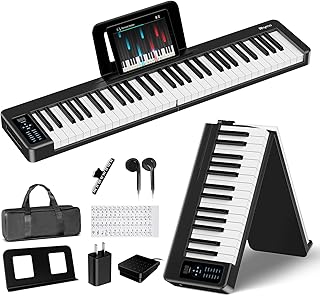
The Rhymo is best for people who want a 61-key arrangement but need a keyboard that can fold for storage and travel. The listed unfolded dimensions are 90 by 19 centimeters, and the folded dimensions are 45 by 11 by 19 centimeters. The product weighs 2.3 kilograms and includes a padded gig bag, according to the supplied product details.
Its listed specifications include weighted keys, Bluetooth MIDI, 128-note polyphony, and 128 built-in timbres. These features make it a more feature-focused choice than a basic mini-key children’s keyboard. A 61-key layout provides more playing range than the 32- and 37-key options in this selection, while the folding body is designed to reduce its carrying footprint.
Choose this if you want a more compact way to carry a 61-key keyboard and value the listed weighted-key action and timbre selection. Limitation: it is still a 61-key instrument, not a full 88-key layout. Confirm that its folded dimensions and 2.3-kilogram weight suit your intended bag and travel routine.
Casio Casiotone CT-S200

The Casio Casiotone CT-S200 is best for a beginner who prefers a conventional portable 61-key keyboard rather than a folding or child-sized model. Its product name lists 400 tones, 77 rhythms, an LCD display, Dance Music Mode, USB-MIDI, and stereo speakers. The listing also identifies a power supply and music rest as included items.
The 61-key count gives this model a broader playing range than the 32-key Casio SA-51 and 37-key Raimy. Its listed functions offer several ways to explore sounds and rhythms, while USB-MIDI is identified as a connection feature. The included music rest can support sheet music or another reading material during practice.
Choose this if you want a beginner-oriented Casio keyboard with many listed tones and rhythms, plus a display and stereo speakers. It is a stronger match for someone who wants a typical 61-key arrangement than for someone prioritizing a keyboard that folds or splits apart. Limitation: the supplied product information does not state its dimensions, weight, battery options, or key action, so check those details against your portability needs before buying.
AiJoy Magnetic 88-Key Keyboard

The AiJoy is best for buyers who want an 88-key arrangement that can separate into two sections for easier transport. Its magnetic connection joins the two 44-key halves, and the product information says one half can be played independently. The listing gives a weight under seven pounds and describes the keyboard as foldable and portable.
Power and key-action details are especially relevant for this model. The provided specifications list a 2000mAh battery with a stated runtime of more than eight hours. The keys are non-weighted, which the product describes as easier for beginners and children to press. It also lists a sustain pedal and piano bag.
Choose this if you want the flexibility of an 88-key layout while being able to separate the instrument into smaller sections for carrying. Its battery and low listed weight may also matter for playing away from a fixed setup. Limitation: the keys are non-weighted, so this is not the pick for someone specifically seeking weighted action. Check that the split-key design suits your preferred playing setup.
Casio Casiotone SA-51

The Casio Casiotone SA-51 is best for young beginners who need a compact keyboard with mini keys. It has 32 keys, fewer than the other keyboards in this comparison except for the Raimy’s 37-key layout. Casio describes the keys as easy for smaller hands to play, making the model a focused option for early music exploration.
The product listing specifies 100 built-in tones, including piano, strings, and percussion. Dedicated direct-access buttons let a player switch to selected tones such as piano, trumpet, or drum set. Those straightforward tone controls can be useful for a child who wants to experiment without navigating a long sequence of menus.
Choose this if small keys and simple sound changes are more important than a large playing range. It is a compact alternative to a 61-key beginner keyboard and is specifically described as suitable for young beginners. Limitation: the 32-key range is restrictive for pieces that require more notes, so an older beginner or a learner planning to progress may prefer a 61-key model.
Buying Guide: How To Choose A Small Portable Music Keyboard
How many keys do you need?
Key count is one of the clearest ways to compare portable keyboards. The Casio SA-51 has 32 mini keys, and the Raimy has 37 keys. These smaller layouts are most appropriate when compact size and younger players are priorities. The Rhymo and Casio CT-S200 have 61 keys, which offer more range for practice while remaining smaller than an 88-key layout.
The AiJoy connects two 44-key sections to form an 88-key keyboard, and the product says either 44-key half can be played on its own. Choose a smaller key count for simple play and easier storage; consider 61 or 88 keys when a wider range is important. A higher key count alone does not determine sound quality or suitability for a particular learner.
Should you choose a folding or fixed design?
A folding design can reduce the space the instrument occupies when it is not in use. The Rhymo folds to a stated 45 by 11 by 19 centimeters and includes a gig bag. The AiJoy uses two magnetic sections and is listed as weighing under seven pounds. These designs may suit a car trip, shared living space, or a user who needs to store the keyboard between sessions.
The supplied details do not provide dimensions for the Casio CT-S200 or SA-51. If the keyboard must fit a specific backpack, desk, shelf, or carry-on space, compare the exact product dimensions before choosing. Also consider whether setting up or reconnecting a folding keyboard is convenient for the person who will use it.
Do key action and key size matter?
Yes. The Casio SA-51 uses mini keys intended for smaller hands. The Raimy listing gives key dimensions and describes them as suitable for children’s fingers. The AiJoy has non-weighted keys, while the Rhymo is described as having weighted keys. These distinctions affect what the product information says about the playing feel, but they do not make one model universally best.
For a child starting out, smaller keys may be easier to reach. For a buyer who specifically wants weighted action, the Rhymo is the only product in this selection whose provided information identifies weighted keys. Check the key style and dimensions if finger comfort or a particular playing feel is a deciding factor.
What power and extra features should you compare?
Power options can affect where you can play. The Raimy requires three AA batteries, which are not included. The AiJoy lists a built-in 2000mAh battery and more than eight hours of use. The CT-S200 listing says a power supply is included. The supplied details for the Rhymo and SA-51 do not specify power arrangements, so verify those requirements before planning to use either away from an outlet.
Extra functions should match how the keyboard will be used. The Raimy lists demonstration songs, rhythms, recording, and learning functions. The SA-51 emphasizes 100 tones and direct tone buttons. The CT-S200 lists 400 tones, 77 rhythms, Dance Music Mode, and USB-MIDI. Rhymo lists Bluetooth MIDI and 128 timbres. AiJoy’s supplied details emphasize its split design, battery, and non-weighted keys.
Which small keyboard is best for a child or beginner?
For a young child, compare the Raimy and Casio SA-51 first: both have fewer than 40 keys, while the SA-51 specifically has mini keys and the Raimy lists built-in learning and play functions. For a beginner who wants a broader range, compare the two 61-key models. Choose between the folding Rhymo and the conventional CT-S200 based on portability, key action, and the listed features that matter most.
Frequently Asked Questions
What is the smallest keyboard in this comparison?
The Casio Casiotone SA-51 has the fewest keys, with 32 mini keys. The Raimy is close in key count at 37 keys and lists dimensions of about 17 by 6.3 by 2.1 inches.
Which portable keyboard has 61 keys?
The Rhymo Folding Piano and Casio Casiotone CT-S200 both have 61 keys. The Rhymo folds and lists weighted keys; the CT-S200 lists 400 tones, 77 rhythms, stereo speakers, and an included power supply and music rest.
Which model has a full 88-key layout?
The AiJoy connects two 44-key sections to create an 88-key keyboard. Its product information also says the sections can be separated and that one 44-key half can be played independently.
Which keyboard is best for a young child?
The Raimy and Casio SA-51 are the most child-focused options based on the supplied descriptions. Raimy lists learning and demonstration functions; the SA-51 has mini keys described as suitable for smaller hands.
Which keyboard is described as having weighted keys?
The Rhymo Folding Piano is described as having weighted keys. The AiJoy listing specifies non-weighted keys, while the supplied product details do not state the key action for the other models.
What should I check before buying a travel keyboard?
Check the folded or assembled dimensions, weight, power requirements, carrying case, and key count. If the product details do not specify a measurement or power option, confirm it before relying on the keyboard for a particular trip or storage space.