
The best small stereo receiver amplifier depends on how you plan to connect speakers and audio sources. The WOOPKER AK45Pro is best for buyers who want Bluetooth, USB, SD, and microphone inputs in a compact unit; the Pyle PDA29BU.5 suits listeners who also want FM radio; and the Fosi Audio BT20A Pro is a simpler option for passive speakers and Bluetooth streaming. Compare the inputs, power specifications, and controls before choosing.
| Model | Best For | Listed Features |
|---|---|---|
| WOOPKER AK45Pro | Flexible everyday listening | Bluetooth, RCA, USB, SD, microphone input, tone controls |
| Pyle PDA29BU.5 | FM radio and karaoke inputs | Bluetooth, FM, RCA, USB, SD, two microphone inputs |
| Daakro AK45 | Basic tone adjustment | Bass, treble, and volume knobs; remote control |
| Joengoep AK50 | Multi-source and microphone use | Bluetooth, USB, SD, FM, AUX, microphone and echo controls |
| Fosi Audio BT20A Pro | Bluetooth-focused passive-speaker systems | Bluetooth 5.0, bass and treble controls, replaceable op-amps |
WOOPKER AK45Pro Stereo Amplifier

The WOOPKER AK45Pro is best for someone who wants several playback choices and front-panel sound adjustments in a compact two-channel amplifier. Its listed rated output is 50 watts per channel, with 400 watts per channel described as peak power. Those figures are not interchangeable, so use the RMS rating when comparing continuous output with other amplifiers.
Its listed connections include Bluetooth, RCA, microphone input, USB, and an SD card slot. Bass, treble, microphone volume, and master volume knobs provide separate adjustments. The included remote offers control from a distance, which can be useful when the amplifier is placed on a shelf or desk.
- Best for: Small apartments, bedrooms, offices, or garages where users want wired and wireless sources.
- Why it stands out: It combines multiple inputs, tone controls, microphone adjustment, and a remote in one small-format unit.
- Keep in mind: The remote requires AAA batteries, which are not included according to the product details.
Choose this model if the USB, SD, or microphone options matter alongside Bluetooth. Buyers who need FM radio should consider a model that explicitly lists an FM tuner.
Pyle PDA29BU.5 Bluetooth Amplifier

The Pyle PDA29BU.5 is best for a compact setup that benefits from FM radio, Bluetooth, and microphone connections. Pyle lists 200 watts of peak power and 100 watts of RMS continuous power. It supports two stereo speakers, according to the product description.
Its source options include an RCA input, Bluetooth, USB, SD, and FM radio. Two 1/4-inch microphone inputs make it relevant for karaoke or voice use. The LED display provides a visible status readout, while the supplied description also mentions an FM antenna intended to improve radio sensitivity and Bluetooth distance.
- Best for: Buyers combining music playback, FM listening, and microphone use.
- Why it stands out: Its stated inputs cover more use cases than a Bluetooth-only mini amplifier, including two microphone connections and FM radio.
- Keep in mind: The listed power includes peak and RMS figures; compare the 100-watt RMS rating with continuous-output specifications from other models.
Choose the Pyle if radio and microphone inputs are priorities. If your system needs a particular input not listed here, such as a dedicated phono input, confirm the connection requirements before buying.
Daakro AK45 Stereo Audio Amplifier

The Daakro AK45 is best for buyers who want straightforward bass and treble adjustment with remote control. Its product name identifies Bluetooth 5.1 and a 300-watt amplifier, while the listed feature details emphasize volume, treble, and bass knobs. The remote lets users adjust audio from a distance.
Separate bass and treble controls can help tailor the tonal balance to a room or listening preference without changing settings on the source device. The listed information is less detailed about its input connections than the WOOPKER and Pyle listings, so buyers should check the full product specifications to confirm that the available connections match their equipment.
- Best for: Users prioritizing basic sound adjustment and remote operation in a small stereo amplifier.
- Why it stands out: It offers dedicated bass and treble knobs and identifies Bluetooth 5.1 in its product name.
- Keep in mind: The supplied feature information does not specify a complete list of inputs or a continuous RMS output rating.
Choose this model if its controls and Bluetooth feature meet your needs and you can verify source compatibility. Avoid assuming it has USB, FM, or microphone support based only on the details provided.
Joengoep AK50 Bluetooth Stereo Receiver

The Joengoep AK50 is best for a home setup that needs several built-in playback modes and microphone controls. Its listed output is 50 watts per channel, alongside a 400-watt-per-channel peak figure. The product information says it supports passive speakers rated from 4 to 16 ohms, a useful detail to check against the speakers’ specifications.
Inputs and playback options include Bluetooth 5.0, USB, SD, FM, and AUX. Independent bass and treble controls provide tone adjustment. The amplifier also lists dual microphone interfaces and an echo adjustment knob, as well as microphone output and connections for external active subwoofers and recording devices.
- Best for: Buyers who want radio, local media playback, microphone connections, and tone controls in one unit.
- Why it stands out: The product listing specifies speaker impedance support and describes more system connections than many compact amplifiers.
- Keep in mind: Its many connections may be unnecessary for a basic Bluetooth-only listening setup.
Choose the AK50 if microphone use or multiple source types are important. Check your speaker impedance before purchase, and distinguish the listed 50-watt-per-channel output from the peak figure.
Fosi Audio BT20A Pro Bluetooth Amplifier
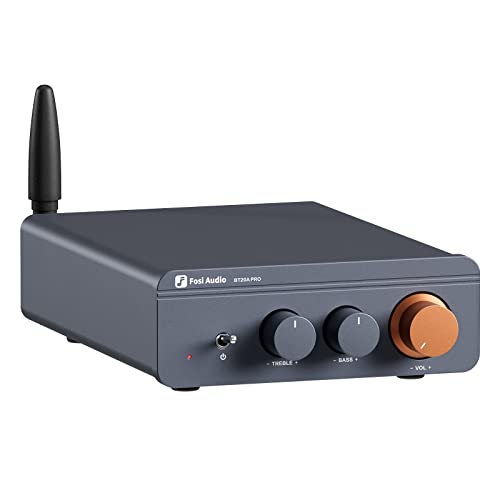
The Fosi Audio BT20A Pro is best for buyers who want a compact amplifier focused on Bluetooth streaming and passive speakers. The product listing describes a TI TPA3255 chip, Bluetooth 5.0, and a stated output of 300 watts by two. It also lists bass and treble control and provides technical distortion and signal-to-noise figures.
A notable feature is the pair of replaceable NE5532 op-amps. The listing names several alternative op-amp models that can be used for customization. Bluetooth pairing includes a memory function, and the description says the connection can be removed by holding the volume control for five seconds.
- Best for: Listeners seeking Bluetooth playback and a two-channel amplifier with adjustable bass and treble.
- Why it stands out: Replaceable op-amps offer an adjustment path not described for the other selected models.
- Keep in mind: The supplied feature list does not describe USB, SD, FM, or microphone inputs, so it may not suit buyers who need those functions.
Choose this unit if Bluetooth and passive-speaker amplification are the main requirements. Confirm the full connection and speaker requirements for your particular system before ordering.
Buying Guide: How To Choose A Small Stereo Receiver Amplifier
Which inputs does your audio system need?
Start by listing the devices you plan to connect. Bluetooth is convenient for phones, tablets, and computers, while RCA or AUX connections can serve wired audio sources. USB and SD slots can play media directly on models that support them. An FM tuner matters if you want radio without a separate receiver. Microphone inputs are useful for karaoke or announcements but are unnecessary for many music-only systems.
Do not assume that every small amplifier includes the same inputs. For example, the Pyle and Joengoep listings specify FM radio, while the Fosi listing emphasizes Bluetooth. Check the exact input types and number of connections against your sources before deciding.
How should you compare amplifier power?
Look for continuous or RMS output when comparing power specifications. Peak power describes a different measurement and should not be treated as equivalent to continuous output. In the products above, WOOPKER and Joengoep each list 50 watts per channel as rated output alongside a larger peak figure. Pyle lists 100 watts RMS continuous power and 200 watts peak.
Power needs also depend on the speakers and the listening situation. A compact bedroom setup may have different requirements from a larger space. The product details do not establish that any one amplifier will perform identically with every speaker, so confirm the speaker’s impedance and the amplifier’s stated support before connecting them.
Do speaker impedance and channel count match?
These picks are described as two-channel stereo amplifiers. Check the speaker specifications and the amplifier’s supported impedance range before purchase. The Joengoep AK50 listing specifically states support for passive speakers from 4 to 16 ohms. The supplied details for other models may not provide the same complete impedance information, so consult the manufacturer’s specifications where needed.
Also determine whether your speakers are passive or powered. A stereo power amplifier is generally selected to drive passive speakers; powered speakers already include amplification and may need a different type of connection. Verify your speaker’s inputs and the amplifier’s outputs rather than relying only on product category labels.
Are physical size and controls important?
Measure the shelf, desktop, or cabinet space available, and allow room for cables and ventilation. Compact designs can suit small rooms, but dimensions are not included in every supplied product description. Check the full listing for measurements before choosing a location.
Consider how you will adjust volume and sound. Bass and treble knobs are available on several options in this comparison. A remote can add convenience, while microphone volume and echo controls matter mainly for voice use. The WOOPKER remote requires separately purchased AAA batteries, according to its product details.
Which features are useful for karaoke or shared listening?
For karaoke or announcements, compare microphone input count and controls rather than choosing solely by Bluetooth or power claims. Pyle lists two 1/4-inch microphone inputs. Joengoep lists dual microphone interfaces and an echo adjustment knob. WOOPKER lists a microphone input and a dedicated microphone volume control. Confirm the microphone connection type and intended setup before purchase.
For shared listening without microphones, prioritize the sources people use most often: Bluetooth, radio, USB, SD, or wired inputs. More connections can be useful, but they can also add controls you may never use.
Frequently Asked Questions
What is a small stereo receiver amplifier?
It is a compact two-channel audio unit that amplifies a source signal for stereo speakers. Depending on the model, it may also include Bluetooth, radio, USB, SD, or microphone functions.
Can a small stereo amplifier connect to Bluetooth?
Several models in this comparison list Bluetooth, including the WOOPKER, Pyle, Daakro, Joengoep, and Fosi units. Check the specific product details for the Bluetooth version and any additional connection requirements.
Is peak power the same as RMS power?
No. Peak and RMS or continuous power are different specifications. Compare RMS output with RMS output when the information is available, and do not treat a peak figure as continuous power.
Which small amplifier is best for FM radio?
The Pyle PDA29BU.5 and Joengoep AK50 product details explicitly list FM radio. Choose one only after confirming its other inputs and speaker requirements suit your system.
Can I connect passive speakers to these amplifiers?
The Fosi is described as an amplifier for passive speakers, and Joengoep lists support for 4-to-16-ohm passive speakers. For other models, check the full specifications and match the speaker impedance to the amplifier’s supported range.
What should I check before buying?
Confirm the inputs you need, continuous output rating, speaker impedance, channel count, and available space. If you plan to use microphones, verify the input type and number of microphone connections.