
The Solid State Logic BiG SiX is the strongest fit here for buyers seeking an analog-style solid-state mixing console with USB recording, while the SSL SiX is better for a compact desktop setup. The Allen & Heath Qu-5 is a digital mixing-console alternative, and the SSL 12 is an audio interface rather than a standalone mixer. Compare the five options below by format, inputs, processing, and recording needs before choosing.
| Product | Best For | Key Distinction |
|---|---|---|
| SSL BiG SiX | Hybrid studio and stage production | Console mixing with a 16-channel USB interface |
| SSL SiX Desktop Mixer | Compact analog-style mixing | Two console-grade mic preamps |
| SSL Six Mixing Desk | Studio, post-production, stage, and podcasts | Condensed professional console format |
| Allen & Heath Qu-5 | Digital mixing and live sound | 32 input channels and motorized faders |
| SSL 12 | Computer-based recording | USB audio interface, not a standalone mixer |
SSL BiG SiX Hybrid Mixing Console

The SSL BiG SiX is the best match in this selection for a buyer who wants a console-style mixer that can also connect to a computer for multichannel recording. Its listed features combine analog console inputs and channel processing with a 16-channel USB audio interface, making it relevant to hybrid studio workflows.
- Four console-grade SuperAnalogue microphone preamps.
- Four stereo line inputs and two external inputs.
- Three-band EQ and dynamics channel processing.
- 24-bit/96 kHz AD/DA converters and a 16-channel USB interface.
Best for: Producers and engineers who need a central mixer for studio or stage use and want USB audio connectivity in the same unit. It was selected because its feature list most directly covers both console mixing and computer-based production.
Limitation: Its listed converters support up to 96 kHz, so buyers who specifically require a higher stated interface sample rate should compare other options. The feature list also describes four mic preamps, so users needing more built-in mic inputs may need another solution.
SSL SiX Compact Desktop Mixer

The SSL SiX is a compact desktop mixer for buyers prioritizing a small-format console with SSL SuperAnalogue performance. Its listed features include two console-grade mic preamps and essential versions of SSL channel EQ and dynamics. Compared with the BiG SiX, the stated feature set is more focused on core mixer functions than on a multichannel USB interface.
- Benchmark SuperAnalogue audio performance.
- Two SSL console-grade SuperAnalogue microphone preamps.
- Essential versions of SSL Channel EQ and Dynamics.
Best for: A small studio, desktop production space, or setup that needs two microphone preamps and built-in channel processing. It was selected because it represents a compact, straightforward solid-state console option among the listed products.
Limitation: The supplied product features do not specify a USB audio interface, input count beyond the two mic preamps, or converter specifications. Buyers who need detailed computer-recording connectivity should verify the full product specifications and compare it with the BiG SiX.
SSL Six Professional Mixing Desk

This SSL Six listing describes a condensed professional console for studio, post-production, stage, and podcast use. Its stated focus is benchmark SuperAnalogue audio performance and low noise and distortion. The broad range of intended applications makes it worth comparing with the desktop SiX, though the supplied listing does not provide as much detail about its individual inputs and processing.
- Condensed console format for professional applications.
- Listed for studio, post-production, stage, and podcast work.
- Benchmark SuperAnalogue audio performance.
- Feature description emphasizes low noise and low distortion.
Best for: Buyers considering a compact professional console across more than one production context. It was selected because the listing specifically identifies several likely use cases, including stage and post-production.
Limitation: The provided features do not state the number of mic preamps, channel processing details, or USB recording capability. Avoid choosing it based only on the general performance description if a particular connection or channel count is essential.
Allen & Heath Qu-5 Digital Mixer

The Allen & Heath Qu-5 is a digital mixer, not a solid-state analog console. It is included as a relevant alternative for buyers whose priority is a full-featured digital mixing workflow. Its listed capabilities include 32 input channels, motorized faders, a touchscreen, onboard FX processors, and a USB interface.
- 96 kHz digital mixer with 17 motorized faders.
- Seven-inch touchscreen and 32 input channels.
- Six FX processors.
- 32-by-32 USB interface and an SLink port for stagebox I/O.
Best for: Buyers who need digital channel capacity, hands-on fader control, and a stated USB interface. It was selected because it provides a clear comparison for someone who may use “mixing console” to mean a stage or production mixer rather than specifically an analog solid-state desk.
Limitation: It is explicitly a digital mixer, so it is not the closest choice for someone seeking an analog signal path or an SSL-style SuperAnalogue console.
SSL 12 USB Audio Interface
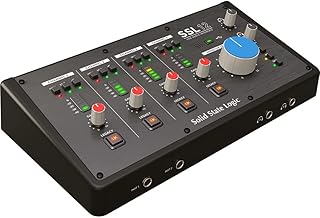
The SSL 12 is an audio interface, not a standalone mixing console. It is relevant for buyers comparing computer-centered recording equipment with a physical mixer. Its listed specifications emphasize conversion, microphone gain, dynamic range, and ADAT expansion rather than console channel strips or mixing controls.
- 12 inputs and eight outputs.
- 192 kHz/32-bit converters and more than 120 dB of dynamic range.
- Maximum operating level of +24 dB.
- 62 dB of mic gain, -130.5 dBu EIN, and an ADAT optical input.
Best for: Computer-based recording setups that need an interface with stated conversion specifications and an ADAT optical input. It was selected as a useful adjacent option for shoppers who may be looking for a recording hub rather than a mixer.
Limitation: The product is identified as a USB audio interface, so it should not be treated as a replacement for a standalone console without checking the required monitoring and mixing workflow.
Buying Guide: How to Choose a Solid-State Mixing Console
Do you need an analog-style console or a digital mixer?
Start by deciding what you mean by “solid-state.” The SSL BiG SiX, SSL SiX, and SSL Six listings describe SuperAnalogue console performance. The Qu-5 listing identifies a digital mixer. These categories support different workflows, so compare the type of mixing and control you need rather than treating every product called a mixer as interchangeable.
An analog-style console can appeal to buyers who want physical channel controls and console-based processing. A digital mixer may be a better fit when the stated requirements include many input channels, motorized faders, a touchscreen, or built-in effects. Confirm the full specifications before deciding which format fits a particular studio or stage setup.
How many microphone inputs do you need?
Count the microphones you expect to connect at the same time. The BiG SiX lists four console-grade mic preamps, while the desktop SiX lists two. The provided features for the SSL Six do not state its mic preamp count. The Qu-5 lists 32 input channels, but that total should not be assumed to mean 32 microphone preamps; check its detailed input specifications if mic inputs are the deciding factor.
For recording a small number of vocal or instrument microphones, two or four stated mic preamps may be sufficient. For larger ensembles, live events, or multi-microphone sessions, compare the precise number and type of available inputs before purchasing.
Will you record directly to a computer?
Check whether the product includes the interface capability and channel count your workflow requires. The BiG SiX lists a 16-channel USB audio interface, and the Qu-5 lists a 32-by-32 USB interface. The SSL 12 is itself a USB audio interface with 12 inputs and eight outputs. The supplied feature lists for the SSL SiX and SSL Six do not specify USB interface capabilities.
Do not assume that a mixer’s USB connection supports multichannel recording simply because USB is mentioned in a listing. Look for the stated number of input and output channels, supported sample rate, and the intended computer workflow.
What channel processing is important?
Built-in processing can reduce the need for external equipment or software during a session. The BiG SiX lists three-band EQ and dynamics channel processing. The desktop SiX lists essential versions of SSL Channel EQ and Dynamics. The Qu-5 lists six FX processors. The SSL Six listing emphasizes overall audio performance but does not detail its channel processing in the supplied features.
Compare the specific processing you need, such as EQ, dynamics, or effects, rather than relying on broad performance language. If processing requirements are central to your choice, verify the controls and routing in the complete manufacturer specifications.
How important are sample rate and conversion specifications?
The BiG SiX lists 24-bit/96 kHz AD/DA converters. The Qu-5 is listed as a 96 kHz digital mixer. The SSL 12 lists 192 kHz/32-bit converters, along with dynamic-range and microphone-gain figures. These specifications describe different types of equipment and do not alone determine which product is best for a particular session.
Choose specifications that match your recording workflow and other equipment. If you need a specific sample rate, bit depth, maximum operating level, or converter performance, check that the exact model provides it. Do not infer an unstated specification from another product in the same brand family.
Is portability or a compact footprint a priority?
The SSL SiX is described as a desktop mixer, and the SSL Six is described as a condensed console. These descriptions make them natural candidates for buyers comparing compact-format options. The product information provided here does not give dimensions or weight, so verify those details if the mixer must fit a particular desk, rack, or travel case.
A larger or more capable console may offer more connections or controls, but those features are useful only if they fit the available space and workflow. Compare layout and connection requirements alongside the physical footprint.
What connections and expansion options should you check?
List every source and destination in the setup: microphones, line-level instruments, playback devices, computers, stageboxes, and monitoring equipment. The BiG SiX lists stereo line inputs and external inputs. The Qu-5 lists an SLink port for stagebox I/O. The SSL 12 lists an ADAT optical input. These are distinct connection features and serve different expansion needs.
Before choosing, check the complete input and output list, connector types, routing options, and any required external equipment. A product’s headline channel count may not describe every connection or how it can be routed.
Frequently Asked Questions
What is the best solid-state mixing console in this selection?
The SSL BiG SiX is the most directly suited to hybrid console and computer recording because it lists four mic preamps, channel EQ and dynamics, and a 16-channel USB audio interface.
Is the SSL SiX a USB audio interface?
The supplied feature list for the SSL SiX does not specify a USB audio interface. It identifies two SuperAnalogue mic preamps and essential SSL channel EQ and dynamics.
Is the Allen & Heath Qu-5 an analog console?
No. The product listing identifies the Qu-5 as a 96 kHz digital mixer with a touchscreen, motorized faders, and digital mixing features.
Can the SSL 12 replace a mixing console?
The SSL 12 is listed as a USB audio interface, not a standalone mixing console. It may suit a computer-based recording setup, but buyers should confirm that its workflow meets their mixing and monitoring needs.
Which option is better for a compact studio?
The SSL SiX is explicitly described as a desktop mixer, while the SSL Six is described as a condensed console. Compare their complete dimensions, connections, and processing details to determine which fits the specific studio setup.
What should I verify before buying a mixer for live use?
Confirm the required input count, mic preamp count, outputs, routing, monitoring, and any stagebox or computer connections. The supplied features do not provide every detail for each product, so check the complete specifications for the exact model.