
Best Solo Strings Library Picks for Intermediate Players
Looking for a strong solo strings library to support practice and recital preparation? This guide highlights five solid options from Alfred Music and Rubank Publications. Each entry is chosen for clear instruction, progression, and practical use in class or private study. The top picks are best for students building technique, sight-reading, and musicality across violin and cello repertoire.
Summary of selected products:
- Solo Time for Strings, Book 1 — Alfred Music — Beginner to early-intermediate string players.
- Solo Time for Strings, Book 3: Violin — Alfred Music — Early-intermediate violinists seeking progression.
- Solo Time for Strings, Bk 2: Cello — Alfred Music — Cellists building reading and technique in mid-level material.
- Solo Time for Strings for Cello, Book 4 — Alfred Music — Later-intermediate cellists with focused technique work.
- Solos For Strings – Violin Solo (First Position) — Rubank Publications — Short pieces for first-position violin repertoire.
Solo Time for Strings, Book 1

This book acts as an introduction to string technique and reading for early students. It emphasizes fundamental bowing, note-reading, and basic ensemble-friendly pieces. Best for beginners beginning formal reading and basic intonation work. Choose this if you need a straightforward entry point that pairs well with private lessons or beginner classroom instruction. A limitation is that pieces are designed for early learners, so more advanced students may outgrow the material quickly.
Solo Time for Strings, Book 3: Violin

Designed for early-intermediate violinists, this book advances reading skills and repertoire with more varied rhythms and intervals. It is best for students who have established basic technique and want to broaden melodic writing and phrasing. Better for independent practice and performance-ready pieces. A potential limitation is that it remains within the same instructional series, so students seeking more varied publishers or style diversity might supplement with non-series materials.
Solo Time for Strings, Bk 2: Cello

Cellists receive emphasized progress in reading with a focus on note learning, classroom or individual instruction, and overall musical progression. This book suits mid-level cellists who need to strengthen reading and technique in a structured way. Best for students who prefer a guided approach and clear progression. A caution: content aligns closely with the series’ curriculum, so it may pair best with other non-thematic cello solos for variety.
Solo Time for Strings – Book 3 (Cello)

This cello-specific book emphasizes accomplishment, progress, and achievement, with arrangements suited for class or individual instruction. It provides progressive material for cellists looking to consolidate technique and musicality while maintaining engagement. Choose this if you want a cello-focused progression within a familiar series. A limitation is that pieces are designed for classroom or private lessons and may not include extensive concert-ready repertoire.
Solo Time for Strings for Cello, Book 4

Cellists at a later-intermediate level will benefit from Book 4’s continued emphasis on technique and musical maturity. It offers more challenging passages, reinforcing reading, tone production, and intonation in a logically sequenced manner. Best for progressing students who want sustained development within the Solo Time for Strings library. A limitation is that the material may require more advanced technical foundations before full enjoyment and mastery.
Solos For Strings – Cello Solo (First Position)

Rubank Publications presents a concise collection of cello solo pieces in the first position. It is ideal for short recital-ready selections and early performance experience. Best for students who need compact repertoire that reinforces fundamental positions. A caveat: the collection’s 16 pages are limited, so players may need additional selections for longer programs.
Solos For Strings – Violin Solo (First Position)
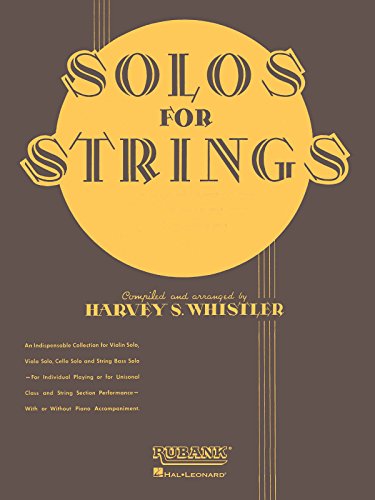
This violin collection provides first-position solo pieces that can serve as quick repertoire additions or warm-up material. Best for early-to-mid-level violinists seeking compact, position-specific solos. A limitation is that the level may vary across pieces, so students should select items aligned with their current skills.
Buying Guide
What should you consider when building a solo strings library?
- Skill level alignment — Match book difficulty to current technique and reading ability. Start with beginner-to-early-intermediate titles and progress to intermediate sets as confidence grows.
- Instrument focus — If you teach multiple instruments, consider a balanced library across violin, viola, and cello to support diverse students.
- Repertoire goals — Choose collections that reinforce tone production, bow control, intonation, and reading progress with a logical progression.
- Length and format — Short, portable solos are useful for warm-ups and quick lessons; longer pieces suit recital preparation and performance readiness.
- Supplementary materials — Look for teachers’ guides, technique notes, and sample accompaniments that complement the core books.
Practical buying questions
- Which book is best for beginners starting with reading and bowing? — Solo Time for Strings, Book 1 provides a straightforward starting point.
- What should I choose for early-intermediate violin progression? — Solo Time for Strings, Book 3: Violin adds more complex rhythms and phrasing.
- Which cello book focuses on reading and class instruction? — Solo Time for Strings, Bk 2: Cello or Solo Time for Strings for Cello, Book 4 depending on level.
- Are short solo collections useful for recitals? — Yes, titles like Solos For Strings – Violin Solo (First Position) and Solos For Strings – Cello Solo (First Position) provide compact recital options.
FAQ
- What is the main advantage of these solo strings books?
They provide structured progression in reading, technique, and musicality suitable for class and private study. - Are the books suitable for independent practice?
Yes, most entries include self-contained exercises and pieces that students can practice with minimal supervision. - Do these titles cover multiple string instruments?
Yes, the list includes violin and cello books for balanced approach across instruments. - Should I mix different publishers in my library?
Mixing can diversify repertoire and teaching styles, but ensure consistency in progression and levels. - Is there a risk of outgrowing early books quickly?
Begin with the first-level books and transition to mid-level volumes as technique improves to maintain motivation. - What is the best way to sequence these titles?
Start with Book 1 for each instrument, then progress to Book 2 or Book 3 as skills advance, finally adding recital-oriented solos.