
The best soundproof box for a microphone helps reduce room echo and reflections around the mic, but it does not make a recording space completely soundproof. The TroyStudio Large Foldable Booth is best for buyers who want a lightweight, roomy box; the enclosed TroyStudio model adds panels and a compact footprint; Rockville’s ISOBOX includes a pop filter and adjustable mic mount. The TONOR shield suits buyers who prefer a freestanding tripod setup, while the microphone isolation ball is a compact option for a compatible mic.
| Product | Best suited for | Standout feature |
|---|---|---|
| TroyStudio Portable Vocal Booth, Large | Portable recording with more interior room | Foldable design and cable and stand openings |
| TONOR Microphone Isolation Shield | Buyers seeking a shield with a tripod | Adjustable height up to 53.1 inches |
| TroyStudio Enclosed Vocal Booth | Home studios seeking an enclosed, compact booth | Foam and high-density panels |
| Rockville ISOBOX | Vocal recording with an integrated pop filter | Adjustable mic mount and four XLR entries |
| Microphone Isolation Ball | Compatible microphones needing a small shield | Five-sided foam enclosure |
TroyStudio Portable Vocal Booth, Large

Best for: Voice-over artists, podcasters, and musicians who want a portable tabletop enclosure with more interior space than a compact mic shield. Its stated internal dimensions are 8 by 10 by 12 inches, and the booth weighs 2 pounds.
The booth uses five pieces of 2-inch-thick, high-density egg-crate foam on its interior surfaces. The product description says this treatment is designed to reduce echoes and reflections, helping produce a drier recording in a reflective room. Openings accommodate audio cables and microphone stands, so buyers can route equipment through the enclosure rather than positioning everything outside it.
It folds to 12 by 12 by 6 inches and includes a backing panel intended to support the structure. That combination makes it a practical choice for people who need to pack away a recording setup or travel with one. Choose this model if portability and a relatively generous interior are priorities.
Limitation: It treats sound around the microphone; it is not a sealed room and should not be expected to block all outside noise. Check the available space against the size of the microphone and any accessories you plan to place inside.
TONOR Microphone Isolation Shield

Best for: Buyers who want a microphone isolation shield mounted on a separate tripod rather than choosing a small tabletop box. The product name specifies an adjustable height with a maximum of 53.1 inches.
The freestanding arrangement may suit a recording position where a desk-mounted enclosure is inconvenient. It is presented for singing and studio recording, and its height range gives buyers a defined measurement to compare with their chair, standing position, and microphone placement. Choose this if the ability to adjust the shield’s height matters more than a fully enclosed box.
The listing information provided for this model does not specify the shield’s dimensions, materials, cable routing, or microphone-mount details. Compare those details on the current product listing before purchase, especially if you need a particular fit or want to know how the shield attaches to the tripod.
Limitation: Available product details establish the tripod and height adjustment, but do not provide enough information to assess the amount of acoustic treatment or microphone compatibility. Avoid choosing it based solely on the phrase “sound proof.”
TroyStudio Enclosed Vocal Booth

Best for: Home recording enthusiasts who want an enclosed, foldable booth with both acoustic foam and denser panels. Its internal dimensions are 8 by 8 by 12 inches, and its listed weight is 2.7 pounds.
The enclosure includes four pieces of 2-inch-thick acoustic foam and two high-density acoustic panels. The product description says this combination is designed to reduce background noise, reflections, and echoes around a recording microphone. Its smaller interior than the large TroyStudio model may be preferable when tabletop space is limited, provided the mic and accessories fit.
Two sturdy panels support the structure, and the listing says the top can hold a laptop. Three openings in the outer frame are intended for cables and different microphone stand arrangements, including desktop, wall-mounted boom arm, and floor stands. Folded dimensions are 12 by 12 by 10 inches, making it a portable option for temporary recording setups.
Limitation: The internal space is only 8 inches wide and long, so check the dimensions of the microphone and any equipment that must sit inside. Like other portable vocal booths, it reduces reflections near the mic rather than isolating a whole room from loud sounds.
Rockville ISOBOX Recording Microphone Box
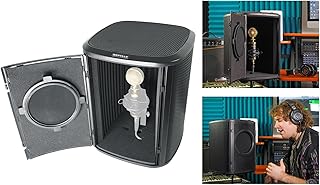
Best for: Vocal and podcast recording where an integrated pop filter and adjustable microphone position are useful. The ISOBOX is described as fully enclosed and includes 1.6-inch acoustic foam, a built-in single-layer pop filter, a mic stand, and a travel bag.
The interior mic mount adjusts to four positions or can be removed. The product description lists compatibility with dynamic, condenser, and USB microphones. Four XLR cable entries provide several points for routing an XLR cable, which can make setup more flexible depending on where the microphone and cable sit.
The built-in pop filter is intended to reduce plosive bursts and air noise, so this model combines two functions: acoustic treatment around the mic and a screen between the speaker and microphone. Choose it if you want those features in one enclosure rather than assembling a separate pop filter and mic support.
Limitation: The product information specifies a single-layer pop filter, not a multi-layer design. Check the dimensions and mounting arrangement on the listing to confirm that your particular setup will fit; the provided details do not give the box’s internal measurements.
Microphone Isolation Ball With Five-Sided Shield

Best for: Buyers seeking a smaller shield for a microphone that matches the listed size range. The product description says it suits many XLR and USB microphones, including condenser microphones with a removable jacket diameter between 50 and 75 millimeters, and includes a holder for different microphone sizes.
Its five-sided foam design surrounds the mic on several sides, while the opening has a double-layer screen. The listing describes the screen as helping reduce plosive sounds and the enclosure as limiting reflections and noise around the microphone. It also notes that the design can help protect a microphone from saliva during close vocal recording.
Choose this model if you want a more compact alternative to a box-style booth and your mic fits the stated diameter range. It may be useful for close-mic voice recording where a large enclosure is impractical.
Limitation: The stated fit range is specific, and the microphone’s removable jacket diameter should be checked before ordering. Its open side and compact format mean it is not a substitute for room soundproofing or a full vocal booth.
Buying Guide: How To Choose A Microphone Soundproof Box
Do you need soundproofing or echo reduction?
Portable microphone boxes and isolation shields primarily manage reflections and reverberation close to the microphone. Foam absorbs some sound energy inside the enclosure, which can make a voice recording sound less affected by a reflective room. These products do not create a fully soundproof room. Traffic, HVAC noise, nearby conversations, and other sounds can still reach the microphone through openings or the surrounding space.
If outside noise is the main problem, first identify its source and consider recording at a quieter time, moving farther from the source, or improving the room itself. A mic box may help with room echo, but buyers should not assume it will eliminate loud or persistent environmental noise.
How much interior space do you need?
Compare a booth’s internal dimensions with the microphone, shock mount, pop filter, and cable connection you intend to use. The larger TroyStudio booth has a stated 8-by-10-inch footprint inside, while its enclosed sibling lists an 8-by-8-inch interior. A compact enclosure may be easier to store, but it can limit microphone placement or leave little room for accessories.
For a microphone isolation ball, the fit depends on the mic’s diameter and the included holder. Measure the microphone as it will be used, including any removable jacket if the listing specifies that measurement. Do not rely only on broad labels such as “USB mic” or “condenser mic,” because shapes and sizes vary.
Should you choose a box, a shield, or a ball?
- Choose a box-style booth if you want an enclosure around the microphone and can accommodate its tabletop footprint. Check the opening and internal dimensions.
- Choose a freestanding shield if a tripod arrangement and adjustable height fit your recording position. Confirm the mounting and shield specifications before buying.
- Choose an isolation ball if compact size matters and the microphone falls within the listed fit range.
Which materials and features matter?
Look for clearly stated foam thickness, panel construction, cable openings, and microphone-positioning options. Thicker foam is a product specification, not a guarantee that all noise will be blocked. Dense panels and supported frames can affect how a booth stands, while cable holes and stand openings can make it easier to arrange equipment. A built-in pop filter adds a vocal-recording feature, but buyers who already own one should consider whether that addition is useful.
For a portable setup, compare folded dimensions and weight as well as the assembled size. A booth that is easy to store can be useful for shared rooms or travel, but it still needs a stable surface and suitable space when in use. Check whether the included stand or mount works for your preferred placement rather than assuming every accessory is interchangeable.
What should you check before ordering?
- Measure the microphone, mount, and available desk or floor space.
- Confirm how the mic stand, cables, and pop filter are positioned in the enclosure.
- Review the product’s stated compatibility and fit measurements.
- Separate claims about echo reduction from expectations about blocking outside noise.
- Check folded size if storage or travel is important.
Frequently Asked Questions
Does a soundproof box completely block outside noise?
No. These products are designed mainly to reduce reflections and echo around a microphone. They are not sealed rooms, so sound from the surrounding environment may still enter the recording.
Will a microphone isolation box improve voice recordings?
It can help reduce the effect of room reflections near the microphone, which may make a recording sound drier. The result depends on the room, mic placement, enclosure design, and the noise present during recording.
Can I use a sound box with a USB microphone?
Some listed products state compatibility with USB microphones, but fit depends on the microphone’s dimensions and mounting arrangement. Check the specific product’s compatibility details and measure the mic before buying.
Is a built-in pop filter necessary?
Not always. A pop filter helps reduce bursts of air from speech sounds such as “p” and “b.” If you already have an effective pop filter, the built-in version may be less important than enclosure size, mounting, or cable access.
What is the difference between a vocal booth and an isolation shield?
A vocal booth generally surrounds more of the microphone with an enclosure, while an isolation shield is typically positioned around or behind the mic. Product designs vary, so compare actual dimensions, openings, and included supports rather than relying on the name alone.