
Best Soundbars for Small Rooms: Compact Picks for Clear Dialogue and Rich Sound
Answering the needs of viewers with limited space, these compact soundbars deliver clear dialogue, balanced audio, and easy setup without crowding a small living area. The top picks below are best for small rooms, desktops, dorms, or bedside TVs. Each product is evaluated for space efficiency, ease of use, and sound performance.
Overview table of chosen products:
- Bose TV Speaker — Best for clear dialogue in ultra-compact form
- Sony S100F — Best all-around balance and compact design
- Samsung HW-B400F — Best for room-filling sound with a built-in woofer
- Saiyin 11.7-inch Sound Bar — Best for ultra-small spaces with multiple input options
- Amazon Fire TV Soundbar — Best for streaming-first setups with virtual surround
Bose TV Speaker: Compact, Dialogue-First Performance

The Bose TV Speaker is designed for ultra-compact setups. It focuses on speech clarity and easy, one-cable HDMI-ARC or optical connections. Best for viewers who prioritize intelligible dialogue over booming bass in a small living space. The built-in two full-range drivers deliver a natural soundstage, making it a solid choice for bedrooms or small apartments where space is at a premium. A limitation is that its bass extension is modest, so it pairs well with a small subwoofer if deeper lows are required.
Who it’s best for: TV watchers who want clear conversations without a large footprint. Ideal for dorm rooms and compact living spaces where simple controls and clean aesthetic matter.
Sony S100F: Slim, Theater-Ready Sound

The Sony S100F offers a slim footprint with a dedicated bass reflex design for richer sound in small spaces. Its straightforward setup and Bluetooth option make it easy to pair with TVs or mobile devices. It’s a strong all-around option for those who want a balanced sound profile that handles movies, music, and gaming without excessive setup complexity. The main limitation is that it lacks a separate subwoofer, so the bass may not satisfy listeners who crave punchier low-end impact in very small rooms.
Who it’s best for: Viewers seeking a compact, easy-to-use unit that delivers balanced audio for daily TV watching, streaming, and casual listening.
Samsung HW-B400F: Built-In Subwoofer, Room-Filling Sound

The Samsung HW-B400F includes a built-in subwoofer, offering deeper bass without needing extra furniture. Its compact design fits nicely under TVs and in front of compact entertainment setups. Best for small rooms where you want a fuller sound with noticeable bass while keeping cable clutter down. A potential limitation is that the remote and app functionality may be less extensive than larger Samsung models, but it remains straightforward for everyday use.
Who it’s best for: Small living spaces that still want immersive sound with a perceptible bass presence. Choose this if you value a simple, fewer-device setup with built-in low-end support.
Saiyin 11.7-Inch Sound Bar: Ultra-Slim, Flexible Setup
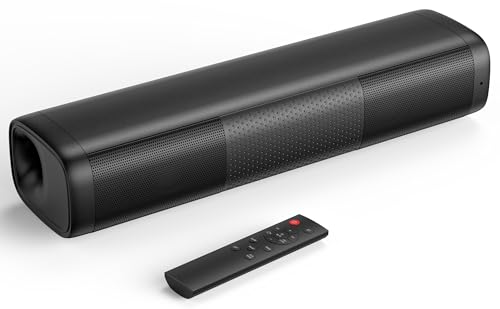
With an 11.7-inch form factor, this Saiyin model is built for extremely small spaces. It supports multiple input options via Bluetooth, optical, and AUX, and offers a dedicated sub-out for expanding bass later. Best for compact desks or wall-mounted setups where space is constrained but you still want a true soundbar experience. A limitation is that smaller drivers may not deliver as much depth in aggressive movie soundtracks as larger systems.
Who it’s best for: Tiny rooms, desktops, or wall-mounted TV spaces where a straightforward, space-saving soundbar is needed. Opt for this if you may add a subwoofer later for richer bass.
Amazon Fire TV Soundbar: Streaming-First Audio Upgrade

The Amazon Fire TV Soundbar emphasizes streaming integration with its built-in Fire TV features and DTS Virtual:X for virtual surround. It delivers clearer dialogue and a more immersive viewing experience in smaller rooms where streaming content is a primary use. Best for users who want an all-in-one device that handles apps, voice search, and standard TV audio in one compact unit. A potential consideration is that its primary strength is streaming, so audio depth may be less robust for dedicated audio enthusiasts when used without a connected subwoofer.
Who it’s best for: Stream-heavy setups where a simple, compact soundbar with smart features is preferred. Choose this if you value integrated streaming and voice-enabled TV control.
Buying Guide: Key Purchase Considerations
- Room size and placement: In very small spaces, choose compact heights under 3 inches and widths under 40 inches for under-TV placement. Consider whether wall-mounting is needed.
- Dialogue clarity vs. bass needs: For bedrooms or study rooms, prioritize speech enhancement modes. If you want a fuller sound, look for built-in subwoofers or a sub out.
- Input and connectivity: Ensure the soundbar supports HDMI-ARC/eARC or optical to simplify control with your TV. Bluetooth is a plus for music playback from mobile devices.
- Ease of use: Look for a simple remote, clear on-device controls, and compatibility with your existing remote ecosystem if possible.
- Future expandability: If you plan to upgrade later, a soundbar with a sub-out or modular design may be beneficial.
Frequently Asked Questions
- What size soundbar is best for a small room?
Answer: A compact model under 40 inches wide and about 2–3 inches tall fits most small rooms without obstructing the TV or decor. - Should I buy a soundbar with a built-in subwoofer?
Answer: Yes if you want deeper bass without extra furniture. If you prefer tight dialogue prioritization, you can skip it and add a sub later. - Is HDMI-ARC essential for small rooms?
Answer: It simplifies control and ensures audio sync with TV; optical is a solid alternative if ARC is unavailable. - Can I mount a soundbar on the wall?
Answer: Yes, most compact soundbars are designed for wall mounting, freeing surface space and improving audio dispersion in small rooms. - Do all soundbars support Bluetooth streaming?
Answer: Many do, but verify Bluetooth version and codec support if you plan to stream high-quality audio. - Is a separate subwoofer necessary for good bass?
Answer: Not always; built-in woofers provide bass, but a separate sub improves depth for movies and gaming.