
If you need to connect bare speaker wire to a 1/4-inch jack, none of the listed products is a direct bare-wire-to-1/4-inch adapter. The EBXYA cable has a 1/4-inch TS plug but ends in XLR, while the other options use 3.5 mm connectors. The table below identifies what each cable actually connects, so you can avoid choosing a plug that does not fit your equipment.
| Product | Connector type | Best suited for |
|---|---|---|
| EBXYA 1/4-inch TS to XLR | 1/4-inch TS to XLR male | Unbalanced instrument or mixer connections |
| Jiozermi 3.5 mm to bare wire | 3.5 mm, three-conductor to open wires | Basic stereo cable repair |
| Poyiccot 3.5 mm screw-terminal adapter | 3.5 mm TRRS to four terminals | Four-conductor wiring projects |
| Maixbomr 3.5 mm to bare wire | 3.5 mm TRRS to four open wires | DIY cable repair with microphone conductor |
| ONXE 3.5 mm splitter | 3.5 mm male to multiple female jacks | Sharing headphone audio |
EBXYA 1/4-Inch TS To XLR Cable

Best for: Connecting equipment with a 1/4-inch mono TS connection to an XLR connection in an unbalanced audio setup. This is the closest match in the list for a buyer specifically looking for a 1/4-inch plug.
The cable is described as a 3-foot, 1/4-inch TS mono guitar-to-XLR male cable and is supplied as a two-pack. The listing identifies guitar-to-mixer and mixer-to-speaker use, and specifies unbalanced transmission. It also describes dual shielding, insulated copper, additional copper braid, and 24 AWG conductors.
Why it was selected: It is the only listed product with a 1/4-inch connector, making it the most relevant option when the required jack is 1/4 inch. However, it terminates in XLR, not bare speaker wire. It is not a direct speaker-wire-to-1/4-inch adapter.
Limitation: The listing describes an unbalanced audio cable, not a speaker cable with bare-wire ends. Check that both connector types and the intended signal path match your equipment before choosing it.
Jiozermi 3.5 Mm Stereo Bare-Wire Cable

Best for: Repairing a compatible stereo audio cable that needs a 3.5 mm male plug at one end and exposed wires at the other. The package contains four 1-foot cables, which may suit short repair or wiring tasks.
The product uses a 3.5 mm, three-pole stereo plug. Its listed wiring directions identify red as the left channel, white as the right channel, and black as ground. Those color references can help during a repair, but users should verify the conductors and pin assignments for their specific equipment rather than assume all cables use identical colors.
Why it was selected: It provides an open-wire end for DIY work and clearly lists a three-conductor stereo wiring scheme. It is a better fit than a molded plug-to-plug cable when the project specifically requires exposed conductors.
Limitation: This cable has a 3.5 mm plug, not a 1/4-inch plug. It is also described for headphone, headset, or earphone cable replacement, so it should not be treated as a verified high-power speaker cable.
Poyiccot 3.5 Mm TRRS Screw-Terminal Adapter
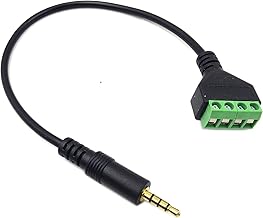
Best for: Projects that need a 3.5 mm four-pole TRRS plug connected to individual wires secured in a screw terminal block. The adapter is 30 cm long and has four terminal positions, according to the product description.
A TRRS plug has four conductors: three signal conductors and a ground, as described in the listing. That differs from a common stereo TRS plug, which has two signal conductors and a ground. This distinction matters when matching the adapter to the device’s port and wiring plan.
Why it was selected: Its screw terminals provide a defined way to attach individual conductors without a separate bare-wire plug termination. It can be useful for low-voltage audio wiring projects where a 3.5 mm TRRS connection is specifically required.
Limitation: It is not a 1/4-inch adapter. The listing also warns that it did not work when attached to a Wi-Fi projector, so buyers should confirm the device’s pinout and intended use rather than assume universal compatibility.
Maixbomr 3.5 Mm TRRS Bare-Wire Cable

Best for: DIY repairs or wiring projects that need a 3-foot cable with a 3.5 mm TRRS male plug and four exposed conductors. The listing says it is intended for replacement of worn or broken 3.5 mm audio cable connections.
The product’s wiring diagram assigns red to the left channel, white to the right channel, green to the microphone, and black to ground. This four-conductor arrangement is relevant when the connected device uses a TRRS port with a microphone connection. Confirm the device’s pinout before connecting wires, because connector standards and wiring assignments can vary.
Why it was selected: It offers a longer open-wire lead than the 1-foot Jiozermi option and identifies a separate microphone conductor. The listing names speakers and several other audio devices among possible applications, but does not establish suitability for every device.
Limitation: Its plug is 3.5 mm TRRS, not 1/4 inch. Avoid choosing it if your equipment requires a 1/4-inch jack or a dedicated high-power speaker cable.
ONXE 3.5 Mm Headphone Splitter

Best for: Sharing audio from a compatible 3.5 mm source with multiple listeners or connecting more than one set of headphones. The listing describes one 3.5 mm male connection and two, three, or four female connections, with use for sharing music, movies, and games.
The product is presented as a headphone splitter for devices such as MP3 players and portable DVD players. Its purpose is to divide a headphone connection for listening, not to convert exposed speaker wire to a 1/4-inch plug.
Why it was selected: It is useful to compare against conversion cables because it shows why identifying the cable’s function matters. A splitter adds headphone outputs; it does not provide screw terminals or bare-wire ends.
Limitation: It has 3.5 mm connectors and no 1/4-inch jack or open-wire end. Choose it only when the goal is audio sharing through headphone connections.
Buying Guide: How To Choose The Right Cable
Do you need a 1/4-inch plug or a bare-wire connection?
Start by identifying both ends of the required connection. A 1/4-inch jack is a 6.35 mm connector; a 3.5 mm jack is smaller and is often called 1/8 inch. Bare wire means the conductors are exposed for attachment to terminals. A cable that has a 1/4-inch plug at one end but an XLR connector at the other does not directly connect to bare speaker wire.
For a direct bare-wire-to-1/4-inch connection, look for a product specifically described as a 1/4-inch TS or TRS plug to bare wire, or an appropriate terminal adapter. None of the five products here is listed as that exact configuration.
What is the difference between TS, TRS, and TRRS?
- TS means tip and sleeve. The EBXYA listing describes a mono 1/4-inch TS connection.
- TRS means tip, ring, and sleeve. It is commonly used for stereo connections or balanced audio, depending on the equipment and wiring.
- TRRS means tip, ring, ring, and sleeve. The Poyiccot and Maixbomr products use 3.5 mm four-pole plugs with an additional conductor compared with a typical stereo TRS plug.
Connector size alone does not identify the signal or wiring. Check the port label, equipment documentation, and pinout before connecting conductors.
Is an instrument cable the same as a speaker cable?
Not necessarily. The EBXYA product is described as an unbalanced audio cable with 1/4-inch TS and XLR connectors. A cable intended for a line-level or instrument signal is not automatically appropriate for carrying power from an amplifier to a passive speaker. Use a cable designed for the actual signal path and follow the equipment maker’s connection guidance.
How many conductors does your project need?
A basic stereo connection commonly uses left, right, and ground conductors. The Jiozermi listing describes that three-wire arrangement. A TRRS connection adds a fourth conductor, identified by Maixbomr as the microphone connection. The Poyiccot adapter also provides four terminals. Match the conductor count and pin assignment to the device rather than relying only on wire colors.
When should you choose screw terminals instead of open wires?
Screw terminals can make it easier to attach and secure individual conductors in a compatible wiring setup. A bare-wire cable is more adaptable for repair work but may require stripping, correct identification, and secure termination. In either case, keep conductors separated as required by the equipment and verify polarity or pinout before powering the system.
Frequently Asked Questions
Is a 1/4-inch jack the same as a 3.5 mm jack?
No. A 1/4-inch jack is approximately 6.35 mm across, while a 3.5 mm jack is smaller. They are different connector sizes and are not interchangeable without a suitable adapter.
Which listed cable connects bare wire directly to a 1/4-inch plug?
None of the listed products is described as a bare-wire-to-1/4-inch cable. EBXYA has a 1/4-inch TS connector on one end and XLR male on the other. The other listed cables use 3.5 mm connectors.
Can I use a 3.5 mm TRRS cable in a 1/4-inch jack?
Not directly. The plugs have different sizes, and their conductor layouts may also differ. A physical adapter alone does not guarantee that the signal wiring will match.
Can the EBXYA cable connect a speaker to an amplifier?
The product is described as an unbalanced 1/4-inch TS-to-XLR audio cable. The listing does not identify it as a speaker wire cable for amplifier-to-passive-speaker power connections. Confirm the required cable type with the equipment documentation.
Should I connect wires by color alone?
No. The listed products provide color-based wiring diagrams, but color conventions can vary. Verify each conductor’s function and the port pinout before making a connection.