
Best TV-Connection Speakers for Seamless TV Sounding
Direct answer: If you want a speaker that connects to your TV, a compact soundbar or TV-friendly speaker system is generally your best bet. The top picks below are chosen for clear dialogue, easy setup, and reliable connections (ARC, HDMI, Bluetooth, Optical). This list suits movie lovers, gaming enthusiasts, and everyday TV watchers who want improved sound without fuss. The buyer-friendly table summarizes each option’s best-use case, primary connection, and ideal setup.
| Product | Best For | Key Connection | Why It Stands Out |
|---|---|---|---|
| Bose TV Speaker | Clear dialogue on small setups | HDMI-ARC, Bluetooth | Compact, speech-focused, easy to install |
| Assistrust Sound Bar | Balanced room-filling sound | ARC, Optical, Bluetooth | 4 drivers, 80W, 3 EQ modes |
| MZEIBO Sound Bar | Versatile home theater | ARC, Optical, AUX, Bluetooth | 50W, 17-inch compact design |
| Saiyin 11.7″ Sound Bar | Space-saving under-TV setups | Bluetooth, Optical, AUX | 48W, balanced audio, sub-out option |
| SunTrok Soundbar With Subwoofer | Entertainment & karaoke nights | HDMI ARC, Optical, Bluetooth | 260W, wireless mics, 2.1 channel |
Bose TV Speaker

Best for: Viewers who want clearer dialogue with minimal setup. Rationale: Bose focuses on vocal clarity using two angled drivers to enhance speech without overwhelming surround effects. This small bar is ideal for bedrooms or compact living rooms where space matters.
What to know: The Bose TV Speaker is designed as an all-in-one solution that emphasizes dialogue. It supports HDMI-ARC and Bluetooth for simple wireless pairing. A potential limitation is the compact size which may not deliver deep bass for action-heavy content.
Key points:
- All-in-one, easy setup
- HDMI-ARC and Bluetooth connectivity
- Speech-focused enhancement
Assistrust Sound Bar

Best for: Viewers seeking a powerful, adaptable sound with multiple placements. Rationale: The 80W system uses four drivers and offers vertical, horizontal, tabletop, or wall-mount placements for immersive sound in varied room shapes. It includes auto volume boost to enhance quieter scenes.
What to know: It supports ARC, Optical, and AUX, but its high output may be more than needed for small rooms. A caution: placement can affect perceived bass; wall mounting provides a cinematic feel but may require additional cables.
Key points:
- 80W output with four drivers
- Auto volume boost for dynamic scenes
- Flexible mounting options
MZEIBO Sound Bar

Best for: People who want a versatile and compact 50W soundbar with broad connectivity. Rationale: It supports Bluetooth 5.3, HDMI ARC, Optical, and AUX, making it easy to pair with TVs, laptops, and projectors without extra gear.
What to know: The design is slim, which helps fit under most TVs. A limitation: while 50W is ample for mid-sized rooms, very large spaces may benefit from a larger system or subwoofer for deeper bass.
Key points:
- 50W output for clear sound
- Multiple connection options
- Slim 17-inch form factor
Saiyin 11.7-inch Sound Bar
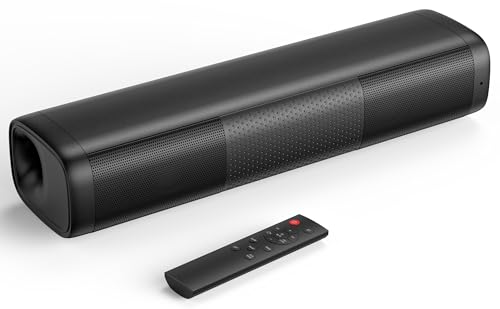
Best for: Small spaces where a low-profile bar is preferred. Rationale: An 11.7″ cabinet fits under most TVs without obstructing the remote or screen edge, while delivering balanced audio with a sub-out option for future bass expansion.
What to know: It offers Bluetooth, optical, and AUX connections plus a dedicated sub-out. Limitation: The single-bar design may not replace a full home theater for large rooms or heavy bass lovers without an external subwoofer.
Key points:
- Under-TV friendly size
- Three connection options plus sub-out
- Balanced, non-fatiguing sound profile
SunTrok Soundbar With Subwoofer

Best for: Family movie nights and karaoke-style entertainment. Rationale: The system includes a wireless subwoofer and two karaoke mics, delivering a robust 2.1 channel experience with multiple sound modes and Bluetooth 5.3 for streaming.
What to know: The package’s expansion to karaoke bursts the sound with vocal emphasis and echo control. Limitation: The included mics require charging and can be a little fiddly to set up for group singing in larger rooms.
Key points:
- 260W total power for strong surround feel
- Two wireless karaoke microphones
- HDMI ARC, Optical, Bluetooth connectivity
Buying Guide: Choosing The Right TV-Connection Speaker
What’s your room size and setup?
Small rooms benefit from compact bars with clear dialogue; larger rooms may warrant a larger bar or a system with a subwoofer for deep bass. Consider mounting options and whether you need wall placement or a shelf setup.
Which connections matter most?
HDMI ARC and Optical are common essentials for TV integration. Bluetooth adds wireless convenience for music. If you need full compatibility with older devices, look for AUX or USB options as well.
Dialogue clarity vs. overall bass?
For clearer voices, focus on bars marketed for dialogue or speech enhancement. If you want cinematic impact, choose options with subwoofers or 2.1 configurations. Avoid systems that overemphasize bass at the expense of dialogue.
Is placement important?
Many soundbars are designed to sit under the TV, but some can be wall-mounted. Wall mounting can improve sound dispersion but requires proper brackets and cable routing. Check whether the model supports both horizontal and vertical placements.
Budget and future expansion
Consider whether you’ll add a subwoofer or extra speakers later. Systems with a sub-out or modular architecture offer easier upgrades. If you only need a quick fix, a compact, all-in-one bar may be sufficient.
Common pitfalls to avoid
Avoid bars that are too small for the room or that lack essential TV connectivity. Beware models with complex remote setups or vague compatibility notes. Prioritize explicit TV-ARC, Optical, and Bluetooth compatibility to minimize setup headaches.
FAQ
- What connection should I use to connect to a TV?
- Do soundbars improve dialogue clarity?
- Is a subwoofer necessary?
- Can I mount a soundbar on the wall?
- Will these work with streaming devices?
- Are these easy to set up?
Use HDMI ARC if available for simple control and the best lip-sync; Optical is a strong alternative if ARC isn’t supported by the TV.
Yes. Models marketed for dialogue or with dedicated dialog enhancement focus on clearer speech and pronunciation.
Not always. A subwoofer adds depth for movies and music; many 2.1 systems include a sub, while 3.1 or larger may not.
Yes, most can be wall-mounted, but confirm weight limits and mounting hardware compatibility in the product specs.
Yes. Most support Bluetooth for wireless streaming and Optical/HDMI for TV connections; they generally work with common streaming setups.
Setup varies by model but many include straightforward step-by-step guides and minimal wiring for plug-and-play use.