
The best speakers with wide dispersion depend on where you need sound to spread: Fluance Elite bipolar speakers are suited to immersive home-theater surrounds, while the OSD Audio Forza is designed for 360-degree outdoor coverage. Pyle’s compact wall-mount pair is another outdoor option, and Creative Pebble models suit close-range desktop listening. The Edifier R1280T is a flexible powered bookshelf choice for people who want two audio inputs and onboard tone controls.
| Speaker | Best For | Dispersion-Related Feature |
|---|---|---|
| Fluance Elite SXBP2 | Home-theater surround | Bipolar radiation pattern |
| OSD Audio Forza | Outdoor area coverage | Omnidirectional 360-degree dispersion |
| Pyle PLMR24 | Outdoor wall mounting | Wide-dispersion midrange cone |
| Creative Pebble V3 | Desktop dialogue and general audio | Angled, near-field listening design |
| Edifier R1280T | Powered bookshelf listening | Two-way speaker design |
Fluance Elite SXBP2 Bipolar Surround Speakers
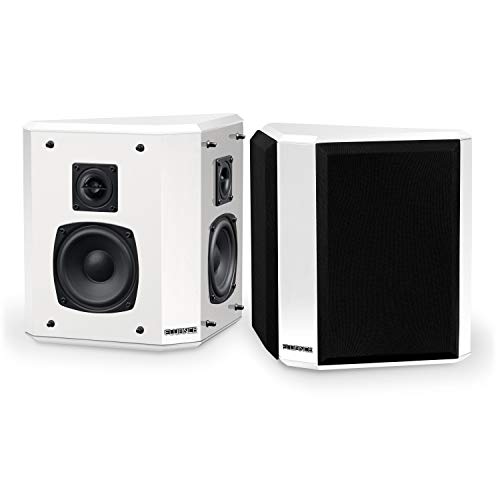
The Fluance Elite SXBP2 pair is the strongest match for buyers who mean wide, enveloping sound in a home-theater surround setup. Its bipolar radiation pattern is specifically intended to support surround imaging, spreading sound from the speaker rather than directing it as a conventional forward-facing design might.
Fluance lists premium components and natural sound reproduction among the design features. The speakers are also described as having seamless timbre to match the Fluance SX Series and other high-quality systems. That makes this pair a consideration for listeners prioritizing a cohesive surround field alongside their existing speakers.
- Best for: Home-theater listeners who want immersive surround effects.
- Why it stands out: The listed bipolar pattern directly addresses surround dispersion.
- Consider: This is a surround speaker pair, not a general-purpose powered desktop speaker. The supplied details do not specify amplification or connections.
Choose the Fluance pair if wide dispersion means creating a broader surround experience in a theater room. For broad outdoor coverage, the OSD Audio Forza is a more directly relevant alternative.
OSD Audio Forza 360-Degree Outdoor Speaker

The OSD Audio Forza is best for listeners seeking sound that radiates broadly through an outdoor space. Its stated 360-degree dispersion makes it the clearest fit in this selection for coverage around a central listening area, rather than a focused listening position in front of a speaker.
The weather-resistant design includes an 8-inch polypropylene woofer and a 1-inch Mylar whizzer cone tweeter. The speaker also has a built-in transformer with 8-ohm and 70V taps, which the product information identifies for both residential and commercial systems. Those options may suit different system designs, but buyers should verify the required setup before purchase.
- Best for: Outdoor listening areas where listeners may be positioned around the speaker.
- Why it stands out: The product specifically identifies omnidirectional 360-degree dispersion.
- Consider: Its 70V and 8-ohm options make checking amplifier and system requirements important.
Choose this model over a directional wall-mounted pair when spreading sound around an area is the priority. Its weather-resistant description supports outdoor use, but it does not remove the need to follow the seller’s placement and installation guidance.
Pyle PLMR24 Compact Outdoor Speakers
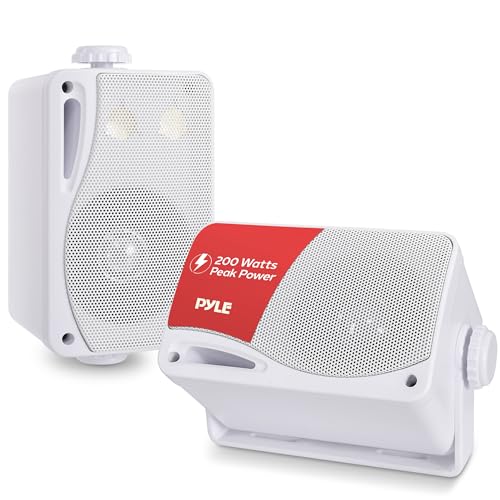
The Pyle PLMR24 is a practical option for buyers who want a compact pair for a patio, deck, garage, poolside, or similar area. Its feature list specifies a 1.75-inch wide-dispersion cone midrange, making it relevant to shoppers looking for broad sound distribution in a small wall-mount speaker system.
The pair uses a three-way design with a 3.5-inch aluminum injection cone woofer, a 1-inch dome tweeter, and a bass-reflex vent. Pyle lists 100 watts RMS and 200 watts peak, along with a 70Hz–21kHz frequency response and 4-ohm impedance. A mounting kit and wires are included according to the product description.
- Best for: Outdoor or utility spaces where a compact, mountable speaker pair is useful.
- Why it stands out: It combines a stated wide-dispersion midrange with a mounting kit.
- Consider: The listed 4-ohm impedance and power figures should be checked against the intended amplifier.
Choose Pyle if you want a conventional pair of speakers that can be positioned around an outdoor area. The Forza is a better match if you specifically want a single speaker described as delivering 360-degree coverage.
Creative Pebble V3 Desktop Speakers
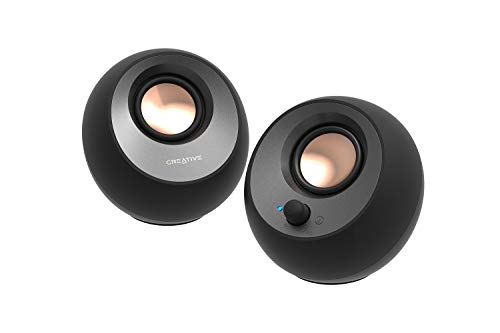
The Creative Pebble V3 is best for desk users who want clear spoken audio from a compact 2.0 speaker set. It is not described as an omnidirectional or wide-dispersion speaker, so it is a better fit for near-field listening than for filling a large room. Its placement and dialogue features make it a useful alternative when the main goal is intelligibility at a computer.
Creative lists 2.25-inch full-range drivers, a built-in gain switch, and up to 8 watts RMS with peak power up to 16 watts. The gain switch requires a 10-watt USB-C or USB-A port. Clear Dialog audio processing is intended to make speech easier to hear without unnecessarily raising volume, while USB-C provides a simple connection path. Bluetooth 5.0 is also included in the product name.
- Best for: Computer users watching videos, shows, or other dialogue-heavy content at a desk.
- Why it stands out: Clear Dialog processing and a gain switch address desktop listening needs.
- Consider: The amplified gain mode requires a sufficiently powered USB port; this is not the pick for broad outdoor coverage.
Choose the Pebble V3 when compact size, USB connectivity, and speech clarity matter more than room-filling dispersion.
Edifier R1280T Powered Bookshelf Speakers

The Edifier R1280T is best for people looking for powered bookshelf speakers with flexible wired connections and simple sound adjustment. Its product information does not claim 360-degree or wide dispersion, so it should not be treated as a specialist coverage speaker. It is included as a general listening choice for users who value a two-way design and straightforward controls.
The speakers use a 13mm silk-dome tweeter and a 4-inch full-range unit, with natural sound reproduction listed as a design goal. Two AUX inputs allow two devices with a 3.5mm headphone output or dual RCA output to connect at the same time. A remote controls volume, while bass and treble controls are located on the main speaker.
- Best for: Home or desk listeners who need two AUX-connected sources and tone controls.
- Why it stands out: It combines powered bookshelf convenience with multiple input and adjustment options.
- Consider: Its listed features do not identify a special wide-dispersion pattern.
Choose Edifier when connection flexibility and tone adjustment are more important than all-around coverage. For a dedicated surround or outdoor dispersion pattern, compare it with Fluance or OSD Audio instead.
Buying Guide: How To Choose Speakers With Wide Dispersion
What does wide dispersion mean for speakers?
Dispersion describes how sound spreads away from a speaker. A speaker with broad dispersion can make listening less dependent on sitting directly in front of it. The exact result depends on the speaker’s design, its placement, the room or outdoor area, and the listening distance. Look for a clearly stated pattern—such as bipolar or 360-degree—rather than assuming every bookshelf or desktop speaker spreads sound widely.
Different product descriptions use dispersion language for different purposes. Bipolar surrounds are intended to contribute to an enveloping theater field. An omnidirectional outdoor speaker is described as radiating around itself. A wide-dispersion midrange driver is one element of a multi-driver speaker, not necessarily a promise that the entire system covers every direction evenly.
Where will you use the speakers?
- Home theater: Consider a bipolar surround design such as the Fluance Elite SXBP2 when your goal is immersive effects around a listening area.
- Open outdoor area: The OSD Audio Forza is explicitly described as a 360-degree omnidirectional speaker.
- Patio or wall installation: The Pyle PLMR24 includes a mounting kit and a wide-dispersion midrange. Confirm that its placement and amplifier requirements suit the location.
- Computer desk: The Creative Pebble V3 prioritizes desktop use and dialogue clarity, rather than broad room coverage.
- General bookshelf listening: The Edifier R1280T offers powered operation, two AUX inputs, and bass and treble controls, but no special dispersion pattern is stated.
Do you need a pair or a single speaker?
A pair can provide left-right stereo or serve as a matching surround pair, depending on the model and system. A single omnidirectional speaker may be more suitable when the aim is to distribute sound around one outdoor location. Check whether the product listing describes a pair or an individual speaker, then plan the number and placement around the area you want to cover.
Should you choose powered or passive speakers?
Powered speakers have amplification built in, while passive speakers generally require an external amplifier or receiver. The Edifier R1280T and Creative Pebble products are identified as powered or USB desktop speakers in their names and supplied features. The supplied information for Fluance and Pyle does not fully specify amplification requirements. For the OSD Audio model, the listed 8-ohm and 70V transformer taps make system matching especially important. Confirm the connection and amplifier details for the chosen model before buying.
Which specifications should you compare?
- Dispersion pattern: Look for a stated bipolar, omnidirectional, or wide-dispersion feature relevant to your use.
- Speaker placement: Consider whether the unit is intended for a wall, shelf, desktop, or outdoor position.
- Connections: Compare AUX, USB, Bluetooth, speaker terminals, and transformer options only against the devices you plan to connect.
- Power and impedance: Match listed power and impedance details to the amplifier or system requirements. Do not compare peak power alone as a complete measure of loudness or performance.
- Environment: For outdoor use, favor a model whose description identifies weather resistance or outdoor use, and check installation guidance.
How can placement improve coverage?
Even a speaker designed for broad dispersion needs suitable placement. Keep the intended listening area in mind, and avoid placing speakers where walls, furniture, or other obstacles block the sound path. For stereo pairs, experiment with spacing and direction while keeping both speakers aimed toward the listening area as appropriate. Outdoor layouts may need more than one speaker to distribute sound across a large or irregular space; use the product’s installation instructions to plan placement.
Frequently Asked Questions
Which speaker in this list has 360-degree dispersion?
The OSD Audio Forza is described as an omnidirectional outdoor speaker with 360-degree dispersion. It is the clearest choice here for buyers seeking sound that spreads around a speaker.
Are bipolar speakers the same as omnidirectional speakers?
No. The Fluance Elite SXBP2 uses a bipolar radiation pattern for surround imaging. The OSD Audio Forza is described as omnidirectional with 360-degree dispersion. These terms refer to different speaker approaches and should not be used interchangeably.
Which option is best for outdoor use?
The OSD Audio Forza is described as weather-resistant and intended for outdoor audio. The Pyle PLMR24 is also listed for outdoor settings such as patios, decks, and poolside areas. Compare coverage style, mounting needs, and amplifier requirements before choosing.
Are desktop speakers suitable for filling a large room?
Desktop speakers such as the Creative Pebble V3 are designed around close listening at a computer. The supplied features do not describe them as wide-dispersion or room-filling models, so a dedicated surround or outdoor speaker may be a better match for larger spaces.
What should I check before connecting a speaker to an amplifier?
Check the speaker’s connection type, impedance, power information, and any transformer settings, then compare them with the amplifier’s specifications. This is particularly relevant for the Pyle PLMR24’s listed 4-ohm impedance and the OSD Audio Forza’s 8-ohm and 70V taps.