
Best Stand Alone Audio Interface for Home Studios and Beginners
Answering the question “which stand-alone audio interface best fits my setup?” this guide highlights five solid options for Mac, PC, and iOS users. Each choice is suited for different needs—from simple vocal demos to multi-instrument projects. The top picks emphasize pro-grade preamps, dependable converters, and user-friendly monitoring. This overview helps buyers identify who each device is best for, what to expect in recordings, and potential limitations to consider before buying. A quick summary table is provided to compare key features at a glance.
Product Comparison Snapshot
| Product | Best For | Key Strength | Limitations |
|---|---|---|---|
| Focusrite Scarlett Solo 3rd Gen | Beginners to small home studios | Air mode, high-headroom inputs | Two-in design may suit solo projects |
| PIYONE Audio Interface 2×2 | Compact setups with stylish design | USB-C, bus-powered, LED gain rings | Two channels only |
| MAONO PS22 Lite | Budget-friendly multi-use | 24-bit/192kHz, versatile inputs | Build quality varies by unit |
| M-AUDIO M-Track Duo | Podcasting and streaming | Dual inputs, zero-latency monitoring | Road-tested for basic tasks |
| Focusrite Scarlett 2i2 4th Gen | Creatives needing reliable dual-channel | Auto Gain, Clip Safe, high dynamic range | Two inputs limits larger setups |
Focusrite Scarlett Solo 3rd Gen USB-C Audio Interface

- Pro-level mic pre-amps with an Air mode for brighter recordings on acoustic instruments.
- Two high-headroom instrument inputs ensure guitar or bass shines without distortion.
- 24-bit/192kHz converters for studio-quality recording and mixing.
Best for: Solo singers, podcasters, and guitarist-vocalists who record one track at a time. The Air mode and solid preamps help voice and acoustic textures cut through a mix. A potential limitation is the two-input design, which may not suit multi-instrument sessions without a second interface or mixer.
PIYONE Audio Interface, 2X2 24-bit/192kHz

- USB-C class-compliant interface with bus power and driver-free plug-and-play setup.
- 24-bit/192kHz fidelity with two-channel depth for clean, low-noise recordings.
- Elegant LED-lit gain knobs for visibility in dim studios.
Best for: Mac or PC users who want a compact, stylish interface with reliable performance for voice and instrument work. Choose this if you value simple setup and modern aesthetics. Limitation: only two channels, which may constrain larger projects.
MAONO PS22 Lite USB Audio Interface

- Records at 24-bit/192kHz with a dynamic range of 106dB for clear, realistic sound.
- Supports condenser and dynamic mics with up to 56 dB of preamp gain and 48V phantom power.
- Dedicated instrument input and impedance adjustments for guitar sounds.
Best for: Budget-conscious creators who need flexible mic support and good vocal/guitar fidelity. Better for simple podcasting or music demos. Limitation: build quality and feature set are geared toward entry-level users.
M-AUDIO M-Track Duo USB Audio Interface

- Two combo XLR/Line/Instrument inputs with phantom power for versatile recording.
- 48kHz recording for clean, consistent results across podcasts and music.
- Zero-latency monitoring with USB/Direct switch for precise control during takes.
Best for: Podcasters and home studios needing straightforward dual-channel recording and monitoring. It’s a dependable choice for voice work or guitar/vocal demos. Limitation: not built for high-channel-count projects or complex live setups.
Focusrite Scarlett 2i2 4th Gen USB-C Audio Interface
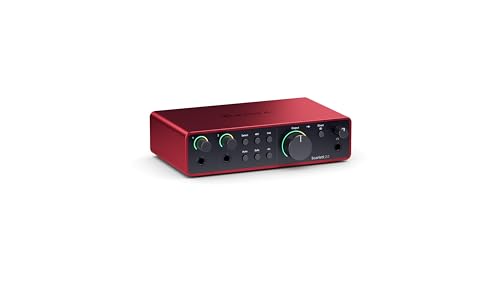
- New 4th Gen design with Auto Gain and Clip Safe technology for easier setup.
- 126 dB dynamic range with premium converters for studio-like results.
- Seamless software integration and reliable mic preamps for vocals and instruments.
Best for: Creators who need dependable dual-input recording with smart gain features and robust dynamic range. Better for projects requiring quick setup and repeatable results. Limitation: two inputs may not cover larger multi-instrument sessions without additional gear.
Buying Guide
What should you prioritize in a stand-alone audio interface?
Key factors include input count, preamp quality, dynamic range, latency, and compatibility. If you record vocals and a guitar at the same time, prioritize two inputs with solid mic preamps. For solo performers, a single-channel device with a clear Air or gain control may suffice. Consider whether you need USB-C power or bus power, and check compatibility with your computer, DAW, and any mobile devices you intend to use.
Which features matter most for different workflows?
- Songwriting and demos: Look for auto-gain, low-latency monitoring, and straightforward gain controls.
- Home studio multi-instrument: Prefer two or more inputs, high dynamic range, and reliable converters.
- Podcasting and streaming: Favor interfaces with good vocal preamps, direct monitoring, and easy headset/monitor routing.
How to choose between USB-C and USB-A interfaces?
USB-C interfaces typically offer broader compatibility with newer laptops and faster data transfer. They also tend to power more efficiently on modern devices. If your computer has USB-C, a USB-C powered interface can simplify cabling. If you rely on an older system or adapters, a USB-A interface remains a solid option as long as it meets your needs.
What about price vs. performance?
Budget interfaces often deliver reliable sound and basic functionality for beginners. Higher-priced models usually add features like higher dynamic range, better preamps, and smarter gain controls. For stand-alone use, weigh how often you’ll need multi-input setups or advanced monitoring versus your core recording goals.
What about compatibility and drivers?
Many modern interfaces are class-compliant, requiring no drivers with macOS or Windows. If you’re on an older OS or need specific software, verify driver availability and DAW compatibility before purchase.
What common limitations should be anticipated?
- Two-input limits for some models may necessitate external mixers for larger projects.
- Build quality and feature depth can vary in budget units; ensure road readiness for travel.
- Some interfaces rely on computer power for bus-powered operation; check your device’s power requirements.
FAQ
- Q: Do I need an audio interface if I already have a USB microphone?
- Q: Is USB-C essential for a stand-alone interface?
- Q: How many inputs should I start with?
- Q: Can I record in 24-bit/192kHz with all these interfaces?
- Q: Do I need external software to use these interfaces?
A: If you want to record instrument inputs in addition to the mic, an interface provides the necessary inputs and preamps. A USB microphone can simplify setups but limits expandability.
A: Not essential, but USB-C offers broader compatibility with newer laptops and potential power efficiency advantages. USB-C models are increasingly common and future-proof.
A: For solo vocal work, one or two inputs are enough. If you plan to record guitar and voice simultaneously or add a bass, two to four inputs are practical.
A: Yes, the majority of listed models support 24-bit/192kHz, delivering professional fidelity for both music and podcast applications.
A: Many interfaces are plug-and-play with popular DAWs. Some models bundle software, but most require minimal additional setup beyond drivers (where applicable).