
The best stereo amplifier with HDMI depends on whether you need simple TV audio through HDMI ARC or a full home theater receiver with HDMI video switching. The Inwa is best for a compact two-channel setup, while the Yamaha and Denon are better for surround sound and modern video features. The Pyle PDA9HBU suits listeners who want many inputs, including phono, and the Rockville BLUAMP 90 combines HDMI ARC with stereo and microphone connections.
| Product | Best For | HDMI Capability |
|---|---|---|
| Inwa Bluetooth Audio Stereo Amplifier | Compact two-channel audio | HDMI ARC |
| Yamaha RX300A | Surround sound and newer video formats | HDMI eARC/ARC and video switching |
| Denon AVR-S570BT | 5.1 surround sound and gaming | 8K HDMI inputs and eARC |
| Pyle PDA9HBU | Broad input selection and turntables | HDMI input and output |
| Rockville BLUAMP 90 | Two-channel audio with microphone inputs | HDMI ARC |
Inwa Bluetooth Audio Stereo Amplifier

Best for: A compact, two-channel system that connects to a TV through HDMI ARC and also handles music from wireless or wired sources.
The Inwa is a 2.0-channel mini amplifier rated at 100 watts RMS per channel at 4 ohms, according to the supplied product details. Its HDMI ARC connection is designed to bring TV audio to the amplifier without requiring a multichannel home theater receiver. Other listed inputs include optical, coaxial, USB, AUX, and Bluetooth 5.3.
Choose this model if your priority is stereo playback, a small setup, and several ways to connect source devices. Bluetooth is listed with a range of up to 50 feet under suitable conditions. Bass and treble controls and an LED display provide basic front-panel adjustment and status information.
Limitation: This is a two-channel amplifier, not a surround sound receiver. Its HDMI feature is ARC; the supplied information does not describe HDMI video switching.
Yamaha RX300A 5.2-Channel Receiver

Best for: Buyers who want HDMI video switching, immersive audio formats, and the option to build beyond a two-speaker stereo setup.
The Yamaha RX300A is a 5.2-channel AV receiver with Dolby Atmos, DTS Virtual:X, and listed support for speaker layouts including 3.1.2 with up-firing or in-ceiling height speakers. The product details specify 70 watts of power and HDMI support for 4K at 120 Hz and 8K at 60 Hz. It also lists Dolby Vision, HDR10+, eARC/ARC, ALLM, and VRR.
This receiver is a better fit than a compact stereo amp when your TV, streaming equipment, or game system needs HDMI switching and you plan to use multiple speakers. Bluetooth Multipoint is also listed for wireless audio connections. The receiver’s surround formats and flexible speaker layouts make it the most theater-oriented choice in this group.
Limitation: A 5.2-channel receiver may be more equipment than needed for a basic two-speaker setup. Confirm that the receiver’s HDMI features and speaker layout match the rest of your system before choosing it.
Denon AVR-S570BT 5.2-Channel AV Receiver

Best for: Home theater and gaming systems that need multiple HDMI sources, 8K video support, and up to 5.1-channel surround sound.
The Denon AVR-S570BT provides 70 watts per channel across five channels, according to the listing. It includes four HDMI 2.1 inputs and one HDMI output, with eARC listed up to 40 Gbps. Supported video features include 8K, HDR, HLG, Dolby Vision, HDR10+, VRR, and QFT. For audio, the product details identify Dolby TrueHD, DTS-HD Master Audio, and 5.1 surround sound.
Choose this receiver if you want a central hub for multiple HDMI devices and a path to surround sound, rather than a simple stereo amplifier. Built-in Bluetooth supports wireless music playback, and the listing names services including Spotify, TIDAL, and Pandora as possible music sources through connected devices.
Limitation: This is a multichannel AV receiver, so it may be unnecessarily complex if you only need two-channel TV sound. Check the exact speaker and source-device requirements for your setup.
Pyle PDA9HBU Home Stereo Amplifier
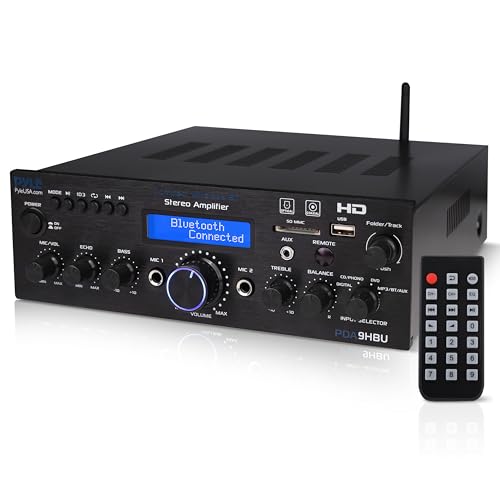
Best for: Users who want a wide mix of analog, digital, wireless, and removable-media inputs, including a direct connection for a turntable.
The Pyle PDA9HBU lists HDMI input and output with 4K and 3D video passthrough. Its other connections include optical, coaxial, phono, CD/DVD RCA, AUX, USB, SD, Bluetooth, and FM radio. A built-in RIAA phono preamp is included, allowing a compatible turntable to connect directly without a separate phono preamp.
This model stands out for input variety. Choose it if you want to switch among a TV, turntable, radio, Bluetooth device, and USB or SD playback from one receiver. The listing says its 11 input modes can be selected from the front panel or remote. Digital optical and coaxial decoding is specified as 16-bit.
Limitation: The HDMI details describe one input and one output with 4K/3D passthrough, not the newer 4K/120 Hz or 8K capabilities listed for the Yamaha and Denon. Verify that this passthrough is sufficient for your video equipment.
Rockville BLUAMP 90 Stereo Receiver

Best for: A two-channel system that needs HDMI ARC, Bluetooth, USB or SD playback, and microphone inputs.
The Rockville BLUAMP 90 lists 60 watts RMS total as 30 watts per channel at 8 ohms, or 50 watts per channel at 4 ohms. Connections include HDMI ARC, Bluetooth 5.0, optical, phono, RCA, and two 1/4-inch microphone inputs. USB and SD playback support WAV, MP3, and WMA files.
Choose this amplifier if you want stereo playback with a TV connection and additional options for a turntable, mobile device, or microphones. It is a more specialized alternative to the Inwa: the listed microphone inputs and phono connection may suit a mixed music and karaoke setup, while HDMI ARC handles TV audio.
Limitation: HDMI ARC is listed, but the supplied information does not specify HDMI video switching or surround sound decoding. The stated output is stereo, so choose a multichannel receiver if you need a home theater speaker layout.
Buying Guide: How to Choose a Stereo Amplifier With HDMI
Do you need HDMI ARC, eARC, or HDMI switching?
These terms describe different capabilities. HDMI ARC sends audio from a compatible TV to an amplifier or receiver over an HDMI connection. HDMI eARC is also an audio-return connection, and the Yamaha and Denon listings specify it. HDMI switching means the receiver accepts HDMI sources and passes video to a display. The Pyle PDA9HBU lists an HDMI input and output, while the Inwa and Rockville list HDMI ARC.
Check the labels on both the TV and the amplifier. An ARC connection requires compatible ARC ports and a suitable HDMI cable. If you plan to connect a game console or streaming device to the amplifier and send video onward to the TV, confirm that the receiver has the required HDMI inputs and video format support. ARC alone should not be treated as evidence of HDMI video switching.
Should you choose a stereo amplifier or an AV receiver?
A stereo amplifier is generally the simpler choice when you use two speakers for music and TV sound. The Inwa and Rockville are two-channel options. They focus on stereo playback and provide HDMI ARC along with other audio connections.
An AV receiver is better suited to a system with several speakers, surround formats, and multiple video sources. The Yamaha and Denon are listed as 5.2-channel receivers, with features such as Dolby Atmos or 5.1 surround support. Consider the room, speaker count, and desired listening setup before paying for capabilities you may not use.
Which HDMI video features should you compare?
Match the receiver’s video specifications to the devices and display in your system. For example, the Yamaha listing specifies 4K/120 Hz and 8K/60 Hz, alongside ALLM and VRR. The Denon listing includes 8K HDMI 2.1 inputs and gaming features such as VRR and QFT. The Pyle PDA9HBU lists 4K and 3D passthrough.
Do not assume every HDMI input supports every listed format. Review the product’s full input-by-input specifications if you need a particular resolution, refresh rate, HDR format, or gaming feature. Also check whether the TV and source device support the same formats.
How many inputs and speaker channels do you need?
Count the equipment you will connect before selecting a model. A TV, turntable, game console, disc player, and phone may each require a different connection. The Pyle PDA9HBU has a particularly broad listed input selection, including phono, optical, coaxial, USB, SD, and Bluetooth. The Inwa also supports several audio sources, including USB, AUX, optical, coaxial, HDMI ARC, and Bluetooth.
Next, decide how many speaker channels the system needs. A two-channel amplifier supports left and right stereo speakers. A 5.2-channel receiver is designed for a larger surround setup. Check the amplifier’s speaker specifications and your speakers’ requirements rather than relying only on a large wattage figure.
What should you know about power ratings?
Compare power ratings only when the measurement conditions are clear. The Inwa listing states 100 watts RMS per channel at 4 ohms, and the Rockville listing gives output figures at both 8 ohms and 4 ohms. Yamaha and Denon each list 70 watts per channel in their supplied details. These figures are not always directly comparable unless the measurement conditions, channel count, and impedance are alike.
Room size, speaker sensitivity, listening distance, and desired volume also affect the power you need. Avoid choosing solely by a peak-power number, which may not describe continuous output. Confirm that the amplifier’s supported speaker impedance is appropriate for your speakers.
When do Bluetooth, phono, and USB matter?
Bluetooth is useful for streaming from a phone or tablet without a cable. Bluetooth versions vary across these products: the Inwa lists Bluetooth 5.3, the Rockville lists Bluetooth 5.0, and the Yamaha lists Bluetooth Multipoint. These features do not replace HDMI for TV audio, but they can add convenience for music playback.
A phono input or built-in phono preamp matters if you use a turntable that needs one. The Pyle PDA9HBU specifically lists a built-in RIAA phono preamp, while the Rockville lists a phono connection. For USB or SD playback, verify the supported file formats and storage limits in the complete product documentation if those features are important.
Frequently Asked Questions
Can a stereo amplifier with HDMI connect directly to a TV?
Yes, if the amplifier and TV have compatible HDMI ARC or eARC ports. Connect the ports marked ARC or eARC and enable the corresponding audio-return settings on the TV. A model with HDMI ARC does not necessarily offer HDMI inputs for other video devices.
Is HDMI ARC enough for a two-speaker setup?
HDMI ARC can be enough when your goal is to send TV audio to a two-channel amplifier. The Inwa and Rockville list HDMI ARC. Confirm that your TV supports ARC and check the audio formats the amplifier accepts if you use external streaming or disc devices.
Can these amplifiers provide surround sound?
The Inwa and Rockville are listed as stereo products, so their supplied details describe two-channel playback. The Yamaha and Denon are multichannel AV receivers, with the Yamaha listing Dolby Atmos and the Denon listing 5.1 surround sound. Match the receiver to the number and layout of speakers you intend to install.
Which option is best for a turntable?
The Pyle PDA9HBU is the clearest choice in this list for a turntable because its features specify a built-in RIAA phono preamp. The Rockville also lists a phono connection. Check your turntable’s output type and the receiver’s input requirements before connecting it.
Does HDMI ARC carry video from the amplifier to the TV?
ARC is primarily an audio-return feature: it sends TV audio to an audio system. To route video from a source device through a receiver, look for HDMI inputs and an HDMI output with the required video passthrough specifications. The Pyle PDA9HBU, Yamaha RX300A, and Denon AVR-S570BT list HDMI video capabilities, while ARC is the stated HDMI feature for the Inwa and Rockville.