Best Stereo Speaker Selector Switches for Home Audio
Stereo speaker selector switches let you route one amplifier to multiple speaker pairs, compare amplifiers, or split outputs safely. Below is a quick comparison of popular options selected for home audio use, followed by detailed product sections and a practical buying guide.
| Product | Brand | Key Feature |
|---|---|---|
| Pyle 4-Zone Speaker Switch Selector – PSS4 | Pyle | SPEAKER SELECTOR (4 pairs) |
| Pyle 6 Zone Channel Speaker Switch – PSS6 | Pyle | Up To 6 Separate Speaker Pairs |
| Pyle PSLSW4 Multi Zone Speaker Selector | Pyle | 100W Max Per Channel, Independent Volume |
| Kurrent Electric A/B A+B 1 In – 2 Out Switch | Kurrent Electric | 2-Way A, B Or A+B Metal Panel |
| SOLUPEAK P2 2-In/2-Out Speaker Switcher | SOLUPEAK | 2-IN-1-OUT Or 1-IN-2-OUT Passive Switch |
Pyle 4-Zone Speaker Switch Selector – PSS4
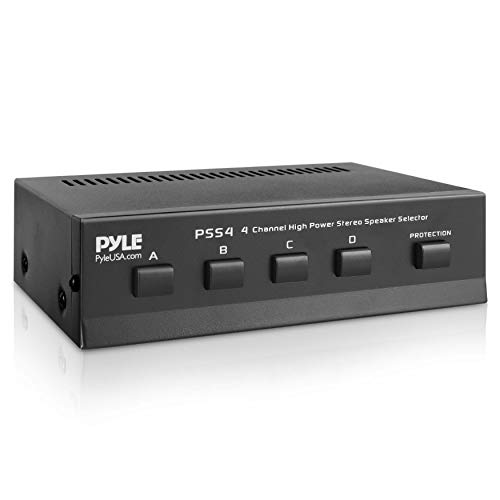
This Pyle PSS4 is a compact distribution box designed to connect a single stereo amplifier to up to four pairs of speakers. The unit provides individual push-button switches for each zone, allowing easy selection of which speaker pairs are active. The selector is intended for straightforward multi-room setups or situations where you want to switch speaker sets without swapping wires. Features emphasize physical switching and distribution rather than per-zone volume control.
Pyle Home 6 Zone Channel Speaker Switch – PSS6

The Pyle PSS6 expands capacity to six speaker pairs, suitable for larger homes or multi-room audio installations. The device uses a distribution hub design with labeled switches for each channel. It is targeted at users who need to route a stereo amp to many zones while keeping wiring centralized. This model focuses on channel selection and simplicity rather than advanced impedance protection circuitry.
Pyle PSLSW4 Multi Zone A B Speaker Distribution Controller
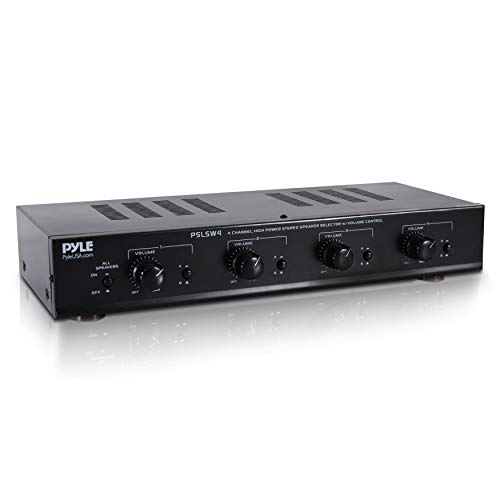
The Pyle PSLSW4 is a more feature-rich tabletop selector with independent volume controls per channel and 100W max power per channel (for 8Ω speakers). It supports up to four speaker pairs and uses screw terminals for secure wiring. This model is suitable when you want per-zone level adjustment in addition to on/off selection. Screw terminals accept up to 14AWG wire and the unit is built for home theater stereo receiver systems.
Kurrent Electric A/B A+B 1 In – 2 Out Stereo Switch
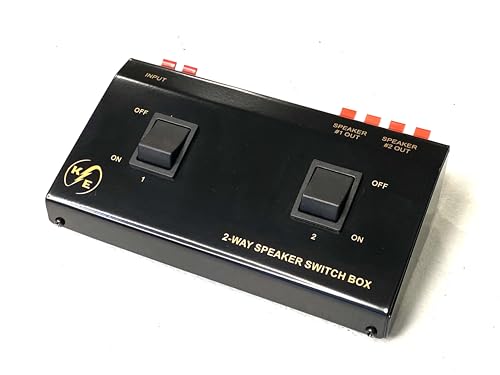
This Kurrent Electric panel is a simple 1-in, 2-out A/B speaker selector that lets you choose set A, set B, or both (A+B). It is a sturdy metal construction intended for basic switching when you want to route one amplifier to two speaker pairs or compare two speaker sets. The design is minimal—no active electronics—making it a passive, low-complexity solution for installers who prefer wall- or panel-mounted switching.
SOLUPEAK P2 2-In/1-Out Or 1-In/2-Out Speaker Switcher
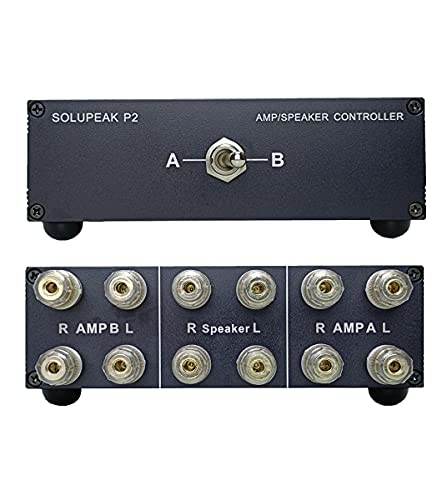
The SOLUPEAK P2 is a compact passive switcher that supports reversible routing: 2 amplifiers to 1 speaker pair (2-in-1-out) or 1 amplifier to 2 speaker sets (1-in-2-out). It uses gold-plated banana jacks and accepts up to 12AWG wires. This unit is useful for quick A/B amplifier or speaker comparisons and for setups where simultaneous operation of both outputs is not required. The device is plug-and-play with no external power.
ADWITS 2-Channel Speaker Switcher Selector Box

The ADWITS 2-channel selector allows two pairs of speakers to be used with one amplifier, with the option to play either pair or both simultaneously. It is designed for low-cost distributed audio applications in homes or small commercial spaces. Terminal clamps make wire connections straightforward, and the unit supports simple A/B or A+B configurations without advanced protection features.
Pyle PSLSW6 6 Channel Speaker Selector With Volume

The Pyle PSLSW6 extends the PSLSW4 concept to six pairs and includes independent volume controls. Rated at 100W max per channel for 8Ω speakers, this controller is intended for larger multi-room setups where per-zone level control is needed. Screw terminals accept up to 14AWG wiring for secure connections and the tabletop design keeps installation simple.
Pyle PSPVC6 6 Zone Volume Control Speaker Distribution Box
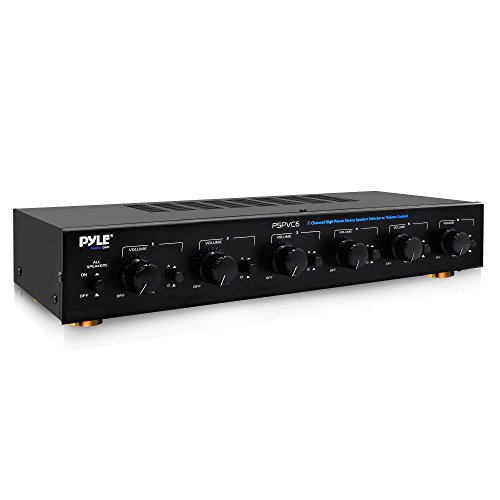
The PSPVC6 focuses on distributing amplifier output to six zones and includes integrated volume controls. It is marketed as a 6-zone distribution hub for higher-powered amplifiers. Features are oriented to installers who require multiple controlled outputs in one compact box.
Buying Guide: How To Choose A Stereo Speaker Selector Switch
Choosing the right speaker selector depends on your system size, required features, and safety considerations. Below are the key factors to evaluate.
Number Of Zones
Determine how many speaker pairs you need to connect now and in the future. Selectors range from simple 1-in/2-out panels to distribution hubs supporting 4–6 pairs. Leave room for expansion when possible.
Power And Impedance Handling
Check the selector’s power rating and supported speaker impedance (commonly 4Ω or 8Ω). Match these to your amplifier and speakers to avoid damage. Some passive selectors list per-channel wattage (e.g., 100W per channel for 8Ω); this indicates safe handling under typical loads.
Volume Control Per Zone
If you need different listening levels in different rooms, choose a model with independent volume controls. Passive on/off selectors are cheaper but require amplifier volume changes to adjust across zones.
Impedance Protection And Switching Method
More advanced selectors include impedance protection or impedance-matching circuitry to prevent overloading your amplifier when multiple speaker pairs are active. Basic passive switches may not protect against low total impedance—consider a model with protection if you intend to run many pairs at once.
Connection Type And Wire Gauge
Look at terminal types: screw terminals, banana jacks, or binding posts. Ensure they accept your speaker wire gauge (common acceptance ranges are 14–12 AWG). Secure connections reduce signal loss and heat buildup.
Use Case: A/B Testing Or Multi-Room
For quick amplifier or speaker comparisons, an A/B or reversible 2-in/1-out unit is ideal. For whole-home distribution, choose multi-zone selectors with clear labeling and zone controls.
Build Quality And Mounting
Metal panel switches suit in-wall or panel installations; tabletop units offer portability. Check for robust switch mechanisms and clear labeling for easier daily use.
Passive Vs. Active (Powered) Units
Most speaker selectors are passive and simple to install. Active or powered distribution units can include impedance protection and buffering but are more complex and often pricier. Match your needs and budget.
Safety And Practical Considerations
- Ensure the total load presented to the amplifier stays within its safe operating range.
- Use impedance-matching pads or protection if you plan to run many zones simultaneously.
- Label wiring during installation to avoid miswiring multiple zones.
Comparison Perspectives
Compare options by capacity (2 vs 4 vs 6 pairs), features (volume control, impedance protection), and connection type. For basic A/B switching, compact metal panels suffice. For multi-room audio with per-zone control, choose a 4–6 zone selector with independent volume knobs and secure terminals.