
The best stereo speakers and subwoofer setup depends on where you plan to listen and whether you want a complete 2.1 system or stereo speakers that can connect to a separate subwoofer. The Cyber Acoustics CA-3090 is best for a straightforward PC setup, while the Bluedee is better for desktop buyers who want Bluetooth and several connection options. The powered bookshelf models suit turntables, TVs, and mixed-use listening; the Polk T15 is a passive speaker pair for building a home theater system.
| Product | Best For | Subwoofer Included? |
|---|---|---|
| Cyber Acoustics CA-3090 | Simple computer audio | Yes, according to the product name |
| Bluedee 2.1 PC Speakers | Flexible desktop connections | Yes, according to the product name |
| Powered Bookshelf Speakers, 40W*2 | Turntables, TVs, and computers | Not specified in the product name |
| Pyle Powered Bookshelf Speakers | Stereo listening with subwoofer output | Not specified; subwoofer output is listed |
| Polk Audio T15 | Expandable home theater audio | No subwoofer listed |
Cyber Acoustics CA-3090 2.1 Speaker System

The Cyber Acoustics CA-3090 is best for someone who wants a compact computer speaker setup with a separate subwoofer. Its product name identifies it as a 2.1 PC speaker system with 18 watts of power, a 3.5 mm audio connection, a volume control pod, and adjustable subwoofer bass. The stated uses include music, movies, and gaming.
Choose this system if a basic wired PC connection and accessible volume control matter more than Bluetooth or a wide range of inputs. The 3.5 mm connection offers a simple way to connect a compatible audio source, while the subwoofer provides a dedicated bass component in the set.
- Best for: Desktop users seeking a named 2.1 system for everyday audio.
- Why it stands out: The listed features include a subwoofer, volume control pod, and adjustable bass.
- Limitation: The provided product information lists a 3.5 mm connection, not wireless connectivity or additional input types.
Bluedee 2.1 PC Speakers With Subwoofer

The Bluedee 2.1 PC speaker system is best for desktop listeners who want several ways to connect their audio devices. Its product name lists Bluetooth 5.4, USB, USB-C, and AUX inputs, along with an adapter-powered design, DSP-tuned sound, an RGB feature, and 80-watt peak power. It is described as a system for laptops and monitors.
Choose this model if your desk setup may use wired and wireless sources, or if you want a subwoofer as part of a computer speaker package. The connection variety is its clearest distinction from the simpler 3.5 mm-only system in this selection. The listed peak-power figure is not the same as a stated continuous power rating.
- Best for: PC users who value Bluetooth and multiple listed connection options.
- Why it stands out: Its name specifies a 2.1 configuration, subwoofer, and USB, USB-C, AUX, and Bluetooth connections.
- Limitation: It is described as adapter powered, so it is not presented as a battery-powered portable speaker system.
Powered Bookshelf Speakers With Multiple Inputs
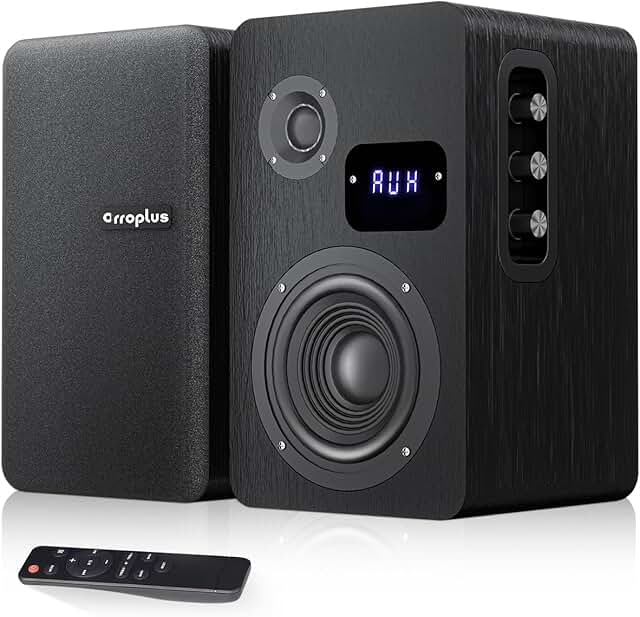
These powered bookshelf speakers are best for buyers who want stereo sound across more than one type of source. The product name lists 40 watts per channel, a 4-inch woofer, and optical, ARC, RCA, AUX, and Bluetooth connections. It is described for turntables, TVs, desktop computers, and vinyl record players.
Choose this pair if your audio setup needs to connect to a TV and another source, or if you want Bluetooth alongside wired inputs. Because the speakers are identified as powered, they are described as an active speaker system rather than a passive pair that requires a separate power amplifier. The listing name does not confirm that a subwoofer is included.
- Best for: Mixed-use listening with a turntable, TV, or computer.
- Why it stands out: It lists several input types and a 4-inch woofer in a powered stereo pair.
- Limitation: A subwoofer is not specified as part of the package; confirm the included components if you require a complete 2.1 system.
Pyle Powered Bookshelf Speakers With Subwoofer Output

The Pyle powered bookshelf speaker system is best for buyers seeking active stereo speakers with Bluetooth and a listed subwoofer output. Its product name specifies 80-watt active stereo speakers, a bass-reflex natural-wood cabinet, and ARC, optical, and coaxial connections. It is described for entertainment and studio use.
Choose this pair if you want stereo speakers that list several connection formats and provide a subwoofer output for a possible separate bass component. That output is useful to note when comparing this product with systems that explicitly include a subwoofer. The name says “subwoofer out,” but does not say a subwoofer comes in the box.
- Best for: Users who want powered stereo speakers and the option to connect a separate subwoofer.
- Why it stands out: The product name lists Bluetooth, ARC, optical, coaxial, and subwoofer output.
- Limitation: Do not assume the system includes a subwoofer; the product information provided identifies an output, not an included subwoofer.
Polk Audio T15 Passive Bookshelf Speakers

The Polk Audio T15 pair is best for buyers starting a home theater system that they may expand later. These are passive bookshelf speakers with a 0.75-inch tweeter and 5.25-inch Dynamic Balance driver. The listed features include wall mounting, use as front, left-right, or rear speakers, and compatibility with Dolby and DTS surround formats as part of an appropriate system.
Choose the T15 if you need a passive speaker pair for a receiver-based setup and value the option to add other home theater components later. Polk lists T50 towers, a T30 center channel, and a subwoofer as possible additions to a larger 5.1 setup. The T15 is not a complete 2.1 system by itself.
- Best for: Home theater beginners planning a system they can expand.
- Why it stands out: It is wall-mountable and can serve in multiple positions in a surround setup.
- Limitation: These passive speakers need an appropriate amplifier or receiver, and no subwoofer is listed as included.
Buying Guide: How To Choose Stereo Speakers And A Subwoofer
Start by deciding whether you need a complete 2.1 system or stereo speakers that can connect to a subwoofer separately. In a 2.1 setup, “2” refers to the left and right speakers and “.1” refers to the subwoofer channel. Product names that explicitly say 2.1 and include a subwoofer are the clearest options for buyers who want the bass component in the same package.
Do you want a subwoofer included?
Check the product description for language that says a subwoofer is included. The Cyber Acoustics and Bluedee product names identify their systems as 2.1 speakers with a subwoofer. By contrast, the Pyle product name lists a subwoofer output, which is a connection point and does not establish that a separate subwoofer is supplied. The powered bookshelf and Polk listings do not identify an included subwoofer in the supplied product details.
Which connections do your devices need?
Match the speaker inputs to the devices you actually plan to use. A 3.5 mm connection is listed for the Cyber Acoustics system. The Bluedee name lists Bluetooth, USB, USB-C, and AUX. The powered bookshelf options list various combinations of Bluetooth, RCA, optical, ARC, coaxial, or AUX. Verify the exact input required by your TV, computer, turntable, or other source before choosing.
Should you choose powered or passive speakers?
Powered speakers have amplification built into the speaker system, while passive speakers need an appropriate external amplifier or receiver. The Pyle and 40W*2 bookshelf models are identified as powered or active. The Polk T15 is explicitly described as passive. Account for this difference when comparing setup complexity, equipment already on hand, and the number of components you intend to use.
What matters for desktop listening?
For a desk, consider the space available for two speakers and a subwoofer, the location of your computer or monitor, and how you prefer to control volume. The Cyber Acoustics product name specifically lists a volume control pod. The Bluedee lists a desktop-oriented design with several connection types and an RGB feature. These details may help distinguish them, but the provided information does not state their precise dimensions.
What should turntable and TV buyers check?
Turntable and TV connections are not interchangeable in every setup. The powered bookshelf product name specifically describes turntable and TV use and lists RCA, optical, and ARC inputs, among others. Check the source device’s output and the speaker’s listed input before buying. For a passive pair such as the Polk T15, make sure your planned system includes an appropriate receiver or amplifier.
How should you compare power claims?
Read the power figure as it is written rather than assuming that all wattage figures describe the same measurement. The Bluedee name says 80 watts peak power, while the Pyle name specifies 80-watt active stereo speakers and the powered bookshelf name lists 40 watts per channel. The Cyber Acoustics name gives an 18-watt system figure. These product names do not provide enough detail to make a direct loudness comparison.
How much room and bass adjustment do you need?
A 2.1 system uses a separate subwoofer, so plan space for that component as well as the left and right speakers. The Cyber Acoustics product name says its subwoofer bass is adjustable. For other products, check the full listing for details about placement, adjustment controls, and included accessories. Do not infer cabinet size or bass performance beyond what the product information states.
Frequently Asked Questions
What does 2.1 mean for stereo speakers?
A 2.1 system has two main speakers for left and right audio plus a subwoofer channel. Confirm that the subwoofer is included if you want a ready-to-use package.
Are bookshelf speakers always sold with a subwoofer?
No. “Bookshelf speakers” describes a speaker style, not a guaranteed package configuration. Check whether the listing says a subwoofer is included or only mentions a subwoofer output.
Can passive speakers work without a receiver or amplifier?
Passive speakers such as the Polk T15 require an appropriate amplifier or receiver to operate. Powered speakers have amplification built into the system.
Which product is best for a basic computer setup?
The Cyber Acoustics CA-3090 is a straightforward choice based on its listed 2.1 PC design, 3.5 mm connection, volume control pod, and subwoofer.
Which speakers offer the most listed connection types?
The powered bookshelf model lists optical, ARC, RCA, AUX, and Bluetooth. The Bluedee lists Bluetooth, USB, USB-C, and AUX. Compare those inputs with the outputs on your own devices.
Does a subwoofer output mean a subwoofer is included?
No. A subwoofer output indicates a connection for a subwoofer. It does not establish that one is included in the package.