
The best subwoofer for a surround sound system depends on whether you need a standalone bass speaker or a complete soundbar package. The Polk Audio PSW10 is a practical pick for small-to-mid-size rooms, while the REL HT/1510 is designed for larger spaces and deeper bass. The ULTIMEA, Saiyin, and LG options bundle a subwoofer with a soundbar system, making them better suited to buyers starting with a more complete TV audio setup.
| Product | Best For | Type |
|---|---|---|
| Polk Audio PSW10 | Small-to-mid-size rooms | Powered standalone subwoofer |
| REL HT/1510 Predator | Large rooms and deep bass | Powered standalone subwoofer |
| ULTIMEA Poseidon M60 | Compact Atmos-style setup | Soundbar system with wired subwoofer |
| Saiyin Sound Bar with Subwoofer | Basic TV, PC, or music use | Soundbar system with subwoofer |
| LG S40TR | Surround sound with rear speakers | Soundbar system with wireless subwoofer |
Polk Audio PSW10 10-Inch Subwoofer

The Polk Audio PSW10 is a powered subwoofer with a 10-inch Dynamic Balance woofer, a directed port, and a built-in amplifier rated at 50 watts RMS and up to 100 watts of power. Its feature description identifies it as a fit for small-to-mid-size rooms and says it is designed to add bass to music and movies.
Best for: Buyers who already have a surround receiver or speaker system and want a separate subwoofer for added low-frequency impact. The compact-room positioning makes it a reasonable option when a very large subwoofer would be excessive.
Why it stands out: The integrated amplifier means the subwoofer is powered, and the 10-inch driver offers a straightforward upgrade path for systems that need more bass. The manufacturer also describes it as able to blend with different speakers, though buyers should check their receiver’s subwoofer output and connection requirements.
Limitation: The product information does not provide a stated low-frequency extension or wireless connection. It is also listed as not waterproof, so it is intended for indoor use.
REL HT/1510 Predator 15-Inch Subwoofer

The REL HT/1510 Predator is a powered 15-inch subwoofer aimed at premium home theaters, stereo systems, and surround sound setups. REL lists bass output down to 20 Hz at -6 dB and says the model is suited to listening spaces up to 800 square feet.
Best for: Buyers with a large listening room who want a substantial dedicated subwoofer. Its large driver and stated low-frequency performance make it better suited to deep, forceful bass than a compact subwoofer intended for a smaller room.
Why it stands out: The product is explicitly positioned for both home theater and stereo use. REL also notes that a stereo pair can be used for an elevated experience or greater impact in larger spaces. It is available in black and white, according to the supplied product details.
Limitation: Its large 15-inch design may be more than a small room or modest system needs. Before buying, confirm the subwoofer’s connection options and placement requirements work with the existing receiver or audio system; the supplied details do not specify those connections.
ULTIMEA Poseidon M60 5.1 Soundbar System

The ULTIMEA Poseidon M60 is a complete 5.1-channel soundbar system with a dedicated wired wooden subwoofer. The listed features include Dolby Atmos, five built-in speakers with two side-firing drivers, up to 300 watts of peak power, and a stated frequency response of 45 Hz–18 kHz. VoiceMX processing is designed to make dialogue clearer.
Best for: Buyers who want a single coordinated soundbar package rather than a standalone subwoofer to add to a receiver-based surround system. It may suit people seeking surround-style audio without separate rear speakers, since its listed design uses built-in speakers and side-firing drivers.
Why it stands out: This system combines the soundbar, surround processing, and wired subwoofer in one package. Its voice-enhancement feature and stated setup time of less than one minute may appeal to buyers prioritizing easy installation and clear dialogue.
Limitation: The subwoofer is wired, so placement depends on routing its cable. This is a complete soundbar system, not a standalone subwoofer for pairing with an existing surround receiver. Check the TV’s available connections and the system’s specifications before purchase.
Saiyin Sound Bar With Dedicated Subwoofer
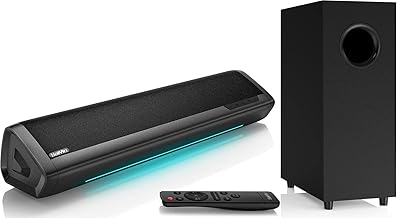
The Saiyin package combines a soundbar and dedicated subwoofer for TV, PC, and home entertainment use. Its feature list highlights a large-cavity subwoofer, three equalizer modes for news, movies, and music, and LED indicators for optical, Bluetooth, and auxiliary connection modes.
Best for: Buyers who want a simple soundbar-and-subwoofer package for everyday TV, computer, or music listening. The three equalizer modes provide a basic way to select a sound profile for different kinds of content.
Why it stands out: Its connection-mode lights make it easier to identify whether the soundbar is using optical, Bluetooth, or auxiliary input. The volume progress indicator also shows the soundbar’s volume level, while the product description says the soft lighting is intended to avoid distracting viewers.
Limitation: The supplied details do not identify this as a discrete 5.1-channel system or provide subwoofer output specifications. The included remote is not compatible with universal or TV remotes, according to the product information. It is a bundled audio system, not an add-on subwoofer for an existing receiver.
LG S40TR 4.1-Channel Soundbar System

The LG S40TR is a 4.1-channel soundbar package that includes a wireless subwoofer and wireless rear speakers. Its listed features include Dolby Audio, Dolby Digital and DTS Digital compatibility, plus AI Sound Pro. Unlike a soundbar with only a bass module, this package includes rear speakers for surround placement.
Best for: Buyers who want a more complete surround soundbar system with rear speakers and a wireless subwoofer, without adding a separate home theater receiver. The wireless rear-speaker connection may help reduce the need to run speaker cables across the room.
Why it stands out: The combination of rear speakers, a subwoofer, and 4.1-channel sound makes it the most explicitly surround-focused bundled option in this list. Dolby and DTS compatibility are listed for a range of shows, movies, and music.
Limitation: This is a soundbar system rather than a standalone subwoofer. The product details do not specify the subwoofer’s frequency response or output, so buyers comparing bass performance with standalone models should consult the full specifications.
Buying Guide: How to Choose a Subwoofer for Surround Sound
A subwoofer handles low-frequency sound, including deep musical notes and many movie effects. Choosing the right one means considering the room, the existing audio equipment, connection type, and whether you want to buy only a bass speaker or a complete soundbar system. Product descriptions do not always provide directly comparable measurements, so compare stated specifications carefully and confirm connection details before ordering.
Do you need a standalone subwoofer or a complete system?
Choose a standalone model such as the Polk Audio PSW10 or REL HT/1510 if you already own a receiver and speakers and want to add or replace the bass speaker. Before purchasing, check that your receiver has a compatible subwoofer output and that the subwoofer accepts the connection your system requires.
Choose a bundled soundbar system if you are also shopping for a TV speaker upgrade. The ULTIMEA, Saiyin, and LG models include a soundbar and subwoofer, while the LG package also lists rear speakers. These bundles are not interchangeable with standalone subwoofers by default; verify system inputs and compatibility rather than assuming a bundled subwoofer will work with another brand’s receiver.
How large is the room?
Room size affects how bass is perceived. Polk describes the PSW10 as suited to small-to-mid-size rooms, while REL lists the HT/1510 for spaces up to 800 square feet. Those descriptions can help narrow choices, but they do not replace considering room shape, furnishings, speaker placement, or listening distance.
A large driver is not automatically the right choice for every space. A compact room may not need the scale of a 15-inch model, while a larger room may benefit from a subwoofer designed for deeper and more forceful output. Compare the product’s stated room guidance with your actual layout.
What do driver size and frequency response tell you?
Driver size describes the diameter of the subwoofer driver, such as the Polk’s 10-inch woofer or REL’s 15-inch driver. It can be useful for comparing product designs, but it does not tell the full story of bass performance. Amplification, enclosure design, placement, and the system’s overall specifications also matter.
Frequency response indicates the range of sound a product is specified to reproduce. The ULTIMEA lists a range of 45 Hz–18 kHz for its complete system, while REL lists output down to 20 Hz at -6 dB for its subwoofer. These figures are presented differently and should not be treated as a direct like-for-like comparison.
Should you choose wired or wireless placement?
A wired subwoofer needs a cable routed to its audio source or soundbar. That may be straightforward when the subwoofer can sit near the main equipment, but cable length and routing can affect placement. The ULTIMEA package specifically lists a wired subwoofer.
A wireless subwoofer can offer more flexibility in room placement, but “wireless” does not mean the unit needs no power cable. The LG package lists a wireless subwoofer and wireless rear speakers. Confirm the setup instructions and power requirements for any system you consider.
Which features matter for movies and dialogue?
For movie-focused use, look for a system that pairs bass with the kind of surround arrangement you want. The LG S40TR lists rear speakers and Dolby Audio, while the ULTIMEA M60 lists Dolby Atmos processing and built-in side-firing drivers. These features distinguish the complete systems from standalone subwoofers, which add bass but do not supply the other surround speakers.
Dialogue clarity is a separate consideration from bass output. ULTIMEA lists VoiceMX processing to enhance vocals, and Saiyin offers three equalizer modes. If speech intelligibility is important, compare those features alongside the subwoofer rather than choosing based only on driver size.
What should you verify before buying?
- Confirm whether the product is a standalone powered subwoofer or a complete soundbar package.
- Check the receiver, TV, or computer connections required by the product.
- Compare the stated room guidance, frequency information, and amplifier details where provided.
- Plan a suitable location for the subwoofer and any wired connections.
- For a soundbar bundle, check whether rear speakers are included and whether their connection method suits the room.
- Do not assume that a subwoofer included with one soundbar can be paired with a different system.
Frequently Asked Questions
Can I add a subwoofer to any surround sound system?
No. The receiver or sound system must provide a compatible subwoofer connection, and the subwoofer must accept it. Check both products’ specifications before buying. Bundled soundbar subwoofers may be designed for use with their included soundbar rather than other equipment.
Is a 10-inch or 15-inch subwoofer better for home theater?
Neither size is best for every room. The Polk PSW10 has a 10-inch driver and is described for small-to-mid-size rooms. The REL HT/1510 has a 15-inch driver and is listed for spaces up to 800 square feet. Choose based on room needs, system requirements, and the product’s full specifications.
Does a wireless subwoofer need a power cable?
Usually, wireless describes the audio connection rather than power. The product information should explain its power requirements and setup. The LG S40TR lists a wireless subwoofer, but check the manual or product specifications for the exact installation requirements.
Is a soundbar with a subwoofer the same as a surround sound system?
Not necessarily. A soundbar and subwoofer package adds bass and can provide surround-style processing, but systems differ in channel layout and speaker placement. The LG S40TR lists rear speakers and 4.1-channel audio; the ULTIMEA M60 lists 5.1-channel audio with built-in speakers and side-firing drivers.
Where should I place a subwoofer?
Place it where the cable or wireless connection can reach and where it does not obstruct walkways or equipment. The best position depends on the room and system. Try more than one practical location and compare the bass from your main listening position, following the manufacturer’s setup guidance.