
A Toslink digital optical audio switcher lets you connect several optical audio sources to one sound system, or route sources and outputs in a supported configuration. The eSynic is best for three sources with remote control, the LiNKFOR 4×1 is better for four sources, and the COOIDEA is suited to buyers who want automatic source detection. The PROZOR adds two outputs, while the LiNKFOR 3×1 offers a straightforward three-input setup. Check audio-format limits and the number of inputs and outputs before choosing.
| Product | Best for | Configuration |
|---|---|---|
| eSynic Portable Optical Switcher | Remote-controlled three-source switching | 3 inputs, 1 output |
| LiNKFOR 4×1 Optical Switch | Four optical sources | 4 inputs, 1 output |
| COOIDEA Automatic Switcher | Automatic source selection | 3 inputs, 1 output |
| PROZOR Digital Audio Switcher | Three sources and two outputs | 3 inputs, 2 outputs |
| LiNKFOR 3×1 Optical Switch | Basic three-source switching | 3 inputs, 1 output |
eSynic Portable Optical Switcher

The eSynic is a 3-in-1, one-output Toslink switcher for connecting up to three optical sources to one receiving device. Its listed supported formats are Dolby Digital, DTS, and LPCM 2.0. That makes it a practical match for a setup where a television, game console, or Blu-ray player shares one optical-equipped soundbar or receiver.
Best for: Buyers who want to switch among three sources from their seat. The unit includes an IR remote, manual button operation, LED source indicators, and a stated remote operating range of up to 10 meters. The product listing describes switching as taking less than 0.5 seconds.
The aluminum-alloy housing is described as providing shielding and heat dissipation. Choose this model if remote operation and a metal enclosure are priorities. Avoid it if you need more than three inputs or support for audio formats not listed in the product details.
LiNKFOR 4×1 Optical Audio Switch

This LiNKFOR model accepts four optical inputs and routes one selected signal to a single SPDIF/Toslink receiving device. It is better suited than the three-input options when the system includes several sources, such as a console, television, disc player, and another optical device.
The listed formats include LPCM 2.0, DTS, and Dolby-AC3, with a stated 96 kHz support specification. The product includes a 3-foot optical cable and an IR remote, according to its name. Its listing also states an output distance of up to 40 meters or 130 feet, using optical fiber cable.
Best for: People who need four inputs and want to select a source without repeatedly changing cables. Limitation: The listing explicitly says it does not support 7.1-channel Dolby Digital Plus or Dolby TrueHD over optical. Choose another connection method, such as HDMI where appropriate, if your required format depends on those signals.
COOIDEA Automatic Toslink Switcher

The COOIDEA is a 3-in-1 optical switch that detects audio activity on its channels. According to the product description, when the current source becomes inactive through muting or shutdown, the switcher can move to another active channel. This distinguishes it from models primarily presented as manually or remotely selected switches.
Best for: Buyers who prefer automatic source changes and have three optical sources feeding one output. The listed audio support includes LPCM 2.0, DTS, and Dolby-AC3 5.1, with a stated sampling rate of up to 192 kHz/24-bit. Its compact dimensions are listed as 2.5 by 1.6 by 0.7 inches.
The automatic behavior may be useful when sources are turned on and off, but it may not suit a setup where the user wants precise manual control over the selected input. Review how source activity and muting behave in your system before choosing an automatic switcher.
PROZOR 3-In 2-Out Optical Switcher
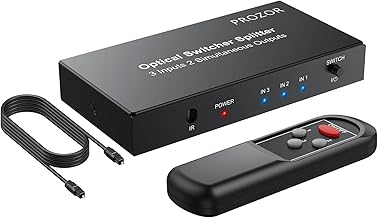
The PROZOR combines three optical inputs with two outputs. This configuration differs from a standard 3-in, 1-out switch: it is intended for setups that need to select among sources and connect output devices in a two-output arrangement. The listed examples include sending audio to a soundbar and a Bluetooth transmitter for wireless headphones.
Best for: Buyers who need more routing flexibility than a single-output switch provides. The product description specifies manual and IR remote switching, an aluminum-alloy body, a Type-C power port, and an included 1-meter optical cable. It lists LPCM 2.0, DTS, and Dolby-AC3 support.
Choose this model if two outputs are relevant to your listening setup. Avoid paying for the added routing configuration if you only need to connect several sources to one output; a simpler 3×1 unit may be a more direct fit. Confirm that the intended outputs behave as required before purchasing.
LiNKFOR 3×1 Optical Audio Switch

This LiNKFOR switch routes one of three optical sources to one SPDIF/Toslink receiving device. It is a direct match for a common home setup in which a television, game console, and disc player share a single optical input on a sound system.
The listed audio formats are LPCM 2.0, DTS, and Dolby-AC3, with support specified at 96 kHz. The product information also states that optical output distance can reach up to 40 meters or 130 feet, depending on the optical cable and setup. The name indicates that an optical cable is included.
Best for: Buyers who need three inputs and one output without the four-input capacity of the other LiNKFOR option. Limitation: Its listing says it does not support 7.1-channel Dolby Digital Plus or Dolby TrueHD over optical. Choose it for supported formats rather than assuming it passes every surround format.
Buying Guide: How to Choose a Toslink Switcher
How many optical inputs do you need?
Count the devices that will send audio through Toslink, not the number of devices in the room. A three-input switch can serve three optical sources; a four-input model is a better fit when you have four sources or want an unused port available for a future device. Each model here has either three or four inputs.
Also confirm the number of outputs. Most models in this list route selected audio to one output. The PROZOR is specified as a 3-in, 2-out unit, which may fit a setup that needs two outputs. Do not assume that every switcher can split, duplicate, or independently route signals in the same way.
Do you want manual, remote, or automatic switching?
Manual switching is straightforward when the switcher is accessible. An included IR remote can make source selection easier when the unit is behind a television or placed away from the seating area. The eSynic and PROZOR list remote and manual operation; the four-input LiNKFOR listing identifies an IR remote.
The COOIDEA is the option in this group that specifically describes automatic switching based on audio activity. That behavior can reduce manual input changes, but it may be less predictable if multiple sources are active or if a device is muted rather than fully shut down. Consider how you use each source before selecting an automatic model.
Which audio formats and sample rates matter?
Match the switcher’s stated support to the audio output formats used by your source devices and sound system. The products list combinations of LPCM 2.0, DTS, and Dolby-AC3. The COOIDEA specifies up to 192 kHz/24-bit, while the two LiNKFOR models specify 96 kHz. These specifications should not be treated as proof that every device will negotiate every format correctly.
Optical connections have format limitations. Both LiNKFOR product descriptions specifically state that their switches do not support 7.1-channel Dolby Digital Plus or Dolby TrueHD over fiber optic cable. If you require those formats, check the source and receiver connection options and consider whether HDMI is needed instead.
What cable and placement details should you check?
Confirm which cables are included and whether their lengths suit your layout. The four-input LiNKFOR listing specifies a 3-foot optical cable, the PROZOR includes a 1-meter optical cable, and the COOIDEA emphasizes its compact size. Cable length, device placement, and access to the switch’s controls can affect installation convenience.
Optical connectors need to be aligned and seated carefully. Keep cable runs within the limits stated for the product and cable, and avoid forcing a connector into place. If you plan a long run, check the switcher’s distance specification and the requirements of the optical cable you intend to use.
When is a metal housing or power connection important?
Some listed models describe aluminum-alloy housings, including the eSynic, LiNKFOR 4×1, and PROZOR. Housing material may matter to buyers comparing construction, but it does not replace checking the supported formats, control method, or port layout. The PROZOR specifies a Type-C power port; verify the power requirements and included accessories in the current product listing.
Before ordering, compare the product’s input count, output count, switching method, audio-format support, included cables, and physical dimensions with your equipment. Those details are more useful than choosing by the word “optical” alone.
Frequently Asked Questions
What does a Toslink digital optical audio switcher do?
It lets you select among multiple optical audio sources and send the selected signal to a receiving device, such as a soundbar or receiver. The number of supported sources and outputs depends on the switcher’s configuration.
Will a 3-in-1 switcher connect three devices to one soundbar?
Yes, a 3-in, 1-out model is designed to route one of three optical inputs to one output. Confirm that the soundbar and source devices have compatible optical connections and that the audio formats meet your needs.
Can an optical switcher carry Dolby TrueHD?
Do not assume that it can. The two LiNKFOR listings state that their switches do not support Dolby TrueHD or 7.1-channel Dolby Digital Plus over optical. Check the specifications for the exact switcher and consider HDMI if your required format needs it.
Is an automatic optical switcher better than a remote-controlled model?
Neither is universally better. Automatic switching can change inputs when a source becomes active, while a remote-controlled model lets the user choose a source directly. Select based on how your devices behave and whether you prefer automatic or deliberate input selection.
Can one optical switcher send audio to two devices?
Only if its design supports multiple outputs. The PROZOR is listed as a 3-in, 2-out switcher; the other products described here are presented as one-output models. Check the product’s routing details to confirm whether its outputs meet your intended use.