
To transfer a microcassette recording to CD, first play it through a compatible microcassette recorder and capture its audio on a computer; then burn the audio file to a CD. The products below include computer-audio capture tools and one pack of blank microcassette tapes, but most are designed for standard-size cassette tapes—not microcassettes. A compatible microcassette player is essential and is not included in this product list.
| Product | Best suited for | Important limitation |
|---|---|---|
| DIGITNOW USB Cassette Converter | Capturing standard cassette audio through USB | Not identified as a microcassette player |
| Reshow Cassette Tape Player | Portable standard-cassette playback and conversion | Does not specify microcassette support |
| SEMIER Small Cassette Tape Player | Standard Type I tapes and SD-card or computer recording | Not stated to accept microcassettes |
| DIGITNOW USB Audio Capture Card | Capturing audio from a separate playback device | Requires a compatible source player |
| Reshow Dictating Microcassette Tapes | Recording new material on microcassette | Blank tapes, not a transfer device |
DIGITNOW USB Cassette Converter

This portable USB cassette player is described as a tool for capturing cassette audio as MP3 files on a laptop or personal computer. It is best for someone digitizing standard cassette recordings who wants a USB-based workflow before creating a CD.
Why it was selected: It explicitly combines cassette playback with computer-based MP3 capture, which addresses the digital-audio stage of a tape-to-CD project.
Important limitation: The product name describes cassette tapes generally, not microcassettes. Do not assume a microcassette will fit or play. For a microcassette transfer, use a compatible microcassette recorder as the playback source and confirm whether this converter can accept its audio output before choosing it.
Reshow Portable Cassette Tape Player

The Reshow is a portable cassette tape player described as converting cassette audio to a digital format through a connection to a laptop or personal computer. It is best for buyers who have standard-size cassette tapes and want a portable playback-and-digitizing option.
Why it was selected: Its stated purpose is to play cassette recordings and transfer their audio to a computer, allowing the resulting file to be prepared for a CD.
Important limitation: The listing name does not identify microcassette compatibility. A microcassette is a different physical format from a standard cassette, so this player should not be treated as a substitute for a microcassette recorder. Choose it only when your tapes match the player’s supported format.
SEMIER Cassette Player With USB-C Or SD
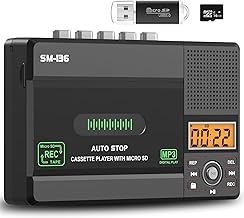
This small cassette player is described as recording audio to a computer or SD card, with USB-C, a microphone, a speaker, and a headphone jack. Its listing also specifies Type I tapes and includes a 16GB SD card. It is best for someone digitizing compatible standard cassette recordings who wants an SD-card option.
Why it was selected: Recording to removable storage can provide an intermediate digital file that can later be moved to a computer and used to make a CD.
Important limitation: The listed tape format is Type I, and the product information does not say it accepts microcassettes. Check the physical tape format before buying. The listing’s microphone feature should not be confused with proof that it can connect directly to every external recorder.
DIGITNOW USB 2.0 Audio Capture Card

This USB 2.0 audio capture card is described as a cassette-to-digital converter and lists support for Mac and several Windows versions. It is best for buyers who already have a suitable tape player or recorder and need a way to capture that device’s audio on a computer.
Why it was selected: Unlike a cassette-shaped player, a capture card may fit a workflow using a separate playback device. That can be useful when the source is a compatible microcassette recorder, provided its audio output and the capture card’s connections work together.
Important limitation: A capture card does not itself play a microcassette. Confirm the required cable, input connection, and recording software before purchase; those details are not fully specified in the product name.
Reshow Blank Microcassette Tapes

This three-pack of blank MC-60 microcassette tapes is described for dictation, lectures, and seminars. It is best for someone who needs blank microcassettes for recording or wants to identify the format and capacity of a tape they already use.
Why it was selected: It is the only item in this list explicitly identified as a microcassette product, making it relevant to readers checking their tape format.
Important limitation: These are blank recording tapes, not a player, USB converter, capture device, or CD burner. They will not transfer existing recordings to a computer or CD.
Buying Guide: How To Transfer A Microcassette To CD
What equipment do you need?
A practical transfer setup has three parts: a working microcassette recorder that can play the source tape, a computer or digital recording device to capture the sound, and a CD writer with software that can create an audio CD. The recorder is critical because a standard cassette converter may not fit or play a microcassette.
Check the recorder’s available audio outputs and compare them with the input on the capture device. If you plan to use a USB capture card, confirm what cable and input it requires. The product descriptions here do not establish that every listed capture tool connects directly to every microcassette recorder.
Should you record to MP3, WAV, or an SD card first?
For most transfers, first capture a digital audio file on a computer or removable storage. MP3 files are compressed and convenient for sharing or listening on many devices. WAV files are uncompressed and can be useful as an archival copy, but they take more storage space. The available recording formats depend on the equipment and software you use.
If your device records to an SD card, move the resulting file to a computer before preparing the CD. Keep a separate backup of the captured file so the recording is not dependent on the disc alone.
How do you make a CD that plays in a regular CD player?
Choose an audio CD project in your disc-burning software if you want a conventional CD player to play the disc. A data CD containing MP3 files is a different format; it works only in players that support those files. Follow the software’s prompts to arrange tracks, check the total recording time, and finalize the disc if required.
Before burning, listen to the digital recording from beginning to end. If there are long pauses, unwanted handling noise, or clipped speech, it is easier to recapture or edit the file before creating the disc.
How can you improve the transfer?
- Use a microcassette recorder that plays the tape correctly and produces clear audio.
- Make a short test recording first, then listen for low volume, distortion, hum, or missing sound.
- Keep the source tape and recorder steady during capture to reduce interruptions.
- Capture the full recording before trimming or dividing it into tracks.
- Save an unedited digital copy before making any changes.
- Label the digital file and disc with useful details, such as the recording date or speaker, when known.
What should you check before buying a converter?
Start with the tape’s physical format. A microcassette is not interchangeable with a standard cassette, so look for explicit microcassette support rather than relying on a general “cassette converter” description. Next, check whether the product plays tapes, captures audio from an external player, or only stores recordings. These are different functions.
Also verify the computer operating system, connection type, and recording method. A product listing that names Mac or Windows support can help narrow the options, but it does not by itself confirm compatibility with every computer or recorder setup.
Frequently Asked Questions
Can I put a microcassette directly into a standard cassette converter?
No. Do not assume a standard cassette converter accepts microcassettes. Use a microcassette recorder designed for that tape format, then capture its audio separately.
Can I transfer a microcassette straight to a CD?
Usually, the recording must first be played and captured as digital audio. You can then use computer software and a CD writer to create an audio CD or a data CD, depending on your intended player.
Does a USB capture card play microcassette tapes?
No. A capture card records audio from a compatible source; it is not a tape player. You still need a microcassette recorder and a suitable connection between the recorder and capture device.
Is an MP3 CD the same as an audio CD?
No. An audio CD is designed for standard CD playback. An MP3 data disc stores files and requires a player that supports MP3 discs. Select the disc format based on the device that will play it.
Which listed product is explicitly for microcassettes?
The Reshow MC-60 product is explicitly described as blank microcassette tapes. It is for recording onto tapes, not transferring recordings. The other listed products describe standard cassette playback or audio capture and do not state microcassette compatibility.
What if the microcassette is damaged or difficult to play?
Do not force a tape into a recorder or repeatedly operate a device that is jamming. A specialist audio-transfer service may be appropriate when the tape is damaged, valuable, or produces unstable playback.