
Best USB Cables for DAC: Clear Choices for Every Audio Setup
The buyer’s search intent is to find reliable USB cables that connect digital audio gear to DACs with stable, clean signal transfers. This guide highlights five top options, detailing who they’re best for, and why they stand out. It’s ideal for audiophiles, home studio setups, and casual listeners seeking better audio clarity without driver hassles. Below is a quick comparison table to help you decide at a glance.
| Product | Best For | Why It Stands Out |
|---|---|---|
| UGREEN USB-B to USB-C Cable 3FT | Compact setups, printers to DACs | Wide compatibility, plug-and-play, 480 Mbps |
| Monosaudio Audiophile USB2.0 A to B Cable 4N 99.998% OFC | High-fidelity audio chains | Ultra-pure copper, gold-plated, high signal integrity |
| UGREEN USB-B to USB-C Cable 6.6FT | Longer runs, studio desks | Similar to 3ft version with extra length |
| SKW Audiophile USB A to USB B DAC Cable 6.5ft/2m | Critical listening DAC connections | Dual shielding, premium conductors, gold ends |
| Sweguard Printer Cable 10ft USB-A to USB-B | Printer-to-DAC style multi-use | Gold-plated, high-speed USB 2.0 |
UGREEN USB-B to USB-C Cable 3FT for Printer & MIDI

Best for compact desk setups where a short, reliable USB-C to USB-B link is needed for printers, MIDI devices, and DACs. This cable supports Type-C laptops and mobile devices, enabling direct connections to audio equipment and printers without driver requirements. It’s an ideal match for a small home studio that uses a DAC for monitoring or a USB audio interface.
Who it’s best for: users needing a short, versatile cable that works with printers and audio gear. Why selected: combines broad compatibility with simple plug-and-play setup and stable data transfer up to 480 Mbps. Limitation: shorter length may not suit all desk layouts or audio racks.
Monosaudio Audiophile USB2.0 A to B Cable 4N 99.998% OFC Pure Copper

Best for dedicated audio chains where signal purity is critical. It uses ultra-pure copper and gold-plated connectors to minimize interference and maximize clarity between DACs and USB sources. The 4N copper level signals a focus on high-fidelity transfer for music playback and studio monitoring.
Who it’s best for: audiophiles and critical listeners seeking lower impedance and improved soundstage. Why selected: premium materials and connectors support clean, consistent transmission up to USB 2.0 speeds. Caution: USB 2.0 limits may not satisfy extremely high-bandwidth digital setups or future-proofing needs.
UGREEN USB-B to USB-C Cable 6.6FT for Printer & MIDI
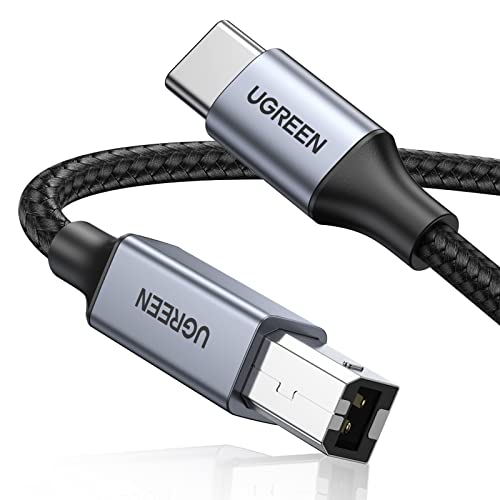
Best for longer desk arrangements where a USB-B to USB-C link supports printers, MIDI gear, and DAC units. The longer length offers flexibility in layout while maintaining plug-and-play operation and similar transfer rates as the 3-foot version. It’s a practical choice for home studios with extended gear spacing.
Who it’s best for: users needing extra cable length without sacrificing performance. Why selected: same robust construction as the shorter version, with the added reach. Limitation: extra length can introduce minor signal loss if routing through busy cable paths; keep it tidy for best results.
SKW Audiophile USB A to USB B DAC Cable 6.5ft/2m

Best for high-fidelity DAC connections where signal integrity is crucial. SKW cables emphasize dual shielding, ultra-pure conductors, and corrosion-resistant gold connectors to reduce interference and maintain consistent audio quality. The 6.5-foot length suits mid- to large-sized setups.
Who it’s best for: listeners who demand low-noise and precise imaging from their DAC-linked sources. Why selected: strong emphasis on shielding and gold-plated contacts improves signal stability. Caution: as with any premium cable, you’ll benefit most when paired with compatible high-quality DACs.
Printer Cable 10ft USB-A to USB-B Cable High Speed

Best for longer desk setups where a USB-B connection must stretch to printers, scanners, or DAC-like devices placed away from the computer. This cable supports USB 2.0 speeds up to 480 Mbps and remains backward compatible with older USB standards. It’s a robust option for multi-device audio environments that also require reliable printing connectivity.
Who it’s best for: users needing a long, reliable USB-A to USB-B link for printers and DACs on larger desks. Why selected: long reach without sacrificing gold-plated contact quality and shielding. Limitation: being USB-A to USB-B, it may require adapters if your DAC uses a different connector standard.
Buying Guide: Key Considerations For Choosing USB Cables For DAC
- Connector compatibility: Ensure the cable matches your DAC and host device (USB-A, USB-B, USB-C). Some DACs use USB-B or USB-C inputs; verify the port type and orientation.
- Data transfer speed: USB 2.0 (480 Mbps) is common for audio, but higher-end setups may benefit from higher-grade USB connections if supported by devices.
- Cable length: Longer cables offer flexibility but can introduce minor signal loss or increased capacitance. Choose the shortest length that fits your layout.
- Conductors and shielding: Premium copper (4N or better) and gold-plated connectors reduce impedance and interference, improving signal clarity for audio.
- Build quality: Look for nylon braiding or robust jackets for durability in studio environments or on-stage setups.
- Plug-and-play reliability: For most DAC applications, driver-free operation is preferred to minimize setup complexity.
- Intended use: If you need multi-device setups (printers, MIDI devices, DACs), prioritize cables that advertise wide compatibility and robust shielding.
Frequently Asked Questions
- Q: Do I need a special USB cable for high-end DACs? A: Not necessarily. Most DACs work well with standard USB cables that offer solid shielding and gold-plated contacts. Premium cables mainly help in noisy environments or long cable runs.
- Q: Can USB cables improve DAC sound quality? A: Cables primarily ensure reliable data transfer. In quiet or compromised connections, higher-quality cables can reduce interference and maintain signal integrity.
- Q: Is USB-C better than USB-A for DACs? A: USB-C offers broader compatibility and newer devices, but audio quality depends on the host and DAC. The choice depends on device ports rather than inherent quality alone.
- Q: Should I avoid longer cables for DAC setups? A: Longer cables can introduce more capacitance, potentially affecting signal. Choose the shortest length that meets your layout needs and avoid unnecessarily long runs.
- Q: Are shielded cables worth it for studio use? A: Yes, shielding helps minimize external interference in environments with many electrical devices, improving signal stability.
- Q: Do these cables require drivers? A: Most USB audio connections are driver-free; these cables are designed for plug-and-play use with compatible devices.