
The best USB guitar pedal controller depends on what you need to control: MIDI effects, computer commands, expression parameters, or pedal power. The M-VAVE Chocolate Plus is the closest match for USB and MIDI control; the iKKEGOL triple pedal suits programmable computer commands, while the M-AUDIO EX-P is for compatible expression inputs. The other options serve narrower needs, so check the connection type before buying: a USB footswitch is not automatically a MIDI controller, and a power cable does not send control commands.
| Product | Best For | Connection Or Function |
|---|---|---|
| M-VAVE Chocolate Plus | Programmable MIDI control | Bluetooth MIDI and USB |
| iKKEGOL Triple Foot Pedal | Multiple computer shortcuts | USB HID keyboard and mouse |
| M-AUDIO EX-P | Continuous parameter control | Expression-pedal input |
| iKKEGOL Single Foot Pedal | One hands-free computer command | USB HID keyboard and mouse |
| USB-to-9V Guitar Pedal Cable | Powering a compatible pedal | USB power conversion |
M-VAVE Chocolate Plus Wireless MIDI Foot Controller

Best for: Guitarists who want a compact controller for MIDI-compatible effects, music software, or loop-pedal setups. This is the most direct match in this list for a USB guitar pedal controller because its listed connections include USB and its functions include MIDI commands.
The unit has four programmable footswitches and supports Bluetooth MIDI as well as a wired USB connection. Its listed MIDI message types include PC, CC, Note On/Off, and SysEx. An app is available for settings and firmware updates, according to the product information. The manufacturer also lists Windows, Mac, iOS, and Android compatibility.
Why it was selected: It combines footswitches, MIDI customization, and USB connectivity in one device. Choose this if you need foot-operated MIDI commands rather than simple keyboard shortcuts.
Limitation: The listing does not establish that it will work with every guitar effect or software setup. Confirm that the target device accepts the required MIDI messages and connection method before buying.
iKKEGOL USB Triple Foot Pedal Switch
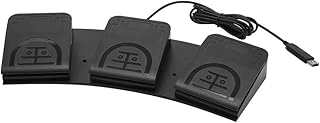
Best for: Players who want to trigger up to three programmable computer keyboard or mouse actions by foot. The listing describes this as a standard USB HID device, which is a different control method from sending MIDI directly to a guitar effects pedal.
The three-key switch is programmable and has wide pedals, optical switches, and a quiet action, according to its product details. Listed uses include media controls, instrument control, push-to-talk, and other hands-free computer tasks. Its larger pedal design may suit users who prefer more foot contact area.
Why it was selected: It offers multiple foot-operated inputs over USB, making it a practical option for controlling computer functions while playing. Choose it if your software can respond to the keyboard or mouse actions assigned to the pedals.
Limitation: USB HID is not the same as USB MIDI. Avoid this option if your effects unit requires MIDI messages and cannot receive keyboard or mouse input.
M-AUDIO EX-P Expression Pedal

Best for: Musicians who need continuous foot control over a parameter such as volume, modulation, panning, or a filter sweep. Unlike a button-style footswitch, an expression pedal changes a value across its travel when connected to a compatible expression input.
M-AUDIO describes the EX-P as a universal expression pedal for MIDI keyboards, controllers, synthesizers, and supported guitar effects devices. It includes a polarity switch intended to help match the pedal to different supported inputs. The product information says it can control MIDI-assignable parameters in real time.
Why it was selected: It covers a distinct guitar-control need that MIDI button controllers do not: gradual parameter adjustment with the foot. Choose this if your device has an expression-pedal input and you want sweeping control rather than preset changes.
Limitation: This is not a USB foot controller by itself. Check that the target device has a compatible expression input; the listed features do not specify direct USB connectivity.
iKKEGOL USB Single Foot Pedal Switch

Best for: A player who needs one hands-free computer command, such as a keyboard shortcut, media action, or push-to-talk command. The product is described as a programmable USB HID foot pedal, so it is intended to trigger computer keyboard or mouse actions rather than act as a universal MIDI pedal.
The listing includes free software for programming and describes a two-meter cable. It also identifies possible uses such as streaming, video games, transcription, media playback, and instrument control. Its broad pedal and sensitive switch are presented as features for comfortable foot operation.
Why it was selected: A single switch can be simpler to assign and operate than a multi-pedal unit when only one command is needed. Choose it if your computer application can use a keyboard or mouse input.
Limitation: The product details do not identify MIDI message support. It is not the right choice if your guitar effects processor specifically requires MIDI control.
USB 5V To DC 9V Guitar Pedal Power Cable

Best for: Someone who needs a USB power source for a compatible 9V guitar effect pedal, especially in a portable practice or performance setup. This cable is included for buyers searching broadly for USB guitar-pedal gear, but it is a power accessory, not a controller.
The listing describes conversion from USB 5V input to DC 9V output, a 5.5-by-2.1 mm connector, and center-negative polarity. It states a maximum current of 800 mAh; because that unit is unusual for current, verify the actual current requirement and the product’s specifications with the seller before use. The listing says it is intended for most 9V single effects pedals and some small electronic devices.
Why it was selected: It addresses a common adjacent need: supplying power to a pedal from USB rather than sending control data.
Limitation: It does not transmit MIDI or switch commands. Confirm voltage, polarity, connector size, and current requirements before connecting any device.
Buying Guide: How To Choose A USB Guitar Pedal Controller
Do you need MIDI, HID, expression, or power?
Start by identifying what the pedal must do. MIDI controllers send messages such as program changes or continuous controller commands to compatible equipment or software. USB HID footswitches send keyboard or mouse actions to a computer. Expression pedals control a continuous value through a compatible expression input. Power cables supply electrical power but do not control sounds or software.
These categories are not interchangeable. A USB connector only describes a physical connection; it does not prove that a device sends MIDI. Check the product’s listed protocol and the receiving device’s input requirements before choosing.
Does the target device accept USB MIDI directly?
For direct control of a computer-based music setup, verify that the operating system and application can receive the controller’s MIDI messages. For a hardware effects processor, check whether it has a USB MIDI host function or another supported MIDI connection. A device with a USB port may use it only for updates, power, or computer connection, so confirm its documented purpose.
The M-VAVE option is the strongest fit here for users seeking programmable MIDI messages through USB or Bluetooth. Its listed PC, CC, Note On/Off, and SysEx functions offer different command types, but the receiving device must support the messages you plan to use.
Would keyboard shortcuts be enough?
If your setup is controlled through a computer application, a USB HID pedal may be sufficient when the software responds to keyboard or mouse commands. The single iKKEGOL pedal is a fit for one repeated action; the triple version gives you more footswitches for separate assignments. Neither listing identifies MIDI message support, so do not treat either as a substitute for a MIDI controller without confirming software compatibility.
Do you need buttons or continuous control?
Footswitches are suited to discrete actions: selecting a preset, toggling a function, or triggering a command. An expression pedal is better for gradual changes such as raising volume or sweeping a filter, provided the effect or controller has a compatible expression input. The M-AUDIO EX-P is an expression pedal, not a USB MIDI footswitch, so check the connection on your equipment.
How many switches should you get?
Choose enough controls for the actions you expect to use, while considering how many switches you can operate reliably during a performance. A four-button MIDI controller may suit several MIDI assignments, while a three-pedal HID unit can handle multiple computer commands. One pedal may be easier to configure when a single action is all that is required.
Also consider programming options, cable routing, and whether a wired or wireless connection suits the environment. The M-VAVE listing specifies both Bluetooth MIDI and wired USB; the iKKEGOL pedals are described as USB devices. Do not assume that all connections are available on every model or that wireless control is appropriate for every setup.
What should you check before powering a pedal?
For a power cable, match the pedal’s required voltage, connector dimensions, polarity, and current draw. The listed USB-to-9V cable specifies a center-negative 5.5-by-2.1 mm connector, but those details alone do not establish compatibility with every effect pedal. A mismatch can prevent operation or risk damage, so consult the pedal’s own power requirements first.
Frequently Asked Questions
Is a USB footswitch automatically a MIDI controller?
No. A USB footswitch may send keyboard or mouse commands using USB HID, while a MIDI controller sends MIDI messages. Check the product specifications for explicit MIDI support and confirm that the receiving equipment accepts that connection.
Which product in this list is the closest match for USB MIDI control?
The M-VAVE Chocolate Plus is the closest match because its listing specifies USB wired connectivity and MIDI functions, including PC, CC, Note On/Off, and SysEx.
Can I use an expression pedal as a preset-switching footswitch?
An expression pedal is designed for continuous parameter control, not discrete switching. Whether it can perform another function depends on the receiving device and its supported inputs; verify that capability in the device documentation.
Can the USB-to-9V cable control guitar effects?
No. The cable supplies power; it does not send MIDI or footswitch commands. Its voltage, polarity, connector, and current capacity must match the pedal’s requirements.
Should I choose a one-, three-, or four-button controller?
Choose based on the number of separate actions you need and the protocol your setup accepts. One switch can suit a single computer command, while multiple switches can provide more assignments. Confirm whether those assignments are MIDI messages or keyboard and mouse actions before purchase.