
The best USB inverter for a car depends on how much power you need and which ports your devices use. The BESTEK 300W model is a compact choice with two AC outlets and two USB ports; the vansoet 400W model offers several USB charging options, including 30W USB-C PD; and the PiSFAU 200W model suits buyers who want four USB ports in a small adapter. Compare the listed output and ports with your devices before choosing.
| Product | Best For | Listed Output And Ports |
|---|---|---|
| BESTEK 300W | Compact travel charging | 300W continuous; 2 AC outlets; 2 USB ports |
| Portable 300W Car Inverter | Buyers focused on a 300W rating | 300W; port details not supplied |
| PiSFAU 200W | Multiple USB devices | 200W; 2 AC outlets; 4 USB ports |
| Cummins CMN400 | Higher listed AC output | 400W; 2 AC ports; USB-A and USB-C |
| vansoet 400W | USB-C fast-charging options | 400W; 2 AC outlets; 2 USB-C and 2 USB-A ports |
BESTEK 300W Car Power Inverter

The BESTEK inverter converts 12–17V DC input to 110V AC output and is listed with 300 watts of continuous power and 700 watts of instantaneous power. It has two AC outlets and two USB ports rated at 4.8A each. The listing describes an iPhone-sized design and a 32-inch cigarette-lighter plug.
Best for: Drivers who want a compact inverter for travel, work trips, or camping and need both AC outlets and USB charging. It stands out for combining a stated continuous wattage with a small form factor and multiple port types.
Limitation: Its listed continuous output is 300 watts. Check the total power requirements of connected equipment, and do not assume the 700W instantaneous rating is continuous operating capacity.
Portable 300W Car Power Inverter

The supplied product information identifies this as a portable 300W car power inverter for vehicles. It does not provide details about the number or type of USB ports, AC outlets, input range, or charging speed. Those specifications should be confirmed in the product listing before purchase.
Best for: Shoppers comparing options around a stated 300W rating who are willing to verify the port configuration and other specifications. It is included because its product name directly identifies it as a portable 300W vehicle inverter.
Limitation: The available feature data is sparse. Choose another option if you need confirmed USB port counts, USB-C PD, or a clearly listed number of AC outlets.
PiSFAU 200W Car Power Inverter
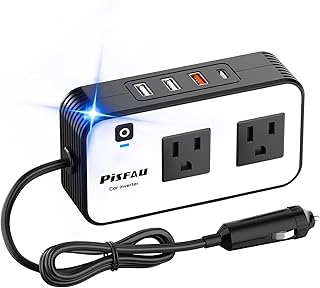
The PiSFAU converts 12V DC to 110V AC and provides two standard AC outlets and four USB charging ports. Its listed output is 200 watts. The listing describes a compact design measuring 2.7 by 1.4 by 5 inches and weighing 8.5 ounces. It also highlights a high-efficiency circuit and heat-dissipation design intended to reduce energy consumption and operating noise.
Best for: Drivers who need several USB connections for phones and other USB-compatible devices, along with a pair of AC outlets. Its four USB ports make it a better fit for charging multiple small devices than a model with fewer USB connections.
Limitation: The listed 200W output is lower than the 300W and 400W options here. Confirm that the combined demand of devices using its AC outlets stays within the stated output.
Cummins CMN400 400W Car Inverter

The Cummins CMN400 is listed to power AC devices up to 400 watts. Its features include two 110V AC ports, a 2.4A USB port, and a 3.0A fast-charge USB-C port. The inverter also has backlighting and a switch for turning it on and off, which the listing says helps make it visible in low-visibility conditions.
Best for: Buyers seeking a higher stated AC capacity than the 200W and 300W models, while also wanting both USB-A and USB-C charging. It is a practical comparison choice when device power needs matter as much as the port selection.
Limitation: The supplied details do not specify the dimensions or describe the USB-C charging protocol. Check the full listing and your device requirements if size or a particular fast-charging standard is important.
vansoet 400W Car Power Inverter

The vansoet inverter converts 12V DC to 110V AC and is listed at 400 watts. It has two AC outlets, one 30W USB-C PD port, one 15W USB-C port, and two 15W USB-A ports. A dedicated AC switch lets users turn the AC outlets on or off independently. The listing also describes an intelligent temperature-controlled fan that activates when needed.
Best for: Travelers who want several USB charging ports, including a specifically listed 30W USB-C PD connection, alongside two AC outlets. It offers more detailed USB output information than the other options in this roundup.
Limitation: The listed 400W capacity does not mean every connected device can draw that amount simultaneously. Check the combined requirements of AC devices and follow the product’s stated operating limits.
Buying Guide: How To Choose A USB Inverter For A Car
What devices do you need to power?
Start by listing the devices you plan to use and checking their input requirements. USB-powered phones and accessories can plug directly into USB ports. Devices with household-style plugs generally need an AC outlet. An inverter with both port types can reduce the need to choose between charging a phone and powering an AC device.
Look at each device’s power label or manufacturer specifications. Add the wattage of devices that may run at the same time, then compare that combined demand with the inverter’s stated continuous capacity. Do not use a peak or instantaneous figure as though it were continuous output.
How many watts should a car inverter have?
Choose an output rating based on the equipment you intend to connect, not only on the number of ports. In this group, the PiSFAU is listed at 200W, the BESTEK and unnamed portable model at 300W, and the Cummins and vansoet models at 400W. A higher rating provides a higher stated ceiling, but the device’s actual requirements still need to fit within the inverter’s limits.
When using several connections at once, check whether the product lists a total output limit across all ports. The supplied details do not state combined USB-and-AC limits for every product, so consult the listing or product documentation rather than assuming each port can deliver its maximum simultaneously.
Which USB ports should you look for?
Match the port type and charging output to your devices. USB-A may suit many standard charging cables. USB-C is useful when your device and cable support it, but the presence of a USB-C port alone does not confirm a particular fast-charging protocol. The vansoet listing specifically identifies a 30W USB-C PD port; the Cummins listing identifies a 3.0A USB-C port without naming a protocol.
If you charge several phones or accessories at once, compare the number of USB ports. The PiSFAU lists four USB ports, while the BESTEK lists two. More ports can provide more connection points, but they do not by themselves indicate faster charging.
Is a cigarette-lighter plug suitable for your vehicle?
These products are described as car-plug or cigarette-lighter-style inverters, and the BESTEK feature list specifies a 32-inch cigarette lighter plug. Check your vehicle’s outlet and the inverter’s connection requirements before buying. Also verify the vehicle outlet’s limits in its manual; do not assume that the inverter’s advertised wattage is available through every vehicle socket.
Does size or cooling matter?
A compact body can be easier to store or use on trips, but placement should still allow appropriate ventilation. The BESTEK and PiSFAU listings emphasize compact designs. The PiSFAU describes heat dissipation intended to reduce heat and noise, while the vansoet listing describes a temperature-controlled fan. If quiet operation is important, consider that the vansoet fan can activate when needed rather than assuming it will always remain off.
Frequently Asked Questions
Can a car inverter charge a phone?
Yes, an inverter with USB ports can charge compatible USB-powered phones. Check the port type and listed output against your phone and cable. Some models also offer AC outlets, but a phone may be charged through USB without using an AC outlet.
Can I run a laptop from a car inverter?
Possibly, if the laptop’s power requirements are within the inverter’s limits and the laptop can use the available connection. Some laptops use an AC power adapter, while others may support USB-C charging. Check both the laptop’s specifications and the inverter’s listed output before connecting it.
Is 400W better than 200W?
A 400W inverter has a higher listed output capacity than a 200W inverter, but it is not automatically the better choice for every buyer. Select a model that meets the needs of your devices and vehicle connection. For USB-only charging of small devices, the number and type of USB ports may matter more than a higher AC wattage rating.
Can multiple devices be connected at the same time?
Products with multiple ports are designed to provide more than one connection point. However, the total power draw must stay within the inverter’s limits, and the supplied specifications may not state the maximum combined output for every port. Check the manufacturer’s instructions before using several high-draw devices together.
What is the difference between USB-C and USB-C PD?
USB-C describes a connector type. USB-C PD refers to a charging protocol that can support specified power delivery when the charger, cable, and device are compatible. A USB-C port is not proof that it supports PD, so check the product’s stated protocol and output.