
The best USB mixer with 48V phantom power depends on how many inputs and recording features you need. The K-mxerpro is best for basic live sound and karaoke, while the Aveek offers USB recording and playback. For more effects and phone-centered streaming, consider the TAVOSOP or Kaschun. The STABCL is a compact option with Bluetooth, USB, and onboard echo and delay. Compare their connection types and intended uses before choosing.
| Product | Best For | Standout Features |
|---|---|---|
| K-mxerpro 4 Channel Mixer | Live sound and karaoke | 48V power, Bluetooth, USB playback, 3-band EQ |
| STABCL 4 Channel Mixer | Compact setups | USB and Bluetooth, echo and delay, 2-band EQ |
| Aveek 5 Channel Mixer | PC recording | USB recording chip, USB-drive playback and recording |
| TAVOSOP 4 Channel Mixer | Effects and phone-connected streaming | 99 DSP effects, 3-band EQ, phone connection interface |
| Kaschun 4 Channel Mixer | Home studios and content creation | USB interface, 99 DSP effects, 7-band EQ |
K-mxerpro 4 Channel Mixer

The K-mxerpro is best for buyers who need a straightforward mixer for small live setups, karaoke, or streaming and want several input and output choices. Its first two channels accept XLR and 1/4-inch connections, while channels three and four use 1/4-inch stereo inputs. The listed features include 48V phantom power, Bluetooth, USB playback, reverberation, and three-band equalization.
For output, it provides both RCA and 1/4-inch left-right main outputs, as well as a headphone jack. Its insert connections and effects output provide additional routing options for compatible equipment. These connections make it a practical choice for a small sound system that needs to combine microphones, instruments, or a phone-connected source.
- Best for: Karaoke, small live performances, and general-purpose mixing.
- Why it stands out: It combines 48V power, Bluetooth, USB-drive playback, and multiple output formats.
- Limitation: Channels three and four are 1/4-inch stereo inputs, not additional XLR microphone inputs.
STABCL 4 Channel Mixer
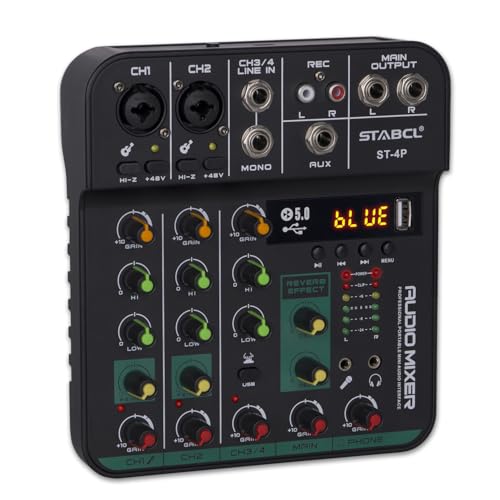
The STABCL is best for a compact home, podcast, or small performance setup that needs two XLR inputs and basic sound shaping. It includes 48V phantom power, gain controls, a two-band equalizer, and echo and delay effects. A USB connection and Bluetooth are listed for playing audio, and the mixer has a recording output described for connection to a computer or phone.
Its main left-right outputs and auxiliary output can connect to active audio equipment or a power amplifier, according to the product details. The maker also describes computer connection through a Type-C cable for power. Buyers should distinguish between music playback and recording needs: check the intended USB connection and device setup before relying on it as a recording interface.
- Best for: Buyers seeking a small mixer with two XLR inputs, Bluetooth, and built-in vocal effects.
- Why it stands out: The feature set combines 48V power with gain, EQ, echo, and delay controls.
- Limitation: The listed equalizer is two-band, rather than the three-band EQ found on some alternatives.
Aveek 5 Channel Mixer

The Aveek is best for users who prioritize recording to a computer and want a mixer with several types of input. It has three XLR input jacks, stereo 1/4-inch inputs, and stereo RCA inputs. The listed features include a built-in recording chip and a USB-B connection for computer recording, plus USB-drive playback and recording.
Its RCA and 1/4-inch main outputs are described for use with active speakers, power amplifiers, or active sound systems. This variety can help buyers connect microphones alongside stereo sources such as a computer, keyboard, or CD player. The product details specify that an output device must be active; they do not describe Bluetooth output capability.
- Best for: PC recording, podcasting, and setups combining microphones with stereo sources.
- Why it stands out: It lists three XLR inputs and both computer recording and USB-drive recording features.
- Limitation: The product information says it is not for connecting an output device with Bluetooth and requires active output equipment.
TAVOSOP 4 Channel Mixer

The TAVOSOP is best for streamers and performers who want onboard effects and a stated phone-connection option. It includes a USB audio interface, Bluetooth, USB-drive support, 48V phantom power, and a 99-effect DSP processor. Its three-band EQ and gain controls allow channel-level tone adjustment, according to the listed features.
The product description says a dedicated interface and Type-C data cable can connect an Android phone for recording or live broadcasting. It also presents the mixer as an option for stage performance, live gigs, and parties. Buyers choosing it for a particular phone or computer workflow should verify the connection requirements and supported setup before purchase.
- Best for: Live streamers and performers who want built-in DSP effects and 48V power.
- Why it stands out: The combination of 99 DSP effects, three-band EQ, and a described phone connection distinguishes it from simpler mixers.
- Limitation: The product details do not specify individual effect names or provide a full list of supported phone configurations.
Kaschun 4 Channel USB Mixer

The Kaschun is best for content creators and home-studio users looking for USB connectivity, detailed tone controls, and a broad effects selection. Its listed features include 48V phantom power, a USB audio interface, Bluetooth input, USB-drive MP3 playback, 99 DSP effects, and a seven-band EQ. XLR and 1/4-inch inputs support connecting microphones, instruments, and audio devices.
The maker says the USB connection can be used with a computer for recording and live streaming. The onboard controls include playback functions for USB-drive audio, while the DSP effects cover categories such as reverb, delay, chorus, and flange. These functions make it a feature-rich option for buyers who expect to adjust sound directly on the mixer.
- Best for: Home studios and creators who want multiple effects and more EQ bands.
- Why it stands out: It lists a seven-band equalizer alongside USB recording, USB-drive playback, Bluetooth input, and 48V power.
- Limitation: Bluetooth is specified for input only, not audio output.
Buying Guide: How To Choose A USB Mixer With 48V Phantom Power
What does 48V phantom power do?
Phantom power supplies electrical power through a compatible microphone connection, commonly for condenser microphones. A mixer with a 48V switch can be useful when a microphone requires that power and the mixer’s input supports it. Check the microphone’s requirements before connecting it. Do not assume that every microphone needs phantom power, or that every input on a mixer provides it.
How many XLR inputs do you need?
Count the microphones you plan to connect at the same time. The K-mxerpro and STABCL list two XLR inputs, while the Aveek lists three XLR input jacks. TAVOSOP and Kaschun list XLR connections but the supplied details do not clearly state the total number of XLR inputs. If simultaneous microphone count is essential, confirm the exact input layout before buying.
Do you need USB recording or USB playback?
USB can mean different things on a mixer. A computer audio interface sends or receives audio for recording, while a USB port may instead play files from a flash drive. Some products list both functions. The Aveek specifically describes computer recording over USB-B and USB-drive playback and recording. Check the feature description and connection type to ensure the mixer supports the workflow you need.
Which connections should you check?
Match the mixer’s inputs and outputs to the equipment you already own. XLR is common for microphones, while 1/4-inch and RCA connections can serve instruments and stereo devices, depending on the mixer. Also check whether your speakers are active or require a separate amplifier. The listed K-mxerpro, STABCL, and Aveek features describe outputs for active equipment or systems that include amplification; do not assume a mixer powers passive speakers unless its specifications say so.
Are Bluetooth and effects important?
Bluetooth can be convenient for receiving music from a phone, but it does not necessarily provide wireless audio output. The Kaschun explicitly says Bluetooth supports input only. Effects such as echo, delay, or DSP presets can help shape vocals without external effects equipment, but the number of effects alone does not indicate which options will suit a particular voice or performance.
How much EQ control do you want?
A two-band EQ offers fewer tone-adjustment bands than a three-band or seven-band design. The STABCL lists two-band EQ, while the K-mxerpro and TAVOSOP list three-band EQ. The Kaschun lists a seven-band EQ. More bands provide more adjustment points, but buyers should also consider whether they want simple controls or more detailed manual tone shaping.
Frequently Asked Questions
Can I use a condenser microphone with a USB mixer that has 48V power?
Often, if the microphone requires 48V phantom power and is connected to an input that supplies it. Check both the microphone and mixer instructions to confirm the correct connection and power requirements.
Does a USB mixer always record to a computer?
No. Some mixers use USB for computer audio, while others use it for USB-drive playback, recording, or power. Read the product’s connection details to confirm the exact USB functions.
Can I connect passive speakers directly to these mixers?
Do not assume so. A mixer needs a built-in power amplifier to drive passive speakers. Check the specifications; mixers that provide line-level outputs generally need active speakers or a separate amplifier.
Is Bluetooth the same as a USB recording connection?
No. Bluetooth is a wireless audio connection, often for receiving playback from another device. A USB audio interface is a wired connection that may send audio to or from a computer. The supported direction and functions vary by mixer.
Which listed mixer has the most XLR inputs?
The Aveek lists three XLR input jacks. The K-mxerpro and STABCL each list two XLR inputs. The supplied details do not give a precise XLR input count for every other model.