
Best Voice Activated Recorders for Clear, Hands-Free Capture
Answering the need for hands-free, reliable audio capture, these voice activated recorders excel in conversations, classes, meetings, and interviews. The top picks below are selected for strong AI noise reduction, long battery life, and ample onboard storage. Ideal buyers include students, professionals, journalists, and researchers who value automatic recording efficiency and durable design. Below is a quick summary of the five highlighted models.
| Product | Storage | Best For |
|---|---|---|
| COHANA Voice Recorder | 5000mAh battery, up to ~35–40 days | Long sessions, meetings, fieldwork |
| Lymorvex AI Recorder | 72GB memory, up to ~9800 hours | Lectures, interviews, professional use |
| OUSUNERY 32GB Mini | 32GB, compact | Pocket use, quick capture |
| EVIDA 128GB Recorder | 128GB, long playback | Lectures and meetings with playback |
| Qunifyed 64GB Recorder | 64GB, USB-C transfer | Meetings, classes, easy file management |
COHANA Voice Recorder With AI Noise Reduction

The COHANA model is built for prolonged recording sessions due to its large 5000mAh battery, delivering up to about 40 days of use depending on usage. It features AI triple noise reduction via DSP processing to minimize environmental noise and improve clarity. It is best for professionals who need reliable, long-term capture in meetings, classrooms, or fieldwork. A potential limitation is that the battery life depends on actual recording duration and settings, which may affect continuous operation in heavy-use scenarios.
Lymorvex AI-Intelligent Recorder

The Lymorvex device offers a high-capacity storage of 72GB with up to 9800 hours of recordings at 192kbps, plus AI noise reduction and a DSP 4.0 chip. It suits professionals, journalists, and students who need extensive capture with robust audio quality. It also supports auto-save when the battery runs low, reducing the risk of lost files. A caution: large memory may not be needed for casual users, and file management could be more complex for simple tasks.
OUSUNERY 32GB Mini Voice Recorder

The OUSUNERY mini recorder emphasizes simplicity and immediacy with a one-switch operation and preset smart VOR (Voice-Activated Recording). It’s ideal for quick on-the-go capture without navigating menus. It supports flexible playback via USB-C, OTG, or inline earphones. A caveat: limited built-in storage means frequent transfers are needed for longer projects.
EVIDA 128GB Digital Voice Recorder
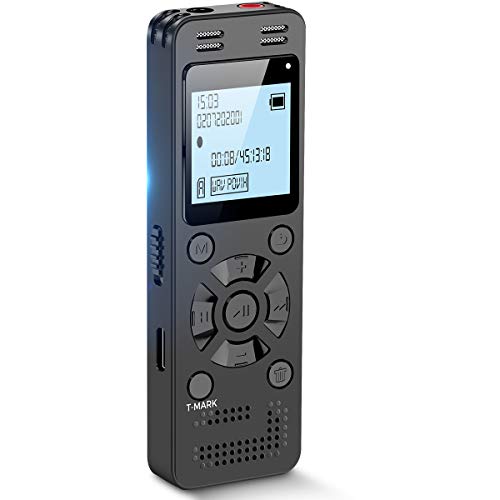
The EVIDA model provides 128GB of storage and supports playback, with up to 54 hours of continuous recording. It uses upgraded noise-canceling mics and a professional chip to deliver clear voice capture, making it suitable for lectures and meetings where playback is required. It offers multiple bitrates and formats (mp3, wav), but the feature overview notes that specific playback controls and user instructions are needed for optimal use.
Qunifyed 64GB AI Noise Reduction Recorder

The Qunifyed 64GB device combines 64GB memory with AI noise reduction and USB-C file transfer, making it a practical choice for meetings, interviews, and lectures. It supports up to 35 hours of continuous recording and emphasizes quick setup with one-touch recording. A limitation is that medium storage may require regular offloading for longer events, especially at higher bitrates.
Qunifyed 136GB Double-Sided Recorder

This model provides a large 136GB capacity with up to 100 hours of continuous recording and enhanced AI noise filtering. It works well for long conferences and extended fieldwork where file storage and durability matter. Choose this if you need extensive archives without frequent data transfers. A note: higher storage may come with a larger device footprint and cost considerations.
Buying Guide
What storage size do I need?
Choose based on your typical recording length and desired retention. Longer events benefit from 64GB to 128GB or more, while casual use can work with smaller capacities. Consider future needs and potential backup plans.
How important is AI noise reduction?
AI-based noise reduction improves intelligibility in noisy environments, such as classrooms or busy offices. If you record in quiet spaces, basic noise handling may suffice, but AI processing helps in extracting speech clarity in less controlled settings.
What about battery life?
Battery life matters for long sessions. Look for devices with extended runtime or auto-save features to prevent data loss when power runs low. For fieldwork, a larger battery or external power option can be a decisive advantage.
One-touch recording vs. menus
One-touch models are easier for quick captures and discreet use. If you need precise controls, a device with accessible menus and multiple recording modes may be preferable.
File transfer and playback options
USB-C transfer, OTG compatibility, and direct playback from the device affect convenience. Devices with multiple transfer methods simplify archiving and sharing recordings.
FAQ
- What is a voice activated recorder? A recorder that starts and stops automatically in response to detected sound, helping save storage and battery by skipping silent periods.
- Is AI noise reduction worth it for meetings? Yes, it improves speech clarity by reducing background noise, which is especially useful in open offices or crowded classrooms.
- Can these recorders play back recordings directly? Many models include playback functionality on the device or via connected computers or mobile devices.
- Do these recorders require an internet connection? No. They operate offline, with some models offering USB-C or OTG for data transfer.
- Which model is best for students? Models with long memory and reliable one-touch recording, such as 72GB or 128GB devices, are favorable for lectures and seminars.
- What should I choose if I need long-term storage? A high-capacity model (128GB or more) with auto-save and AI noise reduction is best for extended sessions and archival needs.