
Best Volume Pedal for Acoustic Guitar: Smooth Swells on Any Stage
Looking for a reliable volume pedal for acoustic guitar? This guide presents top options that offer smooth, silent action, passive operation when possible, and easy control for both live performances and studio work. It suits players seeking clean dynamic control without adding noise or complexity. The best choices here are ideal for players with passive or active pickups, string-crossing tremolo, or subtle live ambience. Below, you’ll find quick comparisons and selected models tailored to acoustic setups, whether you need simple volume control, expressive swells, or dual function pedals.
Summary table of selected products:
| Product | Best For | Key Benefit |
|---|---|---|
| Ernie Ball VP JR 250K Volume Pedal | Passive acoustic or piezo setups | Mono control with two swell rates |
| SONICAKE Passive Volume & Expression EXP | Versatile expression on passive systems | Auto-detects volume vs. expression |
| Lefiko Volume & Expression Pedal | Compact, all-in-one control | Passive design, silent operation |
| Volume (X) Mini Pedal (Jim Dunlop) | Travel-friendly boards | Pro-grade control in a mini form |
| IOppWin Volume & Expression Pedal | Ambient, worship, and multi-style | Mute-on-press, passive power-free |
Ernie Ball VP JR 250K Volume Pedal

The VP JR 250K is a compact, passive-friendly pedal designed for passive signals and acoustic setups. It provides a mono volume control and includes a taper switch for two distinct swell rates, allowing players to tailor the response to their picking dynamics. Best for players with passive pickups or simple volume needs who want a smaller footprint on the pedalboard. A potential limitation is that it emphasizes mono control, which may be inadequate for players seeking full-expression modulation from a single device.
Why this is selected
- Small form factor fits tight pedalboards, ideal for acoustic rigs.
- Mono volume control with selectable swell rates helps shape nuanced acoustic dynamics.
- Works well with passive signals, avoiding extra power requirements.
SONICAKE Passive Volume & Expression EXP Guitar Pedal
The SONICAKE EXP offers dual functionality in one compact unit: passive volume control and expression control. It auto-detects between volume and expression when connected, simplifying setup. It’s a good fit for players who need both pedals’ capabilities without adding extra footprint. Note: using the wrong cable (TRS vs. TS) can prevent gradual control, so follow the connector requirements carefully.
Why this is selected
- Two-in-one design reduces pedalboard clutter for acoustic players who also use effects.
- Automatic detection makes it quick to adapt to different signal paths.
- Broad instrument compatibility, including keyboards and synths, adds future flexibility.
Volume (X) Mini Pedal

The Volume (X) Mini Pedal from Jim Dunlop delivers full expression control in a smaller footprint, making it ideal for travel boards or smaller rigs. It provides smooth swells and a robust build, designed to withstand frequent use. Best for travelers or compact setups that still demand professional-level expressive control. A potential limitation is its reduced space for wiring on very crowded boards.
Why this is selected
- Mini footprint preserves space for acoustic rigs with limited pedalboard lanes.
- Pro-grade expression control supports dynamic delay, modulation, and more.
- Built to endure extensive cycling, ensuring consistent performance over time.
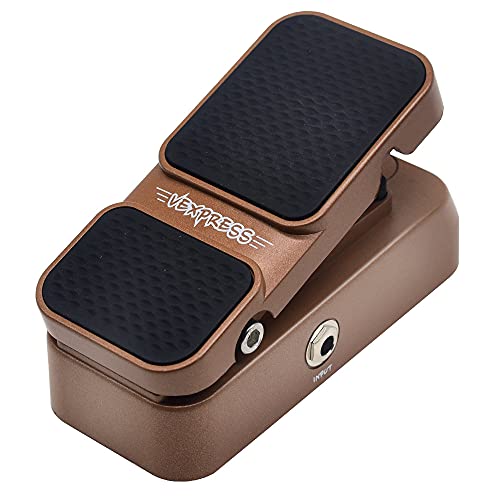
Volume & Expression Pedal – IOppWin

The IOppWin pedal combines volume control, expression control, and a mute-on-press feature in a passive, no-power-required design. It’s particularly strong for ambient and worship styles, where quick, silent transitions are valuable. Choose this if you want a multifunction pedal that can switch between live and studio tones without a power supply. Limitation: some users may prefer explicit separate controls for volume and expression rather than auto-sensing.
Why this is selected
- Mute-on-press enables instant quiet transitions during performances.
- Passive design suits minimal setups and quiet operation on stage.
- Broad compatibility with guitars, keyboards, and multi-effects makes it versatile.
Buying Guide: Key Considerations For Acoustic Players
What should you look for in a volume pedal for acoustic guitar?
- Signal type: Passive vs active pickups. Passive devices often benefit from pedals labeled for passive control, while active setups may need specific impedance handling or tuning controls.
- Control type: Pure volume vs. volume plus expression. Decide whether you need just swell control or dynamic parameter shaping for effects like delay or reverb.
- Footprint and build: Acoustic players frequently tour; compact, sturdy pedals save space and endure travel wear.
- Noise and transition: Silent or near-silent tread is crucial for recording and quiet live shifts.
- Connection requirements: Some pedals auto-detect between volume and expression; others require TRS cables or specific jacks. Confirm compatibility with your gear.
- Power: Most passive pedals do not need external power, simplifying stage setups. If a pedal requires power, consider battery or PSU compatibility.
- Compatibility with effects chain: If you use long-path effects like delay or modulation, a pedal with smooth, consistent response will be preferable.
FAQ
- Why would I choose a passive volume pedal for acoustic guitar?
Passive pedals do not require batteries or external power, reducing setup complexity and potential noise in sensitive acoustic rigs. - What is a taper switch and why does it matter?
A taper switch changes how quickly the pedal reaches its maximum or minimum output, affecting how natural the swell feels for acoustic dynamics. - Can I use a volume pedal with both passive and active pickups?
Yes, but ensure the pedal’s input/output and impedance are compatible with your pickup type. Some pedals are optimized for passive signals; others support active signals too. - Is a dual-function volume and expression pedal better than separate pedals?
It saves space and simplifies setup, but may offer fewer independent adjustments than two dedicated pedals. - What should I avoid when choosing for acoustic use?
A pedal with heavy noise, abrupt swells, or poor build quality can disrupt live performances and recordings. - Do I need a mute function on a volume pedal?
Mute can be useful for quick transitions between sections or songs, especially in worship or live performances.