
A wall-to-car charger converter changes household AC power into 12V DC through a car cigarette-lighter-style socket, letting you power compatible low-wattage car accessories indoors. The two 2A, 24W adapters below are the closest match for that purpose. The other three products are car power inverters: they work in the opposite direction, converting a vehicle’s 12V DC into AC outlets or USB power.
| Product | Best For | Power Direction |
|---|---|---|
| AC to DC Converter, 2A 24W | Low-power car accessories at home | Wall AC to 12V DC socket |
| AC to DC Converter Power Cable | Buyers seeking another 2A, 24W option | Wall AC to 12V DC socket |
| PiSFAU 200W Car Power Inverter | AC or USB power from a vehicle | Vehicle DC to AC and USB |
| FOVAL 200W Car Power Inverter | Vehicle users seeking AC and USB ports | Vehicle DC to AC and USB |
| 150W Power Inverter | Vehicle users seeking AC and dual USB | Vehicle DC to AC and USB |
AC To DC Converter, 2A 24W

This adapter converts household 110–240V AC input to 12V DC through a car cigarette-lighter socket. Its listed maximum output is 2A, or 24W. That makes it the clearest match for someone searching for a wall-to-car converter to run a compatible car accessory indoors.
Best for: Low-power car electronics whose rated power is below 24W and whose current draw is below 2A. The listed examples include dash cams, FM transmitters, air purifiers, and humidifiers.
Why it was selected: The product description directly identifies it as a wall-powered 12V supply with a car socket, and states both the input range and output limit. It also lists short-circuit, overheat, and overload protection.
Limitation: This is a power supply, not a battery charger. The product warns against using it with devices over 24W, including car inflators, vacuum cleaners, coolers, and other high-power appliances. Check the accessory label before connecting it.
AC To DC Converter Power Cable, 2A 24W

This listed adapter is described as converting 110–240V AC from a wall plug to 12V for car appliances. Its name specifies a 2A, 24W rating, so it belongs to the low-power wall-to-car category rather than the higher-output inverter category.
Best for: Buyers who need a wall adapter with a car-style power connection and whose accessory stays within the stated 2A, 24W limit. It may suit someone comparing a second 12V supply option with the same nominal output class.
Why it was selected: Its listed name identifies the conversion direction, household input range, 12V output, and maximum wattage. Those are the key details needed to compare a wall-powered car socket adapter with a vehicle inverter.
Limitation: The supplied product information does not specify safety protections, device examples, or other operating details. Do not assume it will run an accessory that exceeds 24W or 2A; confirm the device’s requirements and the adapter’s full labeling first.
PiSFAU 200W Car Power Inverter
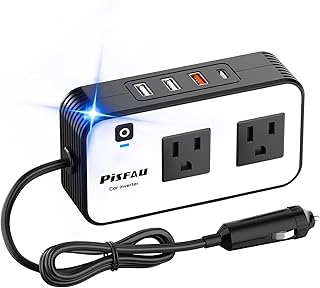
This product is a car power inverter, not a wall-to-car converter. Its title describes a 12V DC vehicle input and 110V AC output, with dual AC outlets and USB-A and USB-C ports. The listed USB output is 4.8A, 24W.
Best for: Drivers who want to use a vehicle’s 12V outlet to supply AC or USB power during travel or camping. It is relevant as an alternative only when the intended conversion direction is from the car to household-style power.
Why it was selected: Its listed ports and power direction make it a useful point of comparison for shoppers who may be using “car charger converter” to mean an inverter.
Limitation: It does not convert a wall outlet into a 12V car socket. Choose a 12V AC-to-DC adapter instead if the goal is to run a car accessory at home.
FOVAL 200W Car Power Inverter
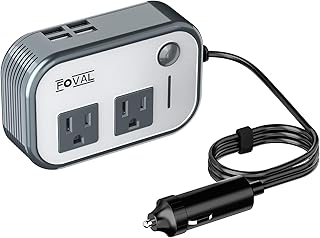
The FOVAL product is listed as a 200W inverter that converts 12V DC from a vehicle to 110V AC. Its name also identifies four USB ports and describes it as a car outlet adapter for devices such as a laptop computer charger.
Best for: Vehicle users who want multiple USB ports alongside AC power. Its four USB ports distinguish it from the wall-powered 2A adapters in this comparison.
Why it was selected: The product information specifies a 200W rating, vehicle-side 12V DC input, AC output, and four USB ports, making its intended use clear.
Limitation: The conversion runs from a vehicle’s 12V supply to AC; it does not accept household wall power as an input. It is therefore the wrong direction for powering a car appliance indoors.
150W Power Inverter With Dual USB
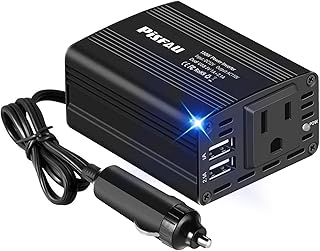
This 150W vehicle inverter is described as converting 12V DC to 110V AC. Its title also lists a cigarette-lighter adapter, dual AC/DC conversion wording, and 3.1A dual USB output.
Best for: Drivers seeking a vehicle-powered inverter with AC output and two USB ports. The listed 150W rating is lower than the 200W ratings of the other two inverters here.
Why it was selected: It offers another clearly named vehicle-to-AC option for readers comparing products that may appear in searches for car charging adapters.
Limitation: Despite the word “converter” in the listing, its stated direction is 12V DC to 110V AC. It does not provide wall-to-12V conversion for indoor use.
Buying Guide: How To Choose A Wall-To-Car Converter
Do you need a wall adapter or a car inverter?
Start by identifying where the power comes from and what the device needs. A wall-to-car adapter takes household AC power and supplies 12V DC through a car-style socket. A car inverter takes 12V DC from a vehicle and supplies AC power or USB output. These are opposite conversion directions, so they are not interchangeable.
If your goal is to run a dash cam or another 12V accessory indoors, look for an AC-to-DC power supply with a car socket. If your goal is to power a laptop or another AC device from a car, look for a vehicle inverter. A product title containing “car charger” does not, by itself, establish the direction of conversion.
How much wattage and current does the accessory require?
Check the device label or manual for its voltage, current, and wattage before buying. The two wall-to-car adapters listed here are rated at 2A and 24W. An accessory rated above either limit is not an appropriate match. For a device labeled in amps and volts, multiplying volts by amps gives its approximate wattage: 12V at 1A is 12W.
Do not assume that a plug fitting the socket means the power supply is suitable. A high-draw device may overload a low-output adapter even if the connector physically fits. The first adapter’s product information specifically warns against use with car inflators, vacuum cleaners, refrigerators, coolers, heating pads, and similar high-power appliances.
Is the adapter a power supply or a battery charger?
A wall-to-car socket adapter supplies power to a connected accessory. It does not necessarily charge a vehicle battery or recharge batteries inside another product. The first listed adapter explicitly says it is not a battery charger. For charging a battery, use equipment designed for that battery type and follow the manufacturer’s instructions.
What safety and operating details should you verify?
Look for the input range, DC output voltage, maximum current, maximum wattage, and any listed protection features. The first 2A adapter identifies short-circuit, overheat, and overload protection. The second adapter’s supplied product information does not specify those protections, so verify the full product labeling rather than assuming the two models have identical safeguards.
Use the adapter in a suitable indoor location, keep its vents or housing unobstructed if applicable, and disconnect it if the adapter or accessory becomes unusually hot. Follow the product instructions and the connected device’s requirements. Do not exceed the adapter’s stated output limits.
How should you compare the listed options?
For the exact wall-to-car use case, compare the two AC-to-DC adapters first. Both listings identify a 12V, 2A, 24W output class. The first includes more detail about supported low-power devices and protection features. The second listing provides less operating information, so buyers should confirm its complete specifications before use.
The 150W and 200W products are not higher-output substitutes for the wall adapters. They are inverters that take power from a vehicle. Their wattage figures describe a different conversion setup and cannot be used to determine whether they can run a car accessory from a household outlet.
Frequently Asked Questions
Can I plug a car accessory into a wall outlet with a converter?
Yes, if you use an AC-to-DC adapter that supplies the correct 12V output through a car-style socket and stays within the accessory’s current and wattage requirements.
Will a 24W wall-to-car adapter run a car vacuum?
Do not use the first listed 24W adapter with a car vacuum. Its product information warns against vacuum cleaners and devices exceeding 24W or 2A. Check any adapter’s stated limits before connecting a high-draw appliance.
Can a car inverter convert household power to 12V?
No. The inverters in this list are described as taking 12V DC from a vehicle and producing AC or USB output. For wall-to-12V conversion, choose an AC-to-DC power supply.
Does a wall-to-car converter charge a car battery?
Not necessarily. The first adapter is explicitly described as a power supply, not a battery charger. Use a battery charger designed for the battery you intend to charge.
How do I know if my device is below 24W?
Check the device’s label or manual for its wattage. If it lists voltage and current instead, multiply those values to estimate wattage. The adapter’s current and voltage limits must also match the device’s requirements.