
The best wireless guitar amp adapter for most players is a transmitter-and-receiver system that plugs into the instrument and amplifier. The JOYO JW-03 is best for rechargeable 2.4GHz use and a rotatable plug, while the JOYO JW-06 is better for players who want a 5.8GHz system with a charging case. The LEKATO 5.8GHz system emphasizes high-resolution audio and a swiveling plug. Compare the listed frequency, battery information, range, and plug design before choosing.
| Product | Best suited for | Key listed detail |
|---|---|---|
| 2.4GHz A9 Black | Players seeking a basic 2.4GHz system | Wireless system for electric instruments |
| JOYO JW-03 | Practice and small-gig use | Up to 8 hours; 220-degree plug |
| JOYO JW-06 | Players wanting a charging case | 5.8GHz; up to 18 hours total with case |
| LEKATO 5.8GHz | Players prioritizing audio specifications | 24-bit/48kHz; 220-degree plug |
| A8 UHF | Players considering a two-mode UHF option | Plug-and-play, one transmitter and receiver |
2.4GHz A9 Wireless Guitar System

This A9 Black system is listed as a 2.4GHz wireless guitar system for electric instruments. It is a straightforward candidate for a player who wants to replace a cable with a transmitter-and-receiver setup and does not need product specifications beyond the stated frequency and intended instrument category.
- Best for: Buyers looking for a 2.4GHz wireless system for electric instruments.
- Why it was selected: It directly matches the wireless guitar adapter search and is identified for electric instruments.
- Check before buying: The supplied product information does not specify battery life, operating range, latency, connector rotation, or charging method.
Choose this if the basic product description fits your needs and you can confirm the missing details on the listing. Avoid assuming it has the same range or battery features as the more fully specified systems below.
JOYO JW-03 2.4GHz Wireless System

The JOYO JW-03 pairs a 2.4GHz transmitter and receiver and is specified for electric guitar, bass, and acoustic-electric instruments. Its listed features include latency under 5ms, a stated range of up to 65 feet in open areas, and up to eight hours of use per full charge.
- Best for: Home practice, rehearsals, recording, worship services, and small venues.
- Why it was selected: Its dual-head USB cable charges both units, and its 220-degree rotating 1/4-inch plug is designed to reach recessed jacks and tight spaces.
- Limitation: The manufacturer does not recommend it for large stages or environments with heavy Wi-Fi or Bluetooth activity.
Choose this if you value rechargeable convenience and a rotating plug, especially when your instrument’s jack is awkwardly positioned. Its stated open-area range is not a promise of the same distance through walls or around obstacles.
JOYO JW-06 5.8GHz System With Case

The JOYO JW-06 uses 5.8GHz digital transmission and includes a charging case. The listed audio specification is 48kHz/24-bit, with latency under 6ms. Each charge provides up to six hours of play, and the case provides two full recharges for up to 18 hours of total battery life.
- Best for: Players who want a case-based charging setup for practice, rehearsals, recording, worship, or small gigs.
- Why it was selected: It combines a stated 5.8GHz connection, four channels, and an included charging case.
- Limitation: The stated 65–100-foot range applies to open areas; with walls or obstructions, the product information recommends approximately 30–50 feet.
Choose this if keeping the transmitter and receiver charged between sessions is a priority. For a busy wireless environment, the product information recommends switching channels to address interference or dropouts. Test the system in the actual playing space before relying on it for an event.
LEKATO 5.8GHz Wireless Guitar System
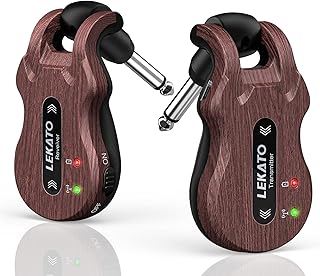
The LEKATO system is specified for 5.8GHz transmission and 24-bit/48kHz audio. Its listed latency is under 6ms, and its stated range is up to 100 feet with line of sight. The 220-degree rotatable plug is intended to fit a range of electric guitars, basses, and electric-acoustic guitars, including instruments with recessed jacks.
- Best for: Players comparing wireless systems by audio format, latency, and plug positioning.
- Why it was selected: Its product details state a 5.8GHz band, uncompressed audio transmission, and a swiveling plug.
- Limitation: The range is specified for line of sight; the supplied information does not give battery life or charging details.
Choose this if the stated audio specifications and rotatable connector address your priorities. Do not treat the advertised maximum range as an indoor guarantee, since obstacles can affect wireless transmission.
A8 UHF Wireless Guitar System

The A8 is described as a UHF wireless guitar system with two modes and a plug-and-play design. The listed package configuration is one transmitter and one receiver. The supplied information does not identify the audio format, range, battery duration, charging method, or instrument compatibility in detail.
- Best for: Buyers specifically considering a UHF option with a simple transmitter-and-receiver arrangement.
- Why it was selected: Its stated wireless format and plug-and-play description make it relevant to shoppers comparing guitar amp adapters.
- Check before buying: Confirm the supported instrument connections, meaning of the two modes, range, and power details on the product listing.
Choose this if UHF and the stated two-mode design are important to your search. Avoid comparing it directly with the other systems on battery life or range without confirming those details, because they are not included in the information provided here.
Buying Guide: How to Choose a Wireless Guitar Amp Adapter
What does a wireless guitar amp adapter do?
A wireless guitar system replaces the cable running from an instrument to an amplifier with a transmitter and receiver. The transmitter plugs into the guitar or bass, and the receiver connects to the amp or another instrument input. These products are not necessarily Bluetooth adapters; the systems here specify dedicated wireless formats such as 2.4GHz, 5.8GHz, or UHF.
Check the physical connections before buying. Confirm that the transmitter plug fits your instrument’s output jack and that the receiver connection suits the amp input. If the jack is recessed or positioned at an angle, a rotating plug such as those listed for the JOYO JW-03 and LEKATO may be useful.
Should you choose 2.4GHz, 5.8GHz, or UHF?
Frequency alone does not establish which system will perform best in every room. The JOYO JW-03 is a 2.4GHz option with stated latency under 5ms and a caution about Wi-Fi- or Bluetooth-heavy environments. The JOYO JW-06 and LEKATO models use 5.8GHz. The A8 is described as UHF, but the supplied details do not state its range or performance figures.
Consider the electronics and wireless devices in the places where you play. If the environment is crowded, compare channel selection and manufacturer guidance, then test the system in that location. The JW-06 specifically lists four channels and advises changing channels to reduce noise or dropouts.
How much range do you need?
For home practice, a long advertised range may be less important than reliable performance across the room. For rehearsal or a small venue, consider both the stated range and its conditions. The JW-03 lists up to 65 feet in open areas. The JW-06 lists 65–100 feet in open areas and recommends roughly 30–50 feet where walls or obstructions are present. LEKATO lists up to 100 feet with line of sight.
Wireless range is affected by the actual environment, so treat open-area figures as reference points rather than guaranteed indoor distances. Test the system in the room or venue before depending on it for a performance.
How important are latency and audio specifications?
Latency is the delay between playing a note and hearing it through the amp. The JOYO JW-03 lists latency under 5ms; the JW-06 and LEKATO list latency under 6ms. The JW-06 and LEKATO also specify 24-bit/48kHz audio. These figures help compare the stated specifications, but they do not replace checking how a system performs with your instrument and setup.
What battery and charging details should you compare?
For frequent use, compare playtime and how the units recharge. The JW-03 lists up to eight hours per full charge and a dual-head USB charging cable for both units. The JW-06 lists up to six hours per charge and up to 18 hours total with two full case recharges. Battery information was not provided for the A9, LEKATO, or A8 products in the supplied details, so confirm it before purchase if battery life matters.
Which system suits your playing situation?
- Home practice: Compare plug fit, charging convenience, and practical indoor range.
- Rehearsal or small gigs: Look for stated latency, channel options, and a range suitable for your space.
- Busy wireless environments: Review frequency and channel guidance, and test for interference before a critical session.
- Recessed instrument jack: Consider a model with a rotating plug, while checking that its connector shape suits your instrument.
- Long sessions away from a charger: Compare the stated runtime and whether a charging case is included.
Frequently Asked Questions
Can a wireless guitar system connect a guitar to an amplifier?
Yes. A transmitter plugs into the instrument and a receiver connects to the amplifier input. Check the product’s connector details to confirm that both ends suit your equipment.
Is a wireless guitar system the same as a Bluetooth adapter?
Not necessarily. The products covered here are described as dedicated wireless guitar systems using 2.4GHz, 5.8GHz, or UHF. Do not assume they pair with Bluetooth devices unless the product listing explicitly says so.
Will a wireless guitar adapter work with bass?
Some listed systems specify bass use. The JOYO JW-03 is described for electric guitar, bass, and acoustic-electric instruments, and the JOYO JW-06 is described for electric guitar and bass. Check the listing for any model whose instrument compatibility is not detailed.
Does a stated 100-foot range mean the system works that far indoors?
No. Range figures may apply only in open areas or with line of sight. Walls and other obstructions can reduce the usable distance, so test the system in the intended room.
Do wireless guitar systems need charging?
Rechargeable systems do. The JOYO JW-03 and JW-06 list battery and charging details, while the supplied information does not state battery specifications for every product. Confirm power requirements before choosing a model.