
The best wireless speaker adapter for a receiver depends on how you want to connect: a Bluetooth receiver adds phone-to-stereo streaming, while a transmitter-and-receiver set sends audio wirelessly between separate components. The Esinkin is a straightforward choice for basic Bluetooth streaming, the 1Mii B06Pro adds more connection options and range, and the 1Mii 2.4GHz set suits linking a TV or other source to powered speakers. Check your receiver’s available inputs before choosing.
| Product | Best for | Connection approach |
|---|---|---|
| Esinkin Bluetooth Audio Adapter | Simple phone-to-stereo streaming | Bluetooth receiver with RCA or 3.5 mm output |
| 1Mii 2.4GHz Wireless Audio Set | Sending audio between separate components | Paired transmitter and receiver |
| KAIY Bluetooth Receiver | RCA or 3.5 mm systems and NFC pairing | Bluetooth receiver |
| 1Mii B06Pro Bluetooth Receiver | Longer-range stereo streaming and multiple inputs | Bluetooth receiver with optical, RCA, AUX, and coaxial connections |
| UGREEN Bluetooth 6.0 Receiver | LDAC-capable listening and two paired phones | Bluetooth receiver |
Esinkin Bluetooth Audio Adapter
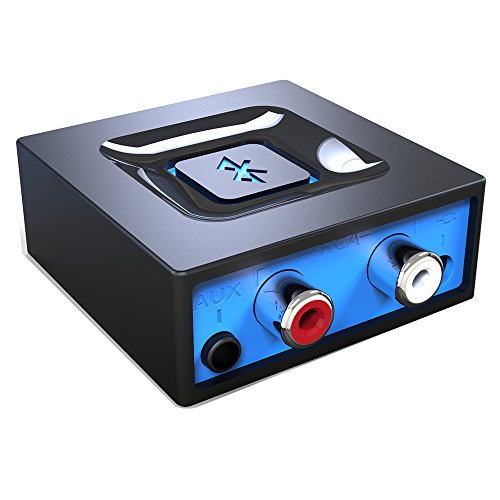
The Esinkin adapter is a compact way to add Bluetooth music streaming to a compatible receiver or speaker system. It connects to audio equipment through either a 3.5 mm cable or an RCA cable, then pairs with a Bluetooth device such as a smartphone or tablet.
Best for: Buyers who want a basic, easy-to-operate Bluetooth receiver for an existing stereo. The large central Bluetooth button handles connection and disconnection, while holding it for three seconds turns the adapter on or off. It can reconnect automatically to the previously paired device.
The listed indoor range is approximately 30 to 40 feet without obstacles. This makes it a practical choice when the phone and receiver are in the same room or nearby rooms with a relatively clear signal path.
Limitation: The stated range is shorter than the long-range figure listed for the 1Mii B06Pro, and the Esinkin connects through 3.5 mm or RCA rather than optical or coaxial inputs. Choose it if those analog connections are available; avoid it if your receiver requires a digital input.
1Mii 2.4GHz Wireless Audio Set
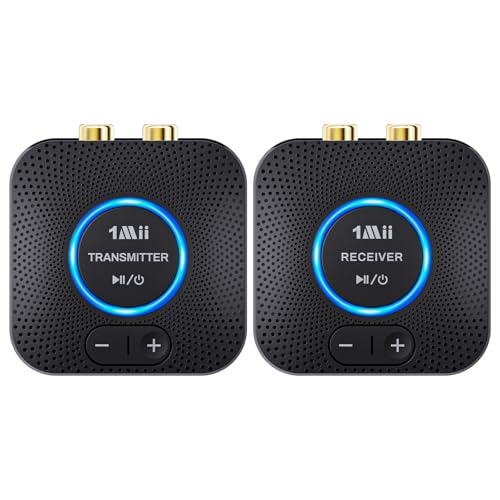
Unlike a single Bluetooth receiver, this 1Mii kit includes a transmitter and a receiver. Connect the transmitter to a source such as a TV, computer, CD player, or MP4 player, then connect the receiver to a powered speaker, amplifier, or home theater component. The listed connections include AUX and RCA.
Best for: Buyers who need to send audio from one location to a separate powered speaker or amplifier without running a long audio cable. The manufacturer lists 25 ms low latency and a wireless range of up to 262 feet. Those figures may help when comparing it with shorter-range Bluetooth receivers, but actual performance depends on the setup and surroundings.
The transmitter and receiver are described as entering pairing mode automatically after they are connected to power. The receiver supports AUX and RCA output at the same time, which can serve two powered speakers. The product information cautions against using AUX and RCA inputs simultaneously because the received audio may be mixed.
Limitation: This set is not intended for subwoofers, according to the product details. It also requires both a transmitter and receiver, so it is not the same simple phone-to-stereo Bluetooth setup as the Esinkin or KAIY.
KAIY Bluetooth Receiver For Home Stereo

The KAIY adapter is designed to add wireless music streaming to wired audio equipment. Its listed connections include RCA and 3.5 mm jacks, making it a potential fit for receivers, speakers, and other systems with compatible analog inputs. It also supports music playback from a TF card.
Best for: Buyers who want a Bluetooth receiver with NFC quick connection as an alternative to manual pairing. The product description says an NFC-enabled smartphone or tablet can connect by being brought close to the adapter. That feature is useful only if the mobile device supports NFC.
This model may suit someone who wants several playback options in one adapter: Bluetooth streaming, RCA or 3.5 mm audio output, and TF card playback. It is a receiver, so it takes wireless audio from a compatible source and passes it to wired audio equipment.
Limitation: NFC pairing depends on having an NFC-capable phone or tablet; it is not a universal one-touch feature for every mobile device. The listed information does not specify a wireless range, so compare it with models that publish a range if distance is a deciding factor.
1Mii B06Pro Long-Range Bluetooth Receiver

The 1Mii B06Pro is a Bluetooth receiver for streaming from a phone or other Bluetooth source to a stereo system. Its listed output connections include optical, RCA, AUX, and coaxial, giving it more connection choices than an adapter limited to analog RCA or 3.5 mm output.
Best for: Buyers who need a longer stated wireless range or want to connect a receiver using a digital audio input. The manufacturer lists up to 197 feet line-of-sight outdoors and 60 to 100 feet indoors without obstacles. It also notes that Wi-Fi routers, receiver antennas, and other conditions can affect range.
The B06Pro supports aptX Low Latency, aptX HD, and a selectable 3D audio mode. It also offers volume adjustment and track controls on the receiver. These features make it a better fit for listeners who want more control at the stereo rather than basic pairing alone.
Limitation: The listed aptX features do not guarantee that every connected phone or source will use them; source-device support matters. The quoted range is not a guarantee for a home with walls or sources of interference.
UGREEN Bluetooth 6.0 Receiver With LDAC

The UGREEN receiver is intended to bring Bluetooth audio streaming to old stereos, wired speakers, and home audio systems. Its distinguishing listed feature is LDAC decoding, with audio sampling rates up to 24-bit/96 kHz. The product details state that LDAC requires a compatible source device.
Best for: Buyers who prioritize LDAC support and want to pair two phones with one receiver. Two devices can be connected at once, but the product information says the second phone must pause playback while the other phone is playing.
The model uses a Bluetooth 6.0 chip, which the manufacturer describes as supporting stable, lower-latency transmission and reducing the possibility of interruptions and power consumption. Bluetooth version alone does not determine sound quality, so codec support on both the receiver and source is important when evaluating audio features.
Limitation: LDAC playback is not assured with older or incompatible phones and tablets. Check the source device’s Bluetooth codec support before choosing this model specifically for LDAC.
Buying Guide: How To Choose A Wireless Speaker Adapter
Do you need Bluetooth streaming or a wireless audio link?
A Bluetooth receiver takes audio from a phone, tablet, or other Bluetooth source and sends it to a wired stereo or speaker. It is the usual choice when the goal is to stream music from a personal device to an existing receiver.
A transmitter-and-receiver kit sends audio wirelessly between two pieces of audio equipment. It can be a better match when a TV or other source is far from powered speakers. Check whether the kit’s transmitter inputs and receiver outputs match the equipment at both ends.
Which input does your receiver have?
Check the rear panel or manual before buying. RCA and 3.5 mm are analog connections. Optical and coaxial are digital connections. Choose an adapter with an output that matches an available receiver input, or verify that you have the equipment needed to make the connection.
Also distinguish between a powered speaker and a passive speaker. Many wireless audio adapters provide a line-level signal and do not power passive speakers directly. The listed 1Mii 2.4GHz set is intended for powered speakers, an amplifier, or a home theater connection; the iFinity product details explicitly state that it does not work with passive speakers.
Does range matter in your room?
Compare the manufacturer’s stated range, but treat it as a reference rather than a guaranteed distance. Open-air line-of-sight range and indoor range are not directly equivalent. Walls, furniture, Wi-Fi equipment, and the placement of the adapter can affect a wireless connection.
For a receiver and phone in the same room, a basic Bluetooth adapter may be sufficient. For equipment in separate parts of a home, compare the listed range and connection type of a dedicated transmitter-and-receiver set or a long-range Bluetooth receiver.
Will the source device support the advertised audio features?
Features such as LDAC, aptX HD, and aptX Low Latency depend on source-device support. A receiver may list a codec, but the phone, tablet, or computer must also support it for that codec to be used. For ordinary streaming, matching the adapter’s physical connection to the receiver is often the first priority.
How important are controls and pairing?
Automatic reconnection can reduce setup steps if you regularly use the same phone. NFC pairing can be convenient when both devices support NFC. On-device volume or track controls may help when the stereo is not easily accessible, but they are not essential for every setup.
Frequently Asked Questions
Can a Bluetooth adapter make any receiver wireless?
It can add Bluetooth audio reception to a receiver with a compatible audio input. Check whether the adapter’s RCA, 3.5 mm, optical, or coaxial connection matches an available input. A Bluetooth adapter does not necessarily provide power to passive speakers.
What is the difference between a Bluetooth receiver and a transmitter-and-receiver set?
A Bluetooth receiver takes audio wirelessly from a Bluetooth source, such as a phone. A transmitter-and-receiver set sends audio from one piece of equipment to another using its paired transmitter and receiver units.
Can I connect a wireless adapter directly to passive speakers?
Usually, a receiver or adapter needs to connect to an amplifier or powered speaker to produce sound. Check the product’s stated requirements. The iFinity product details specifically say it does not work with passive speakers.
Will LDAC or aptX work with every phone?
No. The phone or other source must support the same codec as the adapter. If the source does not support the codec, the connection may use another supported Bluetooth audio option.
Does the listed wireless range guarantee the same range at home?
No. Published range figures depend on conditions and may be reduced by walls, obstacles, wireless interference, or equipment placement. Indoor range and open-air line-of-sight range should be compared separately.