
The best wireless transmitter for an electric guitar depends on your playing environment, battery needs, and preferred features. The JOYO JW-06 is best for players who want a charging case and 5.8GHz transmission; the LEKATO WS-100 suits players who value a case and multiple channels; and the JOYO JW-03 offers a rotating plug and up to eight hours of use. The comparison below highlights the listed features and limitations of five rechargeable systems.
| System | Best for | Notable listed feature |
|---|---|---|
| JOYO JW-03 | Practice and small venues | 220-degree plug and up to 8 hours |
| JOYO JW-06 | Players wanting a charging case | 5.8GHz and 18-hour total case-supported playtime |
| INGPARTNER A9 | Basic plug-and-play use | Stated range of over 100 feet |
| LEKATO WS-100 | Players needing four channels | Charging case and dual plug sizes |
| New Bee 2.4GHz system | Players needing a rotating plug | Six channels and 280-degree plug |
JOYO JW-03: Best For Everyday Practice

The JOYO JW-03 is a 2.4GHz transmitter-and-receiver set with four selectable channels. Its listed latency is under 5 milliseconds, and the stated open-area range is up to 65 feet. The built-in rechargeable batteries provide up to eight hours of continuous use per full charge.
Best for: Guitarists who want a straightforward rechargeable system for home practice, recording, rehearsal, worship services, or small venues. The 220-degree rotating 1/4-inch plug is a practical reason to choose it when a guitar’s jack is recessed or awkwardly positioned. It is listed for electric guitar, bass, and acoustic-electric instruments with most active or passive pickups.
The included dual-head USB cable charges the transmitter and receiver together. This can simplify charging between sessions, though it does not eliminate the need to keep both units charged.
Limitation: The product information does not recommend this model for large stages or environments with heavy Wi-Fi or Bluetooth activity. Its stated range is an open-area figure, so obstructions may affect practical use.
JOYO JW-06: Best With A Charging Case

The JOYO JW-06 uses 5.8GHz digital transmission and lists 48kHz/24-bit audio, latency under 6 milliseconds, and four channels. Each charge provides up to six hours of use. The included charging case can provide two full recharges, for a stated total of up to 18 hours.
Best for: Players who want a case that stores and recharges the units, especially for practice, recording, rehearsals, worship, and small gigs. Compared with the JW-03, this model’s listed advantage is the case-supported total playtime and 5.8GHz band rather than a longer single charge.
The listed range is 65 to 100 feet in open areas. The product information recommends a shorter distance of about 30 to 50 feet when walls or other obstructions are present. It also suggests switching channels if nearby electronics cause noise or dropouts.
Limitation: The six-hour figure applies to a single charge, not continuous operation for the full 18 hours without recharging. The stated range should not be treated as a guarantee through walls or across every venue.
INGPARTNER A9: Best For Simple Setup

The INGPARTNER A9 is a 2.4GHz wireless system described as plug and play: the transmitter and receiver connect when turned on, according to its product information. It has built-in rechargeable batteries and includes a double-sided USB cable for charging both units at the same time.
Best for: Players who prioritize a basic setup and a stated range of over 100 feet. The product listing claims latency under 4 milliseconds and describes the signal as uncompressed. Its indicator lights are listed as red for charging, green for acoustic guitar, and blue for electric guitar.
Choose this system if you want to avoid pairing steps and prefer simultaneous charging with one included cable. Its listed instrument types include electric instruments, and the product name identifies it as a system for electric instruments.
Limitation: The provided features do not specify battery runtime, selectable channels, or a charging case. The listing says to use a 5V charger and warns that using a different charging voltage may damage the battery, so check the power supply before charging.
LEKATO WS-100: Best For Channel Options

The LEKATO WS-100 is a rechargeable 2.4GHz system with four channels and a charging case. The product information lists up to six hours of use per charge and more than 12 hours of total use with two case recharges. It also lists latency below 6.7 milliseconds and a 100-foot effective transmission range.
Best for: Players who want a case for storage and recharging, or bands that need several wireless systems. The listing says four sets can operate simultaneously on its four channels. It also includes dual plugs in 3.5mm and 6.35mm sizes, a distinguishing feature for buyers who need those plug options.
Compared with a simpler single-pair system, the WS-100 is a better fit when channel selection and case-supported battery use matter. The stated 100-foot range and latency are product specifications, not a guarantee of performance in every room or stage setup.
Limitation: The product details do not explain how the two plug sizes affect use with particular instruments or equipment. Check the connection requirements of your setup before choosing it.
New Bee: Best For Six Channels
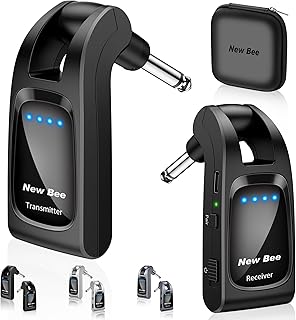
This New Bee system lists six channels, 24-bit/48kHz audio, a rechargeable battery, and a 280-degree rotating plug. Its stated operating distance is over 20 meters. The product information says the battery provides at least six hours of working time after a two-hour full charge.
Best for: Guitarists who want more listed channel choices than the four-channel systems in this comparison, or who need a widely rotating plug to reach a difficult instrument jack. The listing describes the system as plug and play and says it can be used with active or passive pickup devices, electric guitars, basses, acoustic guitars, and other digital music instruments.
The included dual-end USB-C cable is listed as a charging feature, and the system has a battery indicator. These details may help players plan charging and check power status before a session.
Limitation: The product information notes, “No open ‘AMP’ function when use in audio,” but does not clarify what that means. Buyers should confirm that the described operating behavior fits their setup. The stated distance is over 20 meters, not a guaranteed range in obstructed spaces.
Buying Guide: How To Choose A Wireless Guitar Transmitter
How much range do you need?
Start with the size and layout of the space where you will play. A short range may be enough for home practice, while a larger rehearsal room or small venue may call for more room to move. Compare stated ranges carefully: the JOYO JW-03 lists up to 65 feet in open areas, while the INGPARTNER A9 and LEKATO WS-100 list over 100 feet and 100 feet, respectively. The JOYO JW-06 lists 65 to 100 feet in open areas.
Open-area specifications do not account for every wall, person, or electronic device between the transmitter and receiver. The JW-06 listing specifically recommends shorter distances when walls or obstructions are present. If you will use a system onstage, test it in the actual space before relying on it for a performance.
Does the wireless band matter?
Most products here use 2.4GHz; the JOYO JW-06 uses 5.8GHz. Band alone does not establish which system will perform better in your particular location. The JW-03 listing cautions against use in environments with heavy Wi-Fi or Bluetooth activity, while the JW-06 suggests changing channels if nearby electronics cause interference. Consider the electronics around your playing area and whether channel selection is available.
How should you compare channels?
Channels can matter when multiple wireless systems are used in the same space. The products list four selectable channels for the JOYO JW-03 and JW-06, four channels for the LEKATO WS-100, and six channels for the New Bee system. The LEKATO listing specifically says that four sets can run simultaneously. Do not assume that channel count alone guarantees interference-free operation; follow the product instructions and test the setup together.
What battery setup suits your routine?
Compare single-charge runtime with total runtime that includes a case. The JOYO JW-03 lists up to eight hours on a full charge. The JOYO JW-06 lists up to six hours per charge and up to 18 hours with two case recharges. The LEKATO WS-100 lists six hours per charge and more than 12 hours with its case. The New Bee system lists at least six hours after a two-hour charge. The INGPARTNER A9 features do not state runtime.
A charging case can reduce the need to find a separate power source between sets, but it adds an item to carry. A dual-end charging cable, as included with some systems, can charge both units together. Check whether the charging method and runtime match how long you practice or perform.
Will the plug fit your guitar?
Inspect where the instrument’s output jack sits and how much room surrounds it. Rotating connectors may help with recessed or awkwardly positioned jacks: the JW-03 lists a 220-degree rotation, and the New Bee lists 280 degrees. The LEKATO system lists 3.5mm and 6.35mm dual plugs. These details are not interchangeable, so verify the connector type and physical fit for your instrument before buying.
How important are latency and audio specifications?
Latency describes the delay between playing and hearing the sound through the wireless link. The listed figures range from under 4 milliseconds for the INGPARTNER A9 to under 6.7 milliseconds for the LEKATO WS-100. Other listed figures include under 5 milliseconds for the JOYO JW-03 and under 6 milliseconds for the JW-06. The New Bee listing specifies 24-bit/48kHz audio but does not provide a latency figure in the supplied features.
Use these specifications as comparison points, not as a substitute for testing. If tight timing is important for your playing, pay attention to both the stated latency and whether the system remains stable in the room where you plan to use it.
Frequently Asked Questions
Can a wireless guitar transmitter replace a regular instrument cable?
A transmitter-and-receiver system sends the instrument signal wirelessly between the guitar and the receiving unit. The receiver still needs to connect to the next device in your signal chain. Check the system’s connectors and your equipment’s input requirements before use.
Are these wireless systems rechargeable?
All five products in this comparison list built-in rechargeable batteries. Their stated runtime and charging features differ, and the INGPARTNER A9 features provided here do not state a battery runtime.
Can I use these systems with a bass?
The JOYO JW-03, JOYO JW-06, LEKATO WS-100, and New Bee listings specify bass use. The INGPARTNER A9 is described for electric instruments, but the supplied features do not specifically name bass.
Is a longer stated range always better?
No. The usable distance depends on the room and possible obstructions or interference. Treat manufacturer range figures as comparison specifications, and test the system in your intended environment.
What should I check before using a transmitter at a gig?
Confirm that the plugs fit, charge both units, select an available channel if the model supports channel selection, and test the connection in the venue. Check the product’s charging instructions and any stated range limitations before relying on it for a performance.