

Powered vs. Passive Speakers: Build the Right Signal Chain
Draw the whole route from your music source to the speakers. The amplifier has to be somewhere, and each cable needs to connect the right kind of output to the right kind of input.
In this guide
- Find the amplifier before choosing a cable
- Build a passive-speaker route around the amplifier
- Check which cabinet receives power and the source signal
- Powered and active don't describe every circuit in the same way
- Keep line-level inputs and speaker outputs distinct
- Map the functions your music source needs
- Compare the complete setup in the space available
- Finish with a route you can explain in one sentence
Find the amplifier before choosing a cable 1
Passive speakers need a suitable external amplifier, while powered speakers have amplification within the speaker system. That is the first distinction to settle, because a cable or adapter can't replace the job of amplifying a signal for a passive loudspeaker.
Look at the model documentation and rear-panel labels rather than judging from the cabinet's size. A compact speaker can belong to either kind of system, and a pair with one powered cabinet may use the second cabinet differently from two independently powered monitors.
Write the model names on a simple sketch of your setup, including the device that supplies the music. This helps you identify missing functions before ordering accessories, especially when a computer, television, turntable, or receiver already provides part of the chain.
Build a passive-speaker route around the amplifier 1
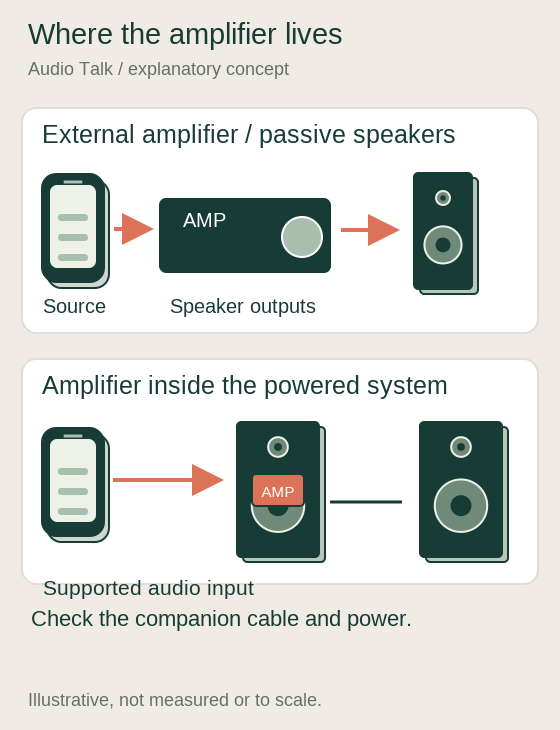
A common passive route is source to amplifier, then amplifier speaker outputs to the passive speakers. The source connection carries an audio signal into the amplifier, while the speaker connection carries the amplifier's output to the loudspeaker terminals.
If you already own a stereo receiver or integrated amplifier, start by checking its input and speaker specifications. Its presence may make passive speakers a practical choice, but compatibility still depends on the actual load, connections, and manufacturer's instructions.
Turn the equipment off before making speaker-wire connections, and follow the terminal and polarity instructions for both devices. Keep stray wire strands from bridging terminals, because tidy connections matter more than an expensive cable package with unclear specifications.
Don't run a passive speaker directly from a laptop's ordinary headphone socket and expect a useful speaker system. A headphone output is intended for a different load and task, so identify a proper amplifier rather than improvising adapters until something makes faint sound.
Check which cabinet receives power and the source signal
With a powered system, the source connects to an input on the speaker system, and the documented power connection supplies its amplifier. You still need to know whether that input accepts analog audio, USB audio, optical digital audio, or another supported signal.
Some powered pairs use one main cabinet with a cable to the companion speaker. Other setups use separate powered speakers, so count the required outlets and check the inter-speaker connection in the actual manual instead of assuming every pair wires up the same way.
A USB socket doesn't automatically mean USB audio, and a power adapter doesn't explain the source connection. Look for the specific function beside each port and keep the supplied power arrangement separate from the cable carrying your music.
For a desk setup, sketch the cable route from the computer and leave space behind the cabinets for the plugs. A speaker can fit the measured shelf depth while its connected cable doesn't, so make the plan with the working setup in mind.
Powered and active don't describe every circuit in the same way 2
In casual shopping language, active and powered are often used together, but an active crossover design describes something more specific. Genelec explains a system that divides the audio into frequency bands before separate amplifiers drive the corresponding speaker units.
A product's built-in amplifier alone doesn't establish that it uses that exact architecture. If the distinction matters to your comparison, read the manufacturer's description rather than assuming every powered pair contains one amplifier for each driver.
For an everyday setup decision, the more immediate question is still what equipment and connections you need outside the cabinets. The internal design is useful context, but it shouldn't distract you from an unsupported input or a missing volume-control plan.
You also don't need to declare one architecture automatically better at every price. Compare the exact systems, their documented functions, their size, and how you intend to use them instead of turning a circuit label into an untested sound-quality ranking.
Keep line-level inputs and speaker outputs distinct
Read the labels at both ends of each connection before plugging it in. An amplifier's speaker output and a powered speaker's line input aren't interchangeable simply because an adapter can physically join the connectors.
If your source is a receiver, check whether it has a documented preamp output suitable for the powered speakers you want to use. Don't substitute its amplified speaker terminals unless the receiving product explicitly supports that kind of connection and provides instructions.
Similarly, a subwoofer output isn't necessarily a full-range stereo output for a pair of speakers. Identify the intended signal and channels, because connector shape alone won't tell you whether the output includes the music information your speakers require.
When the labels aren't clear, stop and consult both manuals or the manufacturers' support teams. Describing “output labeled X to input labeled Y” is much more useful than asking whether a cable with the right-shaped ends should work.
Map the functions your music source needs
A computer using USB audio needs a receiving USB audio device, which may be built into powered speakers or a separate DAC. A computer using an analog output follows a different route, so decide which connection you're actually planning before comparing speaker features.
For television use, check the TV's outputs, the speaker system's supported inputs, and how you'll control volume. A system that sounds promising on paper can still be awkward if the TV remote doesn't control it and the speakers sit out of reach.
A turntable adds a separate question about the phono stage. Identify whether the turntable, amplifier, or powered speakers provide that function, then follow the PHONO and LINE instructions rather than assuming all analog RCA sockets accept the same signal.
If you use several sources, list them before buying a system with only one convenient input. Switching a cable occasionally might be fine for your routine, but it should be an intentional tradeoff rather than a surprise after the speakers arrive.
Compare the complete setup in the space available
For a passive setup, include the amplifier's footprint, ventilation requirements, and access to controls in your desk or shelf plan. The speaker cabinets are only part of the physical system, even when the amplifier is a small desktop model.
For a powered setup, include power adapters, outlet access, and the connection between the speakers. Fewer separate boxes can be convenient, but it doesn't necessarily mean fewer visible cables or that every required function fits inside the cabinets.
Measure the space where you can place the speakers around your normal listening seat. Leave a usable route for doors, drawers, and power cables, and follow the product's placement instructions rather than forcing it into a space that prevents proper use.
Think about repairs and future changes as practical preferences, too. Separating speakers and amplification may suit someone who wants to change individual parts, while another listener may prefer a compact system whose documented inputs already cover the whole routine.
Finish with a route you can explain in one sentence
For the passive option, your sentence should identify the source connection, the external amplifier, and the speaker-wire connection. For the powered option, it should identify the supported source input, the speaker system's power, and any companion-speaker cable.
Then mark who controls the volume and which device provides any needed digital conversion or phono stage. If a box on the sketch has no defined job, investigate it before buying rather than adding equipment because other people's setups contain it.
Check the manuals one final time against the exact model names and planned connections. Keep the sketch with those instructions so you can assemble the system in a sensible order and explain the route if you need support later.
Once every function has a place, the powered-versus-passive decision becomes much less mysterious. Choose the arrangement that fits your existing gear, daily controls, and room, then spend your effort on positioning and using it well.
Sources & how this guide was prepared
Audio Talk Editorial checked these primary sources on October 14, 2026. This is a research-based guide with original practical examples; it does not report our own equipment tests.
Manufacturer instructions for your exact model take priority. Read our editorial method · Photo and illustration credits