
Bookshelf Speaker Placement for Small Rooms
A practical way to find clearer voices, more even bass, and a useful stereo image without giving your whole room over to speakers.
In this guide
- Start with the room you actually have
- Choose the listening seat before moving the speakers
- Give the left and right speakers similar surroundings
- Use a listening triangle as your first layout
- Check height from a seated position
- Treat wall distance as an experiment
- Try the speaker angle your model recommends
- If a shelf or desk is your only option
- Run a short comparison you can repeat
- A practical example for a compact living room
- Know when the setup is good enough
Start with the room you actually have
In a small room, place your bookshelf speakers around your usual seat, give both sides a reasonably similar setup, and follow your model's placement instructions. Then compare a few small moves before buying anything.
You don't need to turn an apartment living room into a recording studio to get started. A chair, tape measure, familiar song, and a little patience give you a useful way to compare the options you already have.
The goal is a setup you enjoy using, with voices that are easy to follow and bass that doesn't overwhelm every song. Start with the steps below, and keep the changes that help from the seat where you actually listen.
Choose the listening seat before moving the speakers 1
Pick your main listening spot: the center cushion, your desk chair, or the armchair you use after work. Setting up for that location is more useful than aiming at an imaginary spot nobody ever occupies.
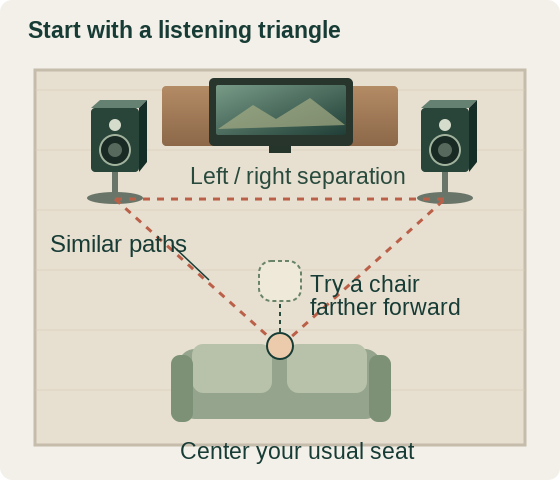
Genelec's placement guidance explains that bass can change with the listener's position in a room. If the sofa sits against the back wall, compare your normal seat with a chair temporarily placed farther forward.
Don't treat that experiment as a demand to rearrange the living room permanently. It simply helps you find out whether the seat is part of the problem before you spend an afternoon moving speakers.
Leave doors, drawers, and walking paths usable while you try positions. If a promising arrangement makes everyday life awkward, write it down as a reference and look for a nearby compromise.
Give the left and right speakers similar surroundings 1
Aim for roughly matching wall distances and speaker heights on both sides, with your main seat centered between them. Genelec links this left-right symmetry to more consistent reflections and stereo imaging.
In practice, look for obvious mismatches: one speaker tucked into a corner while the other faces an open doorway, for example. You may not be able to change the doorway, but you can try moving the pair away from that corner.
Keep the same measuring points each time, such as the center of each speaker's front face and the spot where your head rests. A simple sketch saves you from confusing the cabinet's back edge with its front during later comparisons.
Perfect symmetry isn't a realistic requirement for every home. Get the basics close, listen, and decide whether an audible problem remains before moving furniture you need.
Use a listening triangle as your first layout 2
A useful starting point is roughly equal distances between the two speakers and from each speaker to your head. KEF describes this triangle as a placement goal while acknowledging the compromises of a furnished room.
For a close desk setup, build the triangle around the chair rather than spreading the speakers across the room. For a sofa setup, try enough separation to hear a sense of space without automatically pushing each cabinet into a corner.
Put on a recording with a centered lead vocal and listen from the middle seat. If the voice seems split between the boxes, compare a narrower arrangement; keep a short note so you can return to your starting point.
Check height from a seated position 3
For many conventional bookshelf speakers, a sensible starting point is tweeters near seated ear height. ELAC recommends this approach, although your own speaker's manual should take priority if it specifies a different listening axis.
Sit down before measuring, because a standing estimate can put the speakers far above where you listen. On a desk, compare the tweeter position with your ears when you're sitting normally, rather than leaning toward the screen.
Stands can help with height and placement flexibility, but first check whether your existing support works. Use a stable solution that fits the speaker, and avoid balancing a heavy cabinet on a stack of loose objects.
Treat wall distance as an experiment 1 3
Nearby walls and corners can make bass less even, but there's no single clearance that works for every speaker and room. Start with the manufacturer's guidance, including any instructions for rear ports or supplied port plugs.
If you have room to move, mark the current position and compare it with one a few inches farther out. That small move is an experiment, not a promised improvement or a substitute for your model's stated clearance.
Use a song with several distinct bass notes rather than one long rumble. Listen for whether the notes become easier to tell apart, and check that the same move hasn't made voices or the overall balance less enjoyable.
Wall reflections can also reduce certain frequencies, so more bass isn't the only possible result. Genelec explains that placement affects these interactions; keep whichever tested position sounds more balanced from your seat.
Try the speaker angle your model recommends 4
Toe-in means rotating the speakers inward toward the listener. It is not a rule that every speaker must point directly at your nose, and the preferred angle can depend on the design.
For example, KEF's setup article suggests beginning with its speakers facing straight ahead, then comparing small inward adjustments. Follow your own model's instructions rather than borrowing that starting angle for every brand.
Move both speakers by a similar amount, replay the same passage, and listen from the usual seat. If more than one person uses the sofa, check the neighboring cushion too before choosing the angle.
If a shelf or desk is your only option 5
Work with the surface you have before deciding you need new stands. Check that each cabinet is stable, that books or decorations aren't in front of the drivers, and that the available space meets the manual's requirements.
On a desk, keep the two speakers at comparable heights and avoid hiding one behind the monitor. If you try moving a cabinet toward the front of a shelf, leave its base fully supported and check the shelf's load rating.
Wall mounting can free up furniture space, but it adds decisions about brackets, fixings, and placement. ELAC's support guidance calls for hardware rated for the speaker's size and weight, with suitable support for the total load.
Run a short comparison you can repeat
Choose three familiar tracks: one with a clear vocal, one with changing bass notes, and one with instruments spread across the stereo image. Familiarity makes it easier to explain what changed in words you actually understand.
Keep playback level and sound settings the same while comparing positions. Turn off optional bass boosts for the experiment if you can, and restore your preferred settings afterward.
Change only one thing at a time: speaker separation, wall distance, angle, or chair position. Replay the same short passage after each move instead of judging a new position from a completely different song.
Write observations such as 'voice stays centered' or 'lowest note dominates less' next to the position. If you can't hear a useful difference, choose the arrangement that fits the room better and move on.
A practical example for a compact living room
Imagine a pair of bookshelf speakers on a media cabinet, with a sofa opposite and a doorway beside one end. Start by measuring both speaker-to-seat distances and checking whether the cabinets sit at matching heights.
If the speakers are crowded together around the television, compare a little more separation while keeping both bases supported. Then compare the current wall distance with a modest forward move that leaves the cabinet usable.
If the bass still seems uneven, try a chair slightly in front of the sofa before changing anything else. These are proposed comparison steps, not results from a tested room, and you may prefer the original layout.
Photograph the position you choose and record the key distances. When someone moves a speaker to clean the cabinet, you'll have an easy way to restore the arrangement without starting over.
Know when the setup is good enough
Stop when your favorite recordings are easy to enjoy, the speakers fit everyday life, and further moves don't offer a clear benefit. You don't have to keep chasing an ideal diagram once you've found a practical arrangement.
If a specific problem remains, describe it before shopping: a wandering vocal, a rattling shelf, or one bass note that takes over. That description gives your next troubleshooting step a purpose instead of turning placement into an endless upgrade project.
Sources & how this guide was prepared
Audio Talk Editorial checked these primary sources on October 14, 2026. This is a research-based guide with original practical examples; it does not report our own equipment tests.
- Genelec: How to Position Studio Monitors and Find the Best Listening Position
- KEF: 5 Tips for Positioning Your Speakers and Television
- ELAC: Speaker Placement Guide: Get The Best Sound From Your Stereo
- KEF: How to Set Up Your Speakers
- ELAC Support: Can I Mount Your Bookshelf Speakers on the Wall?
Manufacturer instructions for your exact model take priority. Read our editorial method · Photo and illustration credits