
Where to Put a Subwoofer—and How to Find the Best Spot
Choose a few usable positions, keep the playback conditions steady, and compare from your actual seat. The loudest spot is not automatically the most useful one.
In this guide
- Decide where the bass needs to work
- Make a room plan with real constraints
- Compare positions with one repeatable passage
- Use the subwoofer crawl only when the setup makes it practical
- Check the other seats before keeping the location
- Separate placement from level and integration settings
- Know what a louder setting can't solve
- Keep the best usable setup, not the most dramatic demonstration
Decide where the bass needs to work 1
Start with your main listening seat and a short list of places where the subwoofer can safely fit. Room boundaries and the relationship between the subwoofer and seat can change the bass response, so a location that looks convenient deserves a listening check.
SVS describes placement and listening position as linked parts of the problem. That makes the sofa or desk chair a useful reference point, rather than judging the subwoofer only while standing beside it or walking across the room.
Your target is bass that lets you follow different notes and enjoy the overall balance at an ordinary level. A spot that produces one impressive rumble but makes several notes disappear may be less useful than a quieter, more even arrangement.
Make a room plan with real constraints
Mark two or three locations you can genuinely live with, such as near the front speakers or beside a cabinet. Include the power outlet, signal-cable route, doors, and the clearances your exact subwoofer needs.
Keep the cabinet stable and avoid blocking its ports or required ventilation. A location inside tight furniture may look tidy, but it needs to meet the manufacturer's instructions rather than treating any space that fits the outside dimensions as suitable.
Consider neighbors and shared walls when deciding how you'll use the system, but don't expect a placement change alone to guarantee that bass won't carry. Keep playback considerate and assess the normal listening routine instead of testing at excessive levels.
If the subwoofer is large or heavy, arrange help and a safe route before moving it. The search for a better position isn't a reason to lift a cabinet onto unstable furniture or drag it by its cable.
Compare positions with one repeatable passage
Choose a familiar track with several clearly changing bass notes, and loop a short passage if the player allows it. Keep the source level and system settings the same while comparing the first locations so the position is the main variable.
After each move, return to the main seat and listen to the same passage. Write down whether the notes feel more even, whether a particular note dominates, and whether the bass fits with voices and the rest of the music.
Don't increase the subwoofer level just because one position sounds less dramatic at first. That would mix a level change into the placement comparison, making it harder to learn what the room and location are doing.
Also replay a spoken or quieter passage before deciding a position is better. Your system needs to remain enjoyable across normal material, not only during the bass-heavy moment you used to find the first difference.
Use the subwoofer crawl only when the setup makes it practical 1
SVS describes placing the subwoofer at or near the listening position and listening at possible subwoofer locations for more balanced bass. The method reverses the usual comparison and can help narrow the shortlist before returning the subwoofer to a usable location.
Use a stable, safe placement near that listening position and get help when the cabinet requires it. You don't need to copy a photograph of a subwoofer on a sofa or move a heavy model into an arrangement you can't manage safely.
Play the same bass passage at a modest level and compare the candidate locations from a similar listening height. Keep the exercise focused on the spots you've already judged practical, rather than finding a promising position that blocks the only doorway.
Move the subwoofer to the most promising candidate and listen again from the normal seat. The final installed arrangement still needs that check, because the preliminary exercise is a way to investigate the room rather than a guarantee about the complete setup.
Check the other seats before keeping the location 1
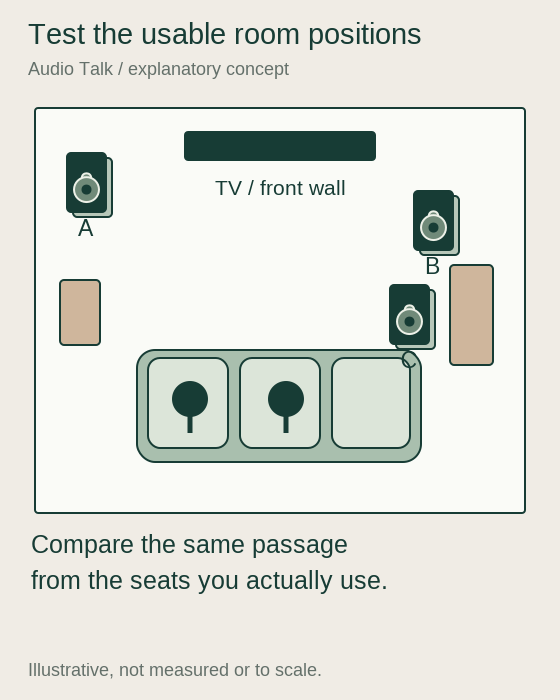
If several people watch television together, visit the neighboring seats during the comparison. A single subwoofer can produce different results across the room, so your preferred cushion shouldn't be the only place considered for a shared system.
Keep a simple note for each seat, using the same short passage and descriptive terms. You might find one location gives the main seat the strongest bass while another creates a more comfortable compromise across the whole sofa.
SVS also recommends remaining flexible about the listening location, because small changes in seat position can matter. If the room allows it, compare a chair slightly forward or to the side before deciding the subwoofer is the only thing that must move.
Treat a temporary chair position as information rather than an instruction to rearrange your home permanently. It can show why the sound changes, then help you find a nearby compromise that still works with the room's everyday use.
Separate placement from level and integration settings
Once you've chosen a workable location, check the level and crossover instructions for your system. Those settings affect how the subwoofer joins the main speakers, and they deserve a separate comparison instead of being adjusted randomly throughout the placement search.
If an AV receiver provides setup calibration, follow its microphone and procedure instructions after the system is in the arrangement you intend to keep. Record the results before making manual changes so you can return to the calibrated starting point.
Don't assume the same crossover or phase setting applies to every speaker pair and room. Use the manuals for the actual receiver, subwoofer, and speakers, especially when one device is meant to manage a function that another device also offers.
If a control changes the result, note which device and setting you adjusted. That small record helps you avoid accidentally stacking different filters or treating a saved receiver setting as though it came from a knob on the subwoofer.
Know what a louder setting can't solve
If one note remains weak while another dominates, simply adding level may make the strong note more annoying without producing the balance you want. Revisit the position and seat comparison before assuming more amplifier power or a different cable is the missing answer.
Check that the subwoofer is receiving a signal on the input and mode documented for your setup. A connection or source-setting problem should be investigated separately from room effects, particularly if bass disappears completely on material that previously played normally.
Use any available EQ according to its instructions, and avoid assuming an aggressive boost can repair every room-related dip. Keep changes conservative and return to the practical placement options when a setting makes the overall result less predictable.
If you need help, share a room sketch, model names, connection path, seat locations, and the settings you've already tried. A clear description of uneven notes and positions is more useful than asking support for one universal best place.
Keep the best usable setup, not the most dramatic demonstration
Photograph or sketch the final position and record the relevant settings once you've settled on a useful balance. A simple reference makes it easier to restore the setup after cleaning, moving furniture, or reconnecting a cable.
Recheck from the normal seats with ordinary music and television at the level you actually use. This final pass can reveal a practical annoyance that didn't show up during the short bass loop, such as a rattling object or an obstructed drawer.
You don't need to continue moving the cabinet after the arrangement works well enough for your room and routine. Placement is a useful experiment, but the result should help you enjoy the system rather than create a permanent search for an imaginary perfect spot.
If you later make a substantial room or seating change, repeat the same brief method from your saved baseline. Knowing how you compared the options lets you make that adjustment with far less guesswork the next time.
Sources & how this guide was prepared
Audio Talk Editorial checked these primary sources on October 14, 2026. This is a research-based guide with original practical examples; it does not report our own equipment tests.
Manufacturer instructions for your exact model take priority. Read our editorial method · Photo and illustration credits