
Best 2.4GHz Antenna Long Range for WiFi: Clear Picks for Extended Coverage
Find the right 2.4GHz antenna long range for your network needs. This guide highlights five top options designed to maximize 2.4GHz performance for home offices, garages, security cameras, and small business setups. Best for outdoor, weatherproof use, point-to-point links, and enhanced security camera feeds. See a quick buyer’s table below to compare core specs at a glance.
Buyer’s summary table (selected products):
- Product: 10dBi Long Range Dual Band Antenna — Best for: outdoor WiFi routers and security systems needing durable, weatherproof gain.
- Product: Kaunosta 22dBi Omni-Directional — Best for: detached buildings and long open-area links where mounting height is feasible.
- Product: Outdoor 15dBi Dual Band Panel — Best for: fixed installations requiring a compact, directional panel with strong range.
- Product: 9dBi Long Range Dual Band — Best for: versatile, mid-range coverage for routers and IP cameras.
- Product: Yagi 25dBi Long Range — Best for: highly directional, long-distance links where alignment is precise.
10dBi Long Range Dual Band Antenna

This outdoor, fiberglass antenna delivers 10dBi gain for 2.4GHz and 5GHz bands, with IP65 weatherproofing and RP-SMA Male connector compatibility. It’s best for outdoor WiFi routers, PCIe adapters, and IP cameras that require resilience against the elements. Choose this if you need a rugged, dual-band range boost for external installations. Limitation: directional gain means precise aiming is essential for peak performance.
Kaunosta 22dBi Omni-Directional Antenna

This high-gain, omnidirectional antenna is designed to extend 2.4GHz signals to detached garages and garden cameras. With 22dBi gain and a 10-foot extension cable, it supports long-range links without needing line-of-sight to the router. Best for property peripherals far from the primary router. Limitation: omnidirectional gain can pick up more interference from nearby networks; suitable mounting height helps minimize obstructions.
Outdoor 15dBi Dual Band Panel Antenna
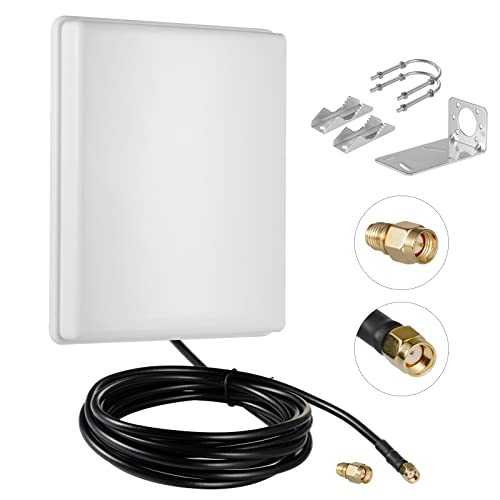
This directional panel antenna provides 15dBi gain on both 2.4GHz and 5GHz bands, optimized for outdoor use with weatherproof construction. It suits fixed installations where you can aim toward the signal source, such as a distant router or access point. Best for security cameras and IP networks that require a stable, focused link. Limitation: directional design means misalignment reduces performance; ensure secure mounting and proper orientation.
9dBi Long Range Dual Band Antenna

This compact, dual-band antenna offers a practical 9dBi gain for 2.4GHz and 5GHz, suitable for routers, access points, and IP cameras needing modest long-range improvement. Best for mid-range setups where higher-gain options are not necessary or where space is limited. Limitation: not the highest gain among options; expect narrower improved range than higher-dBi models.
Yagi 25dBi Long Range Antenna

This highly directional Yagi antenna delivers 25dBi, ideal for long-distance, point-to-point links. It includes a 1.5 m cable for flexible placement and a robust 50-ohm input impedance to minimize mismatch losses. Best for access point hops or camera feeds across large yards or campuses. Limitation: requires precise alignment toward the signal source; not ideal for broad-area coverage.
2 x 8dBi Dual Band Antennas

This pack includes two 8dBi dual-band antennas with RP-SMA connectors, designed to extend wireless range and reduce dead spots. Best for users who want a balanced, cost-effective option and plan to deploy multiple antennas across a single network. Limitation: lower gain compared to higher-dBi options; may require additional antennas to achieve similar coverage as top picks.
Buying Guide: Key Considerations For 2.4GHz Long-Range Antennas
- Gain vs. directionality: Higher dBi gains (like 22dBi or 25dBi) provide longer reach but require precise aiming. Lower-gain omni antennas offer broader coverage but shorter reach.
- Environment: Outdoor, weatherproof antennas are essential where exposure to the elements is expected. Indoor antennas suit compact, controlled spaces.
- Frequency range: Ensure compatibility with 2.4GHz devices and any dual-band requirements if you also rely on 5GHz.
- Antenna type: Omni-directional is best for general coverage; directional (panel or Yagi) is better for targeted, long-range links.
- Connector and cable: RP-SMA and RP-SMA Male connectors are common; longer extension cables enable flexible mounting but may introduce minor signal loss.
- Installation considerations: Mount height, line-of-sight, and obstacles affect performance. Align directional antennas toward the signal source for best results.
Frequently Asked Questions
- What makes a 2.4GHz antenna “long range”? — It typically refers to higher gain (dBi) that extends the usable distance of the signal, especially in open areas or through obstacles.
- Do I need weatherproofing for outdoor antennas? — Yes, outdoor antennas weatherproofing helps ensure reliability in rain, sun, and temperature swings.
- Is an omnidirectional antenna better than a directional one for home networks? — Omnidirectional offers broader coverage with less precise aiming, while directional antennas excel at long-range links to a specific point.
- Will higher dBi antennas decrease performance near the router? — Higher gain can lead to highly directional signals; improper alignment can reduce coverage in unintended areas.
- Can I use these antennas with any router? — Most RP-SMA and similar RP-SMA Male connectors are designed for compatibility with many WiFi routers, access points, and PCI adapters, but always confirm connector type and impedance matches your device.
- Do I need more than one antenna for a bigger home? — Depending on layout, multiple antennas or a mesh/point-to-point setup may be needed to cover different zones.