
Best 4 Pin Amphenol to XLR Cables for Pro Audio and Video Setups
Answer: This guide highlights top 5 4-pin XLR to Amphenol-compatible cables ideal for studio, stage, and on-location work. Each pick is evaluated for durability, shielding, and compatibility with gear like cameras, monitors, mixers, and power supplies. Best for: professionals needing reliable signal integrity (XLR audio paths) or robust power extensions in dynamic environments, and hobbyists seeking solid, affordable builds. The table below compares the featured products at a glance.
| Product | Use Case | Best For | Key Benefit |
|---|---|---|---|
| WORLDS BEST CABLES WBC-PRO-QUAD | 4-pin XLR to Amphenol power/mic path | Stage and studio professionals | Superior EMI/RFI rejection with Quad Star design |
| MEIRIYFA XLR 4 Pin | Main power or extension cable | DSLRs, monitors, power packs | Shielded, flexible, long 1.8M |
| Xilaghy 4-Pin XLR Extension | Patch cable for mic/speakers | Live sound and recording setups | Gold-plated contacts, robust shielding |
| Kallaudo 4-Pin XLR Cable | DIY upgrades | Durable plug housing with protective features | |
| CNCESS 4-Pin XLR Female to Female | Specialized routing and lab work | Female-to-female design for coupling |
WBC-PRO-QUAD Ultra-Silent Star-Quad XLR Cable

The WORLDS BEST CABLES WBC-PRO-QUAD uses a Star Quad design with four 0.08mm fine-stranded 99.99% oxygen-free copper cores. It features dense shielding (over 98% coverage) and a rugged black tweed jacket. This setup minimizes EMI and RFI, delivering clean signal transmission for stage and studio use. Best for: professionals requiring the quietest signal path and strong shielding in high-interference environments. Better for long cable runs where EMI/RFI are concerns. Caution: the bulkier construction may be less flexible in tight spaces.
MEIRIYFA XLR 4 Pin Male to Female Extension Patch Cable

This cable features XLR 4-pin male to female connections with shielded construction and a PVC black jacket. It offers a 1.8-meter length, making it suitable as the main power lead or an extension cable for video cameras, monitors, stage lights, mixers, and chargers. Best for: users needing a flexible, shielded power extension in DSLR or video setups. Choose this if you want a longer, lighter option for on-camera power. Limitation: not specified for ultra-high-flex environments where extremely frequent bending occurs.
Xilaghy 4-Pin XLR Extension Patch Cable
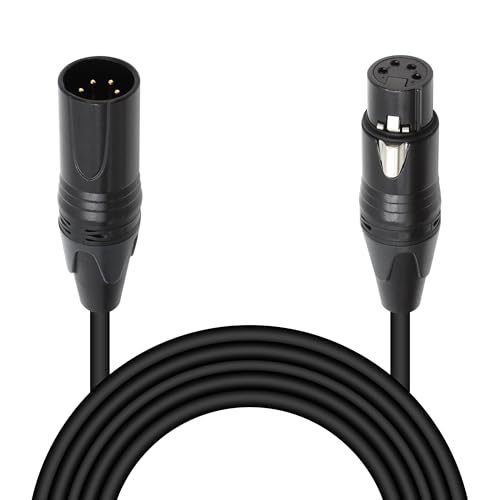
The Xilaghy cable uses oxidation-resistant pure copper with gold-plated contacts, providing durable signal transmission and noise shielding. It features a rugged die-cast alloy plug housing and a flexible PVC jacket for protection. Best for: live sound and studio applications where reliable audio paths are essential. Better for environments where EMI shielding is a priority. Caution: some users may prefer additional shielding for extremely long runs.
Kallaudo 4-Pin XLR Plug Cable, 2 Pack

The Kallaudo 4-pin XLR plugs are made with sturdy alloy die-casting and a black baked finish. The design includes rubber grommets to prevent plug drops and a flexible tail sleeve for cable protection. Best for: DIY cable upgrades and projects where a durable, visually clean connector is desired. Choose this if you want a cost-effective option with robust construction. Limitation: the description emphasizes durability over extreme high-flex testing.
CNCESS 4-Pin XLR Female to Female Coupler

The CNCESS coupler provides a female-to-female connection to facilitate balanced audio routing. It supports compatibility with 4-pin XLR gear and is shielded for tidy cable management. Best for: studios or setups needing simple coupling between two XLR lines. Limitation: as a coupler, it does not extend length by itself and relies on additional cable runs.
Buying Guide: 4-Pin Amphenol To XLR Cables
- Shielding and interference: For dense environments, prioritize cables with multiple shielding layers and high coverage to minimize EMI/RFI.
- Connector durability: Look for nickel or gold-plated contacts and rugged housings to reduce contact wear over time.
- Cable flexibility vs. length: Long, flexible cables are ideal for on-camera power but may be less manageable on tight racks.
- Application alignment: Choose main power cables for cameras and monitors, and patch or splitter cables for audio routing or stage needs.
- Amphenol compatibility: Ensure the Amphenol-influenced design matches your gear’s pin configuration and power requirements.
Frequently Asked Questions
- What is a 4-pin XLR used for? This configuration commonly carries power or balanced audio signals for professional gear.
- Are all 4-pin XLR cables interchangeable with Amphenol connectors? Many are compatible but verify pinout and shielding for your equipment.
- Why choose a shielded cable? Shielding reduces interference from nearby electrical devices, improving signal clarity.
- Is a coupler cable useful for extending runs? Yes, couplers allow additional cables to connect in a controlled path, but they do not add length by themselves.
- What should I consider when selecting for stage use? Prioritize durability, EMI/RFI shielding, and connector integrity for easy replacements during performances.