
Best Amplifier for PA System: Top Picks for Clear, Reliable Live Sound
Answering the question “which amplifier is best for a PA system?” this guide highlights five carefully chosen options that cover small rooms to bigger venues. These amplifiers are suited for event hosts, DJs, small venues, and offices that need dependable power, clear sound, and straightforward setup. Below you’ll find a quick buying table, followed by in-depth product sections and a practical buying guide.
| Product | Best For | Key Benefit |
|---|---|---|
| Pyle PMX3500PH | Home, karaoke, small parties | 500W peak power with 70V/100V outputs |
| Pyle PTA1000BT | Bridged multi-speaker setups | 2000W bridged, Bluetooth ready |
| Pyle PMSA126BU | Public address with 70V/100V | 500W with dual mics and USB/MP3 |
| Gemini XGA-5000 | Pro gigs, heavy use | 6000W peak, wide input/output options |
| Crown XLi800 | Rugged, reliable pro gigs | 600W bridged, professional-grade headroom |
Pyle Bluetooth PA Mixing Amplifier PMX3500PH

Best for karaoke and home entertainment systems that need a robust 500W peak with versatile inputs. This model supports FM radio, MP3 playback, USB/aux, two mic inputs, optical and coaxial digital inputs, and 70V/100V outputs. It also includes Bluetooth streaming for easy device pairing. Use this when you want a compact, all-in-one solution for small gatherings.
Who it’s best for: small venues or home setups where wireless streaming and multiple input options matter. Why selected: strong all-around feature set for moderate audiences with straightforward operation. Caution: high-volume use can require proper venting to avoid thermal throttling in enclosed spaces.
Pyle 2-Channel Rack Mount Power Amplifier PTA1000BT

Best for bridging multiple speakers with high power, this 2000W peak amplifier excels in environments needing strong, clean output. It supports Bluetooth for wireless music streaming, and offers multiple inputs (TRS, XLR) plus SpeakOn outputs for flexible speaker connections. Choose this when you plan a larger PA or a bridged setup and you want easy wireless pairing.
Who it’s best for: event hosts or venues needing scalable amplification. Why selected: high peak power and versatile inputs support larger, clearer sound. Caution: bridged configurations require careful impedance matching to avoid overloading speakers.
Pyle Public Address Amplifier PMSA126BU
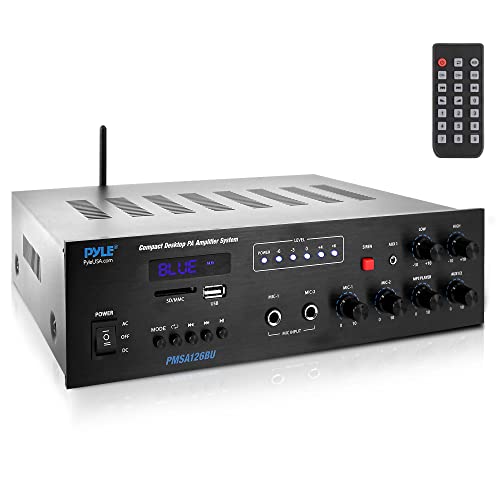
Best for 70V/100V public address use with dual mic inputs and USB MP3 playback. This 500W unit is designed for commercial settings like restaurants, shops, and conference rooms. It also provides Bluetooth streaming for flexible audio sources. Ideal when you need a compact, dedicated PA with easy mic control.
Who it’s best for: small to mid-sized venues requiring fixed public address output. Why selected: strong 70V/100V compatibility with straightforward mic and media controls. Caution: not the quietest option for extremely delicate dynamic ranges at ultra-low volumes.
Gemini XGA-5000 2-Channel Power Amplifier

Best for pro audio systems needing extreme output. The XGA-5000 delivers 6000W peak with wide input/output options, including XLR, TRS, RCA, Speakon, and banana posts. It’s built for DJs, sound engineers, and events requiring headroom and durable protections. Use this when your crowd demands powerful, clear sound at high levels.
Who it’s best for: heavy-use gigs and large venues. Why selected: unmatched peak power and versatile connectivity. Caution: power requirements are significant; ensure electrical supply and ventilation meet demands.
Crown XLi800 Two-Channel Amplifier

Best for rugged, professional gigs with reliable performance. The XLi800 offers 300W continuous at 4 ohms per channel and selectable input voltage, making it a solid choice for fixed installations or touring setups. This model provides dependable power with a focus on fidelity and durability.
Who it’s best for: professional DJs and venues that require predictable, consistent output. Why selected: proven Crown reliability for live sound. Caution: may require additional processing or a separate mixer for certain complex rigs.
Buying Guide: Key Considerations For PA System Amplifiers
Power needs: Match amplifier wattage to speaker ratings and room size. More headroom reduces distortion at high volumes.
Impedance and load: Ensure speakers’ impedance matches amplifier capability (4–8 ohms typical for PA systems). Bridging requires careful pairing to avoid damage.
Inputs and outputs: Look for mic inputs, line inputs, USB/MP3, Bluetooth, and multiple speaker outputs (Speakon, binding posts). Flexible inputs save sourcing separate gear.
Output type: 70V/100V systems are common in public addressing. For standard club PA, low-impedance 4–8 ohm outputs are typical.
Protection features: Consider limiters, thermal protection, short-circuit protection, and robust fan cooling for longer events.
Size and installation: Rack-mountable units save space in fixed installations. For portable use, lighter units with handle options may be preferable.
Budget and future-proofing: Balance upfront cost with potential expansion, such as bridged configurations or additional channels for a larger venue later.
Frequently Asked Questions
- What does 70V/100V output mean? It indicates a high-voltage line-level distribution designed for long runs to multiple speakers in commercial systems.
- Is bridgable power amplifier better? Bridging increases output to drive more power into a single speaker or a higher-impedance load, but requires compatible speakers and careful setup.
- How do I choose the right wattage? Compare amplifier wattage to your speaker rating and the room size. Aim for headroom to avoid clipping at peak moments.
- Can Bluetooth be used in professional PA setups? Yes, for convenience. For best sound quality, use wired sources for main channels and Bluetooth for secondary playback when appropriate.
- Do I need a mixer with these amplifiers? Some models are integrated mixers; if not, pair with a separate mixer to manage multiple audio sources and mics.
- What maintenance helps longevity? Ensure proper ventilation, clean connectors, and periodic checks of power and speaker load compatibility.