
Best Audio Interface With Stereo Inputs for Home Studios
If you need an audio interface that handles stereo inputs for podcasts, music recording, or streaming, these five models deliver reliable stereo capture and flexible monitoring. They’re suited for musicians, podcasters, and content creators who want clear, detailed sound without complex setup. This guide highlights which is best for your needs and why.
| Product | Best For | Key Benefit |
|---|---|---|
| M-AUDIO M-Track Duo USB Audio Interface | Multi-instrument recording | Two combo inputs with 48 kHz resolution and zero-latency monitoring |
| JOLGOO 2×2 USB Audio Interface | Studio-quality, portable setups | 24-bit/192 kHz, dual inputs, +48V phantom power |
| Cubilux CB5 USB Audio Interface | Casual recording and streaming | 5-in-1 hub with multiple jacks and stereo monitoring |
| BOMGE mini 2 Channel USB Audio Interface | Compact streaming and guitar/vocal work | 2 in/2 out with phantom power, portable USB design |
| Synido USB C Audio Interface | Modern USB-C setups | 24-bit/48 kHz with three monitoring modes |
M-AUDIO M-Track Duo USB Audio Interface
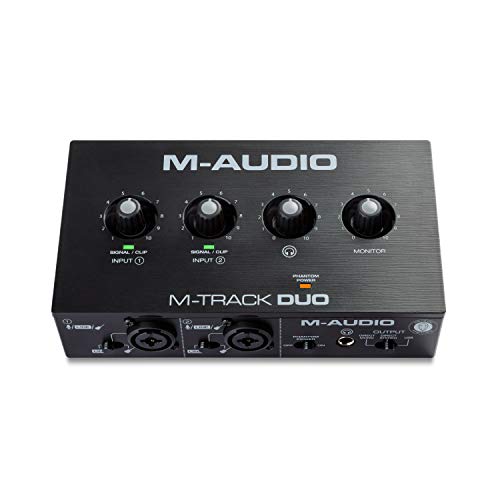
The M-Track Duo offers two combo XLR/Line/Instrument inputs with phantom power and 48 kHz resolution. It supports stereo monitoring via a 1/4″ headphone output and stereo 1/4″ outputs, with a USB/Direct switch for zero-latency monitoring. Best for: home studios needing flexible two-channel stereo capture and easy monitoring for vocals, guitar, and line-level signals. Caution: interface performance depends on computer USB bandwidth and driver compatibility.
Focusrite Scarlett Solo 3rd Gen USB-C Audio Interface

The Scarlett Solo provides high-quality mic pre-amps and an Air mode for added clarity on acoustic recordings. It has two inputs with excellent converters capable of up to 24-bit/192 kHz. Best for: solo musicians or podcasters who want studio-grade sound in a compact, bus-powered unit. Limitation: it is a 2-in/2-out interface with one instrument and one mic input, which may be less ideal for complex stereo drum or keyboard setups.
Jolgoo 2×2 USB Audio Interface
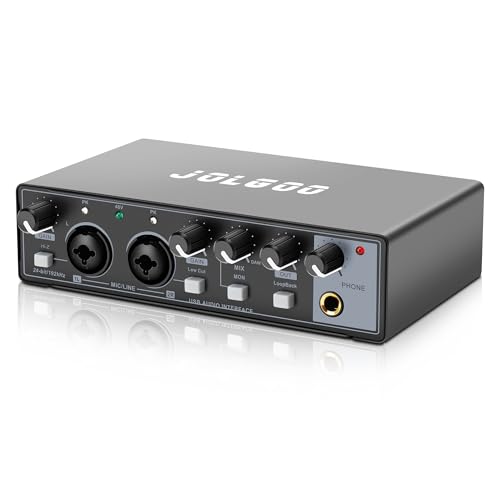
This 2×2 interface features 24-bit/192 kHz audio, dual XLR/Line inputs with +48V phantom power, and Direct Monitoring for zero-latency listening. It’s well-suited for podcasters and musicians who need robust headroom and clear vocal or instrument recordings. Best for: portable studio work with professional-grade clarity. Caution: control layout and LED indicators may be less intuitive for beginners.
Cubilux CB5 USB Audio Interface

The CB5 is a versatile 5-in-1 hub with multiple inputs and outputs, allowing two stereo mic jacks, line-in, line-out, and headphone monitoring. It supports multi-track recording and up to 96 kHz/24-bit quality, offering flexible connectivity for streaming and podcasting. Best for: users who want a compact interface that can double as a small mixer-like hub. Caution: line-out and headphone output cannot be used simultaneously in some configurations.
BOMGE mini 2 Channel USB Audio Interface

The BOMGE mini focuses on two-in, two-out recording with phantom-powered inputs and USB connectivity. It delivers 48 kHz resolution and is described as portable and straightforward for guitar or vocal work. Best for: small setups needing reliable stereo monitoring and simple operation. Limitation: some users may want more advanced pre-amps for demanding vocal tracks.
Buying Guide: Key Purchase Considerations
What matters most when choosing an audio interface with stereo inputs? Consider input count, monitoring options, and compatibility with your workflow.
- Input configuration: If you need true stereo input paths, prioritize interfaces with dual mic/line inputs that can capture stereo pairs or dual mono tracks simultaneously.
- Monitoring and latency: Look for zero-latency monitoring or direct monitoring features to avoid echo and delay during recording.
- Resolution and converters: Higher bit depth (24-bit) and sample rate (44.1 kHz–192 kHz) improve detail, especially for vocals and acoustic instruments.
- Phantom power: Necessary for condenser microphones. Ensure the unit provides +48V phantom power on the applicable inputs.
- Connectivity: USB-A, USB-C, or USB-C native devices affect compatibility with modern computers and tablets. Check driver support if needed.
- Portability versus studio needs: Portable models are great for on-the-go recording, but some setups benefit from more I/O and built-in monitoring controls.
- Software and stability: While this guide focuses on hardware, consider bundled software and long-term driver stability for your computer OS.
Who Should Consider Each Model?
- M-Track Duo: Best for dual-monor or stereo-capable recordings with flexible monitoring; ideal for small bands or podcast teams.
- Focusrite Scarlett Solo: Best for solo creators seeking studio-grade pre-amps in a compact form; choose this if you primarily record one voice and one instrument.
- Jolgoo 2×2: Best for portable studios requiring higher sample rates and robust phantom-powered inputs; choose if you record vocals and instruments in stereo or need crisp live sound.
- Cubilux CB5: Best for budget-conscious users who want multiple jacks and a simple hub approach; choose if you need quick connectivity for streaming and casual recording.
- BOMGE mini: Best for ultra-compact setups and on-the-go recording; choose if you want a simple two-channel solution without extra frills.
- Synido USB C: Best for modern USB-C workflows and easy switching between monitoring modes; choose if your rig is USB-C based and you want flexible monitoring options.
FAQ
- Do I need phantom power for all microphones? Not all mics require phantom power; condenser mics do. Check your mic type and power needs.
- Is 24-bit/192 kHz necessary for home recording? It improves detail and headroom, but many projects sound good at 24-bit/96 kHz. Consider your workflow and need for headroom.
- Can I use these interfaces with smartphones or tablets? Some support USB-C or USB-C OTG; confirm compatibility with your device and OS.
- What is latency, and why is it important? Latency is the delay between input and output. Zero-latency monitoring helps performers hear in real time.
- Do I need multiple outputs for stereo monitoring? Yes, stereo outputs help with accurate monitoring in a two-channel path for speakers or headphones.
- Are these interfaces easy for beginners? Several models target beginners with straightforward controls; some offer advanced features for growing studios.
This selection focuses on interfaces that provide clear stereo input/output paths, reliable monitoring, and practical connectivity for American home studios. Each model serves distinct workflows—from solo vocal-recording setups to small-band or streaming rigs—while keeping the setup approachable and scalable for future needs.