
Best Aux Cable and Adapter Options for Connecting Headphones to Other Devices
Looking for reliable ways to connect headphones or speakers to devices with different audio jacks? This guide highlights five top options that convert, adapt, or extend a headphone jack for better compatibility. The best pick depends on your setup: car systems, home stereos, or portable devices. The top picks below are suited for different needs—from short, durable cables for in-car use to robust adapters for studio gear. The following summary table helps compare key points at a glance.
| Product | Connection Type | Length | Best For | Limitations |
|---|---|---|---|---|
| JSAUX RCA to 3.5mm Cable | RCA Male to 3.5mm Aux | 6.6 ft | Connecting smartphones/tablets to RCA-enabled receivers | RCA to 3.5mm is not ideal for laptops without RCA input |
| Nanxudyj AUX Cord 6ft | 3.5mm Male to Male | 6 ft | In-car setups and gaming consoles with 3.5mm jacks | Right-angle design may vary compatibility with some cases |
| SYNCWIRE 3.5mm Nylon Braided | 3.5mm Male to Male | 3.3 ft | Everyday devices and home stereos | Shorter length may limit long-distance use |
| VCE 3.5mm to 1/4 Adapter | 3.5mm to 1/4″ (1/4 in) | 2-Pack | Mixing pro audio gear with consumer devices | One-time fit may feel loose in tight sockets |
| CableCreation 3.5mm Aux Cable | 3.5mm Male to Male | 18 inches | Car or desk setups needing a short extension | Not ideal for long-distance use |
JSAUX RCA to 3.5mm Cable 6.6ft

Best for: Users needing to connect a smartphone, tablet, or other device with a 3.5mm output to an RCA-enabled stereo or receiver. The dual-shielding gold-plated connectors and oxygen copper core minimize interference for clearer stereo sound. The RCA connectors are color-marked for quick left-right hookup and easy grip. This cable is well-suited for home audio setups, car stereos, and TVs with RCA inputs.
Why selected: It combines reliable build quality with a long 6.6-foot length, making it versatile for different room layouts or vehicle interiors. The bi-directional capability ensures consistent stereo transmission.
Limitation: Requires an RCA input on the destination device; if your setup lacks RCA ports, you’ll need an additional RCA-to-3.5mm adapter or a different connectivity path.
Nanxudyj AUX Cord 6ft

Best for: In-car setups, gaming consoles, and portable devices that require a right-angle connector to minimize stress on the jack. The 90-degree design helps in cramped spaces and when resting a controller or device against your body.
Why selected: The clean copper core and triple shielding support clear, lossless audio with minimal static, and the nylon braided exterior adds durability for daily use.
Limitation: The right-angle design may not fit all cases or docks; check port layout on your device before purchase.
SYNCWIRE 3.5mm Nylon Braided Aux Cable

Best for: General home audio, headphones, and car stereos needing a reliable, long-lasting 3.5mm cable with strong shielding.
Why selected: The 24K gold-plated connectors reduce signal loss and noise. The 3.3-foot length balances portability with usability, and the nylon braid adds durability for daily use.
Limitation: While durable, this length may require an extension for longer setups or larger rooms.
VCE 3.5mm to 1/4 Adapter

Best for: Connecting a 3.5mm headphone or auxiliary cable to a pro audio device with a 1/4″ input, such as mixers, amplifiers, or keyboards.
Why selected: The 24K gold-plated connectors optimize conductivity and minimize signal loss. The solid brass construction with a secure TRS interface ensures a solid, stable fit.
Limitation: This adapter is directional—use the 3.5mm male to 1/4″ female on receivers or devices expecting a 1/4″ input; reverse connections may not work as intended.
CableCreation 3.5mm Aux Cable 0.45m
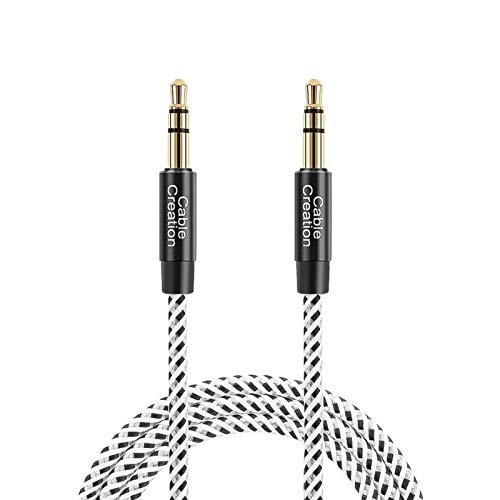
Best for: Short-distance connections such as car audio or desktop speaker setups where a compact cable is preferable.
Why selected: The cable length is ideal for tight spaces, and it’s designed for reliable performance with a focus on secure connections. It’s important to ensure your device has a 3.5mm jack and tight-fitting ports for best results.
Limitation: Not suitable for long-distance use; consider a longer option if you frequently require more slack between devices.
Buying Guide
What should you consider when choosing an aux cable or adapter?
- Compatibility: Check device jacks—3.5mm, RCA, or 1/4 inch—and match them to the adapter’s outputs.
- Length: Longer cables provide flexibility but may introduce more signal loss or tangling risk; short cables reduce clutter but limit placement options.
- Durability: Nylon braiding, gold-plated connectors, and reinforced joints improve longevity in daily use and travel.
- Directional vs. universal: Some adapters are directional (1/4 to 3.5) and work only one way; others are universal and bidirectional.
- Use case: Home theater, car audio, studio gear, or portable devices each have different priorities like shielding, bend life, and connector quality.
Frequently Asked Questions
- Q: Do I need an RCA-to-3.5mm cable if my device has a 3.5mm jack? A: No. An RCA-to-3.5mm cable is for connecting devices with RCA outputs to devices with 3.5mm inputs, not for devices that already have a 3.5mm jack.
- Q: Can I use a 3.5mm to 1/4 inch adapter with headphones? A: Yes, if your headphones or source provide a 3.5mm jack and you are feeding a 1/4 inch input on an amplifier or mixer.
- Q: Do gold-plated connectors improve sound quality? A: They reduce oxidation and may improve conductivity slightly, but most audible differences come from shielding and cable construction.
- Q: Is a right-angle AUX cable better for car use? A: Right-angle designs can reduce strain in tight spaces but ensure the angle fits your device’s port layout.
- Q: How do I avoid crackling or static in an AUX cable? A: Choose a cable with solid shielding and well-seated connectors; avoid coiling cables too tightly and ensure plugs are fully inserted.
- Q: Are there any cases where these adapters won’t work? A: Some devices with protective cases (e.g., LifeProof, OtterBox) may obstruct connectors; check clearance before purchasing.