
Best Headphone Amplifier for Studio: Top 5 Models for Clear Monitoring
Answering the common buyer intent for studio monitoring enthusiasts: these headphone amplifiers provide independent per-channel volume control, low-noise operation, and enough output to drive multiple headphones at precisely controlled levels. The top picks below suit different user profiles—from compact home studios to small project studios needing multiple independent mixes. The summary table highlights the key fit for each product to help you compare quickly.
| Product | Best For | Channels / Outputs | Key Benefit |
|---|---|---|---|
| Mackie HM-4 Headphone Amplifier | Small studios needing 4 independent listeners | 4 channels | Quad independent level controls |
| FIFINE N6 4-Channel Amplifier | Budget-friendly four-monitor setup | 4 channels | Solid build, minimal distortion at high volume |
| TONALUXE 8-Channel | Professional multi-headphone monitoring | 8 channels, 16 outputs | Dual input modes, flexible routing |
| LZSIG 4-Channel with Bass Boost | Compact home studios with extra bass control | 4 channels | Bass boost and wide compatibility |
| Pyle PHA40 4-Channel | Portable, budget-conscious multi-monitor setup | 4 channels | Independent volume controls for each listener |
Mackie HM-4 Headphone Amplifier (4-Channel)

The Mackie HM-4 provides four independent headphone outputs with individual level controls, making it an ideal choice for small studio sessions where multiple listeners need to hear the main mix at their preferred volume. Best for compact rooms or small projects where separate monitoring is essential. The 1/4-inch and 1/8-inch compatibility ensures versatile connection to common mixing consoles and interfaces.
Best for: small recording sessions, live tracking, and teaching studios where ongoing volume autonomy matters. Limitation: basic feature set focused on monitoring; no advanced DSP or bass controls beyond separate volume. The four outputs enable clear separation among listeners, reducing cross-talk in shared environments.
FIFINE N6 4-Channel Headphone Amplifier
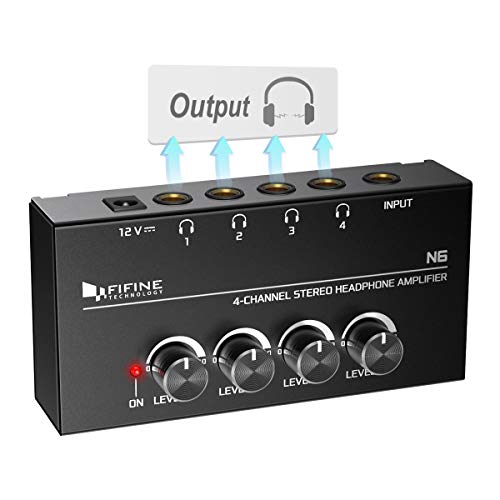
The FIFINE N6 is a budget-friendly four-channel amplifier with individual volume knobs for each output. It’s well-suited for multi-person monitoring in smaller studios or classroom setups. It maintains signal integrity when all four headphones are connected and avoids audible crackle at higher volumes. A solid choice for entries into multi-headphone monitoring without overspending.
Best for: home studios and entry-level setups needing dependable four-channel monitoring. Better for: users who want separate volume control per listener with straightforward, plug-and-play use. Caution: ensure input cables match the required 1/4″ TRS connections; included cables are not specified.
TONALUXE 8-Channel Headphone Mixing Distribution Amplifier

The TONALUXE unit stands out for larger monitoring needs, delivering up to 16 headphone outputs across eight channels. It supports mono and stereo routing, plus dedicated rear inputs for clean signal paths. This makes it a strong candidate for professional studios or live monitoring environments where different engineers require their own independent mixes.
Best for: small to mid-sized professional studios and live monitoring setups. Choose this if: you need high channel count and flexible routing. Limitation: higher cost and footprint than four-channel options; may require more space and cabling.
LZSIG Headphone Amplifier with Bass Boost
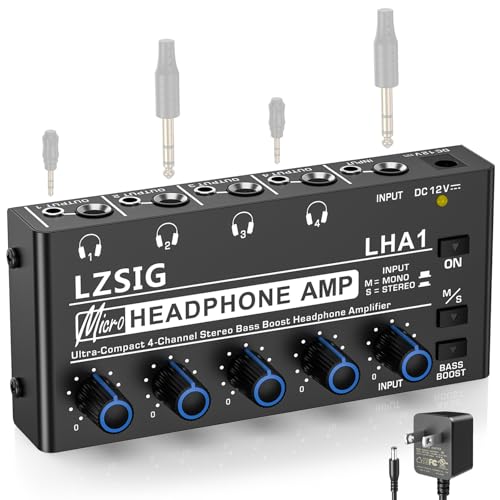
The LZSIG LHA2 provides four independent channels with a bass boost feature, which can help bring clarity to vocals and bass in a dense mix. It supports both 1/4″ and 1/8″ plugs, making it versatile for various headphones. This is especially useful in home studios where bass response can influence perceived mix quality during monitoring.
Best for: home studios needing crisp distribution with an optional bass enhancement. Better for: users who want to tailor monitoring to bass-heavy mixes. Caution: bass boost is an effect, not a substitute for proper mix balance; use judiciously in critical listening.
Pyle PHA40 4-Channel Headphone Amplifier

The Pyle PHA40 offers four independent headphone outputs with individual volume controls, making it a practical option for four-person monitoring in small studios. It is a compact, portable choice that can travel between spaces or fit into tighter control rooms. The device supports ¼” TRS outputs and a source input jack for easy integration with a mixer or interface.
Best for: portable project studios and classroom environments needing multiple monitoring points. Caution: build and component quality may be more variable at budget price points; verify power and cabling when setting up.
Buying Guide: Key Considerations For Choosing A Studio Headphone Amplifier
- Channel count and headphone compatibility: Choose the number of independent outputs you need. Confirm the headphone jack size (1/4″ vs 1/8″) and the impedance your headphones require.
- Independent level controls: Per-headphone volume control helps prevent cross-listener interference and allows precise monitoring for each listener.
- Signal routing and input options: Look for devices with flexible input connections (1/4″ TRS, XLR, USB) and, if needed, mono/stereo routing for specific mixes.
- Noise and distortion: Low-noise circuitry and high signal-to-noise ratio improve listening clarity during dense sessions or late-night work.
- Size and portability: Compact units suit small rooms and mobile rigs; larger multi-channel models best fit dedicated control rooms.
- Power and reliability: Check the power requirements and whether the unit includes a dedicated power supply to ensure stable operation during long sessions.
- Budget vs. features: Balance cost with needs such as bass boost, rear inputs, or 8-channel expansion. Not all setups require top-tier specs.
Frequently Asked Questions
- What is the main benefit of a headphone amplifier in a studio? Answer: It provides independent volume control for each listener, preserves the main mix integrity, and reduces cross-talk during monitoring.
- Do I need a multi-channel amplifier if I only record solo? Answer: Not necessarily. If you only need one or two monitoring cues, a smaller 2- or 4-channel unit may be sufficient and save space.
- Should I choose mono or stereo monitoring on each channel? Answer: Stereo monitoring is standard for listening to stereo mixes. Mono can be useful for checking phase or balance in separate elements.
- How important is bass boost on a headphone amp? Answer: It can help emphasize certain frequencies during monitoring, but it should not replace proper equalization for your mix.
- Can I use a headphone amplifier with a laptop or mobile device? Answer: Yes, many models support 1/8″ or 1/4″ inputs and adapters, but check impedance and compatibility for the best performance.
- Is a higher channel count always better? Answer: Not necessarily. Match channel count to the number of listeners or engineers who need independent monitoring.