
Best Optical Audio to USB Cables and Adapters for Crystal-Clear Digital Sound
The search intent here is clear: find reliable USB-to-S/PDIF optical adapters or cables to convert digital audio from USB devices into high-quality optical output. These picks are best for gamers, movie lovers, and home theater enthusiasts who want lossless, low-latency audio without bulky setups. The top products below are selected for compatibility with PCs, laptops, consoles, and sound systems, focusing on unidirectional transmitters and easy plug-and-play use. A quick comparison table is provided to help you compare core specs at a glance.
| Product | Brand | Best For | Notes |
|---|---|---|---|
| Cubilux USB A to TOSLINK Optical Audio Adapter | Cubilux | PCs, Laptops, PS5/4 users seeking simple USB-A to optical out | Plug & Play, no driver required |
| CERRXIAN USB to Optical Audio Adapter Cable | CERRXIAN | Notebook users needing portable one-way USB-A to Toslink | Input USB-A, output Toslink |
| USB C to Toslink Optical Audio Cable (QIMIAOUS) | QIMIAOUS | USB-C devices including smartphones, laptops | Hi-Res 16-bit/96kHz supported |
| MISYNLON USB to Optical Audio Adapter Cable | MISYNLON | Any USB-A source to soundbar or DAC | Plug-and-play, USB-A to Toslink |
| Cubilux USB C to SPDIF Transmitter | Cubilux | USB-C to optical transmitter for 5.1-capable output | Output only, supports 5.1 with proper setup |
Cubilux USB A To TOSLINK Optical Audio Adapter

Best for: PC or console users who need a simple USB-A to optical output without extra cables. This unidirectional, plug-and-play device converts USB A from a laptop, PC, or gaming console into a S/PDIF/TOSLINK signal for sound bars, home audio systems, external DACs, or amplifiers. It’s ideal when you want lossless digital audio with minimal setup.
- Instant connectivity from USB A devices to S/PDIF sound systems, enabling lossless audio with minimal clutter.
- Crystal-clean hi-res sound at 48 kHz/24-bit up to 192 kHz/24-bit, preserving audio details.
- No driver or external power required; works with Windows and Mac OS on USB Type A ports.
Best for: gamers and movie enthusiasts who use laptops, desktop PCs, or PS5/4 with a dedicated optical input. Caution: Not compatible with TV or other devices, and it is unidirectional — audio flows from USB to optical only.
CERRXIAN USB To Optical Audio Adapter Cable

Best for: Laptop users who want a portable, one-way USB-A to Toslink solution to feed a soundbar, DAC, or home theater receiver. The unidirectional design helps ensure clean signal flow from source to output, reducing potential noise.
- Unidirectional USB-A to Toslink transmission ensures a clear signal path from source to receiver.
- Converts a laptop/PC USB-A port into a 16-bit/48 kHz digital audio source for immediate use with Toslink devices.
- High-quality stereo digital audio over a fiber optic link—ideal for enhanced clarity and detail.
Best for: users prioritizing compact, driver-free operation. Limitation: Intended for USB-A source devices; not for reverse audio input.
QIMIAOUS USB C To Toslink Optical Audio Cable
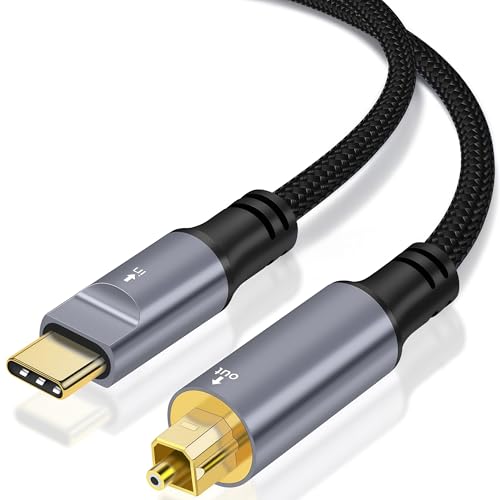
Best for: USB-C devices like modern laptops, tablets, or smartphones needing a direct optical audio path to soundbars, DACs, or amplifiers. It supports 5.1 surround-ready transmission when used with appropriate content and equipment.
- USB-C to Optical Audio Cable converts digital audio from USB-C to Toslink.
- Widely compatible with most USB-C devices and destinations with optical input.
- High-performance, Hi-Fi audio up to 16-bit/96 kHz; designed for low-noise, stable transmission.
Best for: users seeking 5.1-capable transmission to optical receivers. Caution: Some setups may require compatible decoders or receivers to realize 5.1 surround.
MISYNLON USB To Optical Audio Adapter Cable
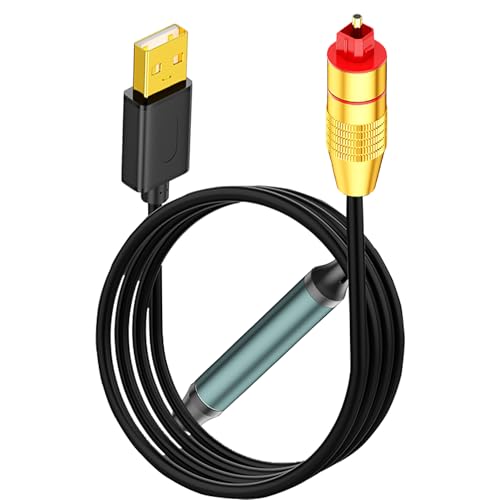
Best for: Users who want a straightforward USB-A to Toslink path with plug-and-play setup. It’s suitable for connecting a PC, laptop, or PS5 to a speaker system, DAC, or home theater device.
- Plug-and-play: no drivers or external power required.
- High-fidelity audio with a focus on crisp, lossless output over fiber optic.
- Delivers up to 16-bit/48 kHz performance suitable for most home audio scenarios.
Best for: users prioritizing simplicity and reliable USB-A to optical output. Limitation: 16-bit/48 kHz spec may be less than premium multi-channel formats, depending on content.
Cubilux USB C To SPDIF Transmitter

Best for: MacBook Pro/Air and other USB-C devices needing an optical output to soundbars or DACs. This transmitter focuses on unidirectional S/PDIF output from USB-C to optical, enabling 5.1-capable paths when your system supports it.
- Converts USB-C port audio into an SPDIF optical signal for external devices.
- Output only — not for receiving SPDIF signals from a source; suitable for transmitting to Toslink-equipped receivers.
- Supports 5.1 and stereo output with proper content and decoders; not guaranteed to provide true 7.1 in all setups.
Best for: users with USB-C laptops or Macs who want a dedicated optical transmitter. Caution: Does not function as a bidirectional audio interface.
Buying Guide: Key Considerations For Optical Audio Over USB
- Directionality: Most products reviewed are unidirectional (USB-A or USB-C to Toslink). If you need to capture audio from a device, these may not be suitable.
- Compatibility: Check your source device and destination receiver. Some devices require specific bitrates (commonly 16-bit/48 kHz or higher) to achieve the best results.
- Input/Output Interfaces: USB-A and USB-C adapters deliver optical audio output only. Ensure your source has the correct port and your receiver accepts Toslink.
- Audio Quality: Look for products advertising high-resolution support (e.g., 24-bit/96 kHz or 192 kHz) to maximize fidelity with lossless formats.
- Power Requirements: Most units operate without external power; if yours requires power, confirm connector compatibility and any necessary power sources.
- Latency and Sync: While not always a major concern for movies, games, and live audio, consider products that emphasize low-latency transmission for real-time use.
- Content and Use Case: For home theater, prioritize devices that can handle 5.1 or 7.1 with proper decoders; for music, stereo clarity may suffice.
- Portability: If you travel or move between devices, compact, plug-and-play models are advantageous.
Frequently Asked Questions
- What is an optical audio adapter used for?
It converts digital audio signals from USB ports to an optical S/PDIF/TOSLINK signal for compatible receivers like soundbars, DACs, or AV receivers.
- Are USB-A and USB-C to Toslink adapters bidirectional?
No. Most are unidirectional, transmitting from the USB source to the optical receiver. They do not receive optical signals back.
- Will these adapters improve all audio formats?
They improve digital transmission quality where the source and receiver support optical S/PDIF. Not all formats or content can be enhanced beyond the source’s capabilities.
- Do I need drivers for these adapters?
Many are plug-and-play and do not require drivers. Some may require specific OS support, so verify compatibility with your computer’s OS.
- Can I use these with my TV?
Most listed products are intended for computers, laptops, consoles, and audio receivers. They may not work with TVs unless the TV’s source and input align with the adapter’s direction and output.
- What about 5.1 surround sound support?
Some adapters can output 5.1 with compatible content and equipment, but success depends on your source material and decoding capabilities of the receiving device.