
Best Power Laptop From Car Cigarette Lighter: Top Inverters for on-the-Go Charging
When you’re on the road, you’ll want reliable, portable power to keep your laptop, phone, and essential devices charged. This article highlights five car power inverters that connect to a cigarette lighter or 12V socket and deliver steady 110V AC or USB-C/USB-A charging for laptops and other gear. It’s ideal for travelers, road-trippers, students commuting, and professionals who need a portable workspace in the vehicle. Below you’ll find clear comparisons, who each option is best for, and practical buying guidance.
| Product | Best For |
|---|---|
| YSOLX 300W Portable Charger Car Power Inverter | Families and campers needing multiple USB-C/USB-A ports and dual AC outlets |
| PiSFAU 300W Car Power Inverter | Travelers needing six ports and compact design |
| AeternaSol 200W Portable Inverter | Backseat passengers who require fast charging for multiple devices |
| vansoet 300W Car Power Inverter | Road trips with emphasis on PD/QC fast charging |
| BESTEK 300W Pure Sine Wave Inverter | Laptop users needing clean power and USB-C/USB-A fast charging |
YSOLX 300W Portable Charger Car Power Inverter

The YSOLX inverter provides 300 watts of continuous DC-to-AC power with 4 USB-C/A ports (24W total) and dual 110V AC outlets. It’s designed to power smartphones, cameras, laptops, and small household devices from a vehicle’s cigarette lighter or 12V socket. A six-output configuration supports lighting, fans, and compact appliances for camping or long road trips. An upgraded cooling system helps maintain steady performance during extended use.
Best for: families or outdoor enthusiasts who need multiple simultaneous charges and both AC outlets and USB ports accessible from the front or back seats.
Caution: The total load must not exceed 300W; avoid running high-wattage appliances simultaneously for extended periods.
PiSFAU 300W Car Power Inverter DC 12V to 110V AC

This unit features six ports: two USB-C ports (24W fast charge), two USB-A ports (24W fast charge), and two 110V AC outlets. It emphasizes quiet operation and high efficiency through advanced heat dissipation. Its compact, same-size-as-a-cellphone footprint makes it a convenient travel companion.
Best for: travelers who need multiple fast-charging options and a compact curb-appeal inverter for front-seat use.
Caution: The device’s total output is capped at 300W; plan around moderate loads and avoid heavy high-wattage devices at once.
AeternaSol 200W Portable 12V to 110V Car Inverter

AeternaSol offers 200W of continuous power with 2 AC outlets, 2 USB-C (PD 20W) and 2 USB-A (QC 36W). The unit supports charging up to six devices at high speed, with an LCD display to monitor input voltage. It includes an extra-long, 39.4-inch cable for easier accessibility from rear seats and a single-button power switch for straightforward use.
Best for: backseat commuters and family trips where USB-C PD charging and clear power readouts improve usability.
Caution: The maximum 200W output means it may not handle high-wattage laptops or powerful devices at full load.
vansoet 300W Car Power Inverter

vansoet delivers 300W continuous power with 1 USB-A and 1 USB-C port, plus 2 AC outlets. It highlights PD 30W and QC 18W fast charging to quickly power phones, tablets, and laptops. A built-in 40-amp fuse and LED indicators support protection against short circuits, overheating, and voltage issues. It is designed for road trips and car use with safety and efficiency in mind.
Best for: drivers who want reliable PD/QC fast charging for multiple devices on long drives.
Caution: The inverter’s total wattage remains a consideration; avoid plugging multiple high-wattage devices at once.
FLYLEAD 200W Car Charger USB C with GaN and PD100W
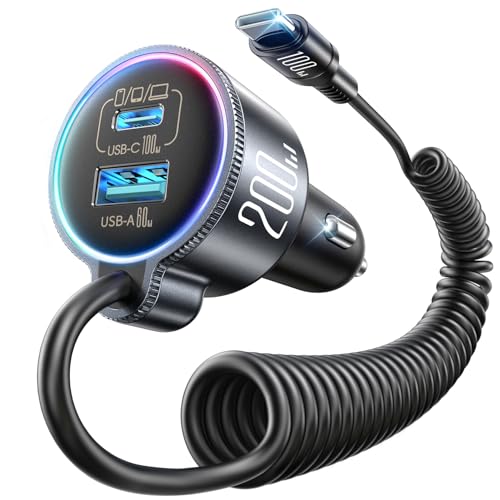
FLYLEAD combines a 200W capacity with GaN technology and PD100W fast charging. It features one fixed USB-C cable and one USB-C port, allowing two devices to charge at full speed simultaneously. The smart power allocation prioritizes efficiently distributing power between devices, making it a strong pick for laptops and phones on the go. The built-in coiled cable helps keep the car interior tidy, and the unit serves well as a practical travel charger for trucks, SUVs, and family road trips.
Best for: users needing high-speed PD charging on the move, especially with laptops and large phones.
Caution: Only two USB-C/USB-A charging ports are available; plan device charging accordingly if multiple guests require power.
Buying Guide: Key Considerations for Car Inverter Purchases
- Power output and device load: Match the inverter’s continuous wattage to your typical device mix. Laptops often require 60–180W; high-performance models may demand more. Always leave headroom for peak loads.
- Ports and charging technology: USB-C with PD is essential for fast laptop charging. Multiple USB-A ports are helpful for phones and tablets. Ensure there are enough AC outlets if you plan to use traditional laptop chargers.
- Pure sine wave vs modified sine wave: For sensitive electronics, a pure sine wave inverter is safer and provides cleaner power. If your devices tolerate it, a modified sine wave can be adequate and more affordable.
- Cooling and noise: Look for a unit with an intelligent or quiet cooling fan, especially for extended use or when powering laptops under load.
- Safety features: Prioritize built-in fuses, over-voltage and short-circuit protection, and under-voltage protection to protect both the inverter and connected devices.
- Cable length and accessibility: A longer output cable and easy-access ports improve usability for backseat passengers and drivers alike.
- Portability and size: If you travel often, a compact, lightweight inverter is easier to store and deploy in different vehicles.
Frequently Asked Questions
- Can you run a laptop directly from a car cigarette lighter? Yes, using a car power inverter that converts 12V to 110V AC or provides USB-C PD for laptops.
- Is a pure sine wave inverter necessary for laptops? It’s safer for sensitive electronics; many laptops tolerate modified sine wave, but pure sine wave provides steadier performance.
- How many devices can you charge at once? It depends on the inverter’s wattage and port types; select a unit with enough total output and ports for your needs.
- What’s the risk of using high-wattage devices in a car inverter? Overloading can trigger protection, drain the vehicle battery, or cause overheating. Always monitor the total draw.
- Are high-watt PD ports worth it for laptops? Yes, PD ports enable faster charging for modern laptops, tablets, and many USB-C devices.
- Do these inverters protect the car battery? Most include protections to prevent over-draws and overheating, but it’s wise to avoid running heavy loads for extended periods without engine running.
In summary, the right car inverter depends on your device mix, the number of simultaneous charges you need, and whether you prioritize pure sine wave power or compact portability. The listed models offer a range of ports, wattage, and charging speeds to suit different on-the-road work and travel scenarios.