
Best SPDIF to XLR Cables for Clear Digital-to-Analog Audio
Answering the need for clean one-way digital-to-analog conversion, these SPDIF (Toslink) to XLR cables adapters deliver stereo two-channel output with high sampling rates up to 192 kHz. Best for home theater setups, powered monitors, and hi-fi enthusiasts who want a simple, reliable path from optical sources to XLR inputs. This guide focuses on five reliable options, highlighting ideal users, key reasons to choose each, and any practical limitations to consider.
| Product | Brand | Best For | Key Point |
|---|---|---|---|
| ESWN DNXB 192KHz DAC Optical to XLR Male Converter | ESWN DNXB | Two-channel PCM applications with high-precision audio | 192 kHz support; one-way optical-to-XLR |
| Sabary 192KHz DAC Optical to XLR Converter | Sabary | Compact setups needing built-in cable | Includes 3.3 ft optical cable; PCM/LPCM only |
| AUTOUTLET 192kHz Optical to Dual XLR Stereo Converter | AUTOUTLET | Stereo amplification with dual XLR outputs | Integrated cables; PCM/LPCM only |
| NCGGY 192KHz Optical to Dual XLR Male Converter | NCGGY | Two-channel hi-fi routes with balanced outputs | Dual XLR outputs; 192 kHz support |
| YYTCG Audiophile RCA to XLR Cable | YYTCG | Improved RCA-to-XLR interconnects for compatible gear | Gold-plated connectors; emphasis on shielding |
ESWN DNXB 192KHz Optical To XLR Converter

The ESWN DNXB device converts Toslink/SPDIF optical signals into two-channel XLR output. It operates in a unidirectional path from optical to analog, not reverse. It supports up to 192 kHz sampling and 24-bit data, making it suitable for two-channel PCM audio from televisions, game consoles, and media players. Best for users seeking a compact, dedicated optical-to-XLR solution with stable unbalanced XLR outputs. Limitations include non-support for 5.1 channel formats and only outputting via the XLR connected device.
Sabary 192KHz Optical To XLR Converter
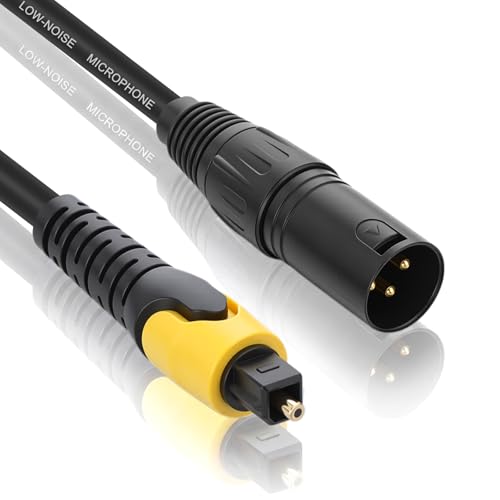
The Sabary converter provides one-way optical-to-XLR conversion with included 3.3 ft optical cable. It handles sampling rates up to 192 kHz and 24-bit data, outputting two-channel PCM/LPCM audio without electromagnetic interference. It is best for users who want a ready-to-use kit with a short optical cable included. Note that Dolby Digital and DTS or 5.1-channel formats are not supported, so use PCM/LPCM sources for best results.
AUTOUTLET 192kHz Optical to Dual XLR Stereo Converter

Autoutlet’s unit converts Toslink/SPDIF to two unbalanced XLR outputs, delivering clean stereo signals for amplifiers, powered speakers, or mixers. It supports 32–192 kHz sampling with 24-bit data and emphasizes electromagnetic-noise-free transmission. It requires the source to output PCM/LPCM. This is a solid choice for people connecting a set of powered speakers or a small mixer where two independent XLR outputs are advantageous. A potential limitation is the lack of 5.1 channel decoding, which may affect home theater setups relying on surround formats.
NCGGY 192KHz Optical To Dual XLR Converter

NCGGY’s dual XLR outputs provide two-channel, unbalanced analog signals from optical input, aimed at improving stereo separation for two independent lines. It supports 192 kHz with 24-bit data and requires setting the source to PCM/LPCM. Best for users needing two separate XLR channels with reliable high-resolution audio, such as connecting to two amplifiers or two sets of speakers. A caveat is that 5.1 channel formats are not supported, so ensure your source is PCM/LPCM only.
YYTCG Audiophile RCA To XLR Cable
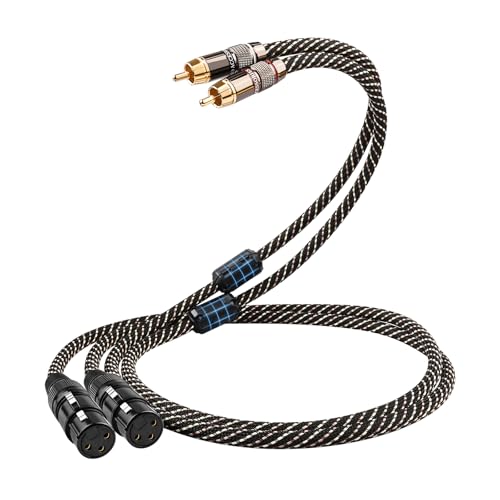
YYTCG focuses on high-fidelity RCA-to-XLR interconnects as a different type of signal path. This option highlights balanced-sounding detail via 99.99% OFC conductors and heavy shielding, including gold-plated connectors for durability and corrosion resistance. It’s best for users seeking improved sonic purity when converting from RCA to XLR within hi-fi chains. Note that this is an RCA-to-XLR cable, not a pure SPDIF-to-XLR digital converter, so ensure compatibility with your gear’s inputs.
Buying Guide: Key Considerations For SPDIF To XLR Converters
- One-way vs. two-way: All options here convert optical to XLR (one-way). Do not expect XLR-to-optical reversal unless specifically stated.
- Channel format: Most devices output PCM/LPCM stereo. If using Dolby or DTS, confirm compatibility or select a unit that explicitly supports only PCM/LPCM to avoid no-sound issues.
- Sampling rate and bit depth: Look for products supporting up to 192 kHz and 24-bit to preserve high-resolution audio fidelity.
- Number of outputs: Choose single-XLR or dual-XLR outputs based on whether you need one or two independent channels to feed multiple amplifiers or speakers.
- Included cabling: Some products come with integrated cables (e.g., short optical cables). If not, you may need to supply your own optical cord.
- Ground and EMI considerations: Shielding and ferrite cores help reduce EMI/RFI, improving signal integrity in complex setups.
- Compatibility with your gear: Ensure the source device is set to PCM/LPCM and that the downstream device accepts XLR inputs at line-level.
Frequently Asked Questions
- What is SPDIF Toslink to XLR conversion used for?
Answer: It converts digital optical audio to analog XLR, allowing connection to pro-audio or hi-fi gear that accepts XLR inputs. - Can I use these converters for 5.1 surround formats?
Answer: Most listed models do not support 5.1-channel formats; they are designed for two-channel PCM/LPCM output. - Do any of these cables include an extra optical cable?
Answer: Some models include a short optical cable; verify the product listing for included accessories. - Is XLR output unbalanced or balanced?
Answer: The products in this guide generally provide unbalanced XLR outputs suitable for consumer-grade amplification and stereo setups. - Will I be able to control volume through my TV remote?
Answer: In most cases, volume control is on the receiving device, not on the converter or via the TV remote. - What is PCM vs. Dolby or DTS in this context?
Answer: PCM/LPCM is a basic two-channel, lossless format used for stereo playback; Dolby AC3 and DTS are multi-channel formats not supported by all converters.