
Best USB Interfaces for Recording: Top Picks for Home Studios
Answering the most common buyer question: which USB audio interface best fits your recording needs? This guide highlights five standout options ideal for podcasts, music production, and live streaming. Each pick is chosen for compatibility with Mac and PC, ease of use, and solid input/output options. The top buyers are home musicians, podcasters, and content creators seeking clear, reliable sound with simple setup.
| Product | Best For | Key Benefit |
|---|---|---|
| M-AUDIO M-Track Duo | Dual-input recording and monitoring | 2 combo inputs with USB direct monitoring |
| Kmise USB Audio Interface | Budget-friendly, beginner setup | 24-bit/192kHz, plug-and-play |
| XTUGA Q-12 | Low-latency mobile recording | 48V phantom, plug-and-play |
| JOLGOO 2×2 | Professional-sounding vocals and instruments | 24-bit/192kHz, direct monitoring |
| Behringer UMC22 | Compact, reliable DAW integration | Midas mic preamp, broad DAW compatibility |
Below, each product is examined for who it’s best for, why it stands out, and any practical limitations to consider.
M-AUDIO M-Track Duo USB Audio Interface
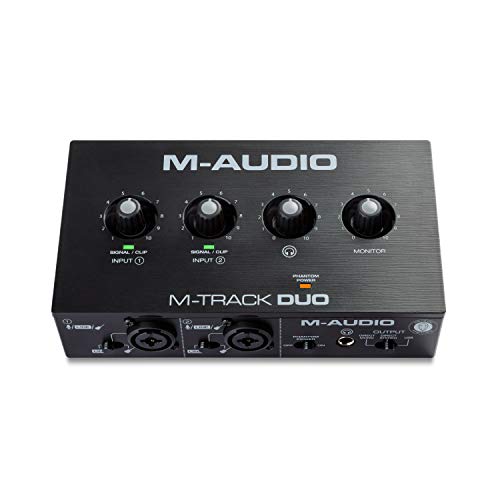
The M-Track Duo provides two combo XLR/Line/Instrument inputs with phantom power, making it a solid choice for podcasters and musicians who need versatile on-the-go recording. It records at 48kHz for clear, professional-sounding tracks and offers 1/4″ headphone and stereo outputs for flexible monitoring. The USB/Direct switch supports near-zero latency monitoring, ideal for performers who must hear themselves in real time. Best for home studios or portable setups where multiple input types are necessary.
Best for: Podcasters and small bands that require easy setup and reliable dual-channel recording. Limitation: May lack advanced onboard effects or high-end preamps found in pricier models.
Kmise USB Audio Interface

Kmise emphasizes crystal-clear sound through high-quality converters and preamps, delivering 24-bit/192kHz recording resolution. It features low-latency drivers and plug-and-play usability, making it suitable for beginners and mobile creators who want plug-and-play operation without driver headaches. This interface excels for home studios focusing on vocals and instruments where clean detail matters.
Best for: Beginners or mobile creators who want high-resolution capture with simple setup. Limitation: Fewer professional features or built-in DSP options than premium models.
XTUGA USB Audio Interface for PC

XTUGA’s Q-12 focuses on reliable dual inputs with 16-Bit/48kHz resolution. It supports 48V phantom power and emphasizes zero-latency operation with plug-and-play USB connectivity. It’s a practical pick for PC-based creators who want stable, straightforward setup for daily recording, practice sessions, or casual home studios. Users who require higher bit depth may look elsewhere.
Best for: PC users needing a dependable, portable interface with fast setup. Limitation: 16-bit resolution is lower than the 24-bit options offered by some competitors.
JOLGOO 2×2 USB Audio Interface
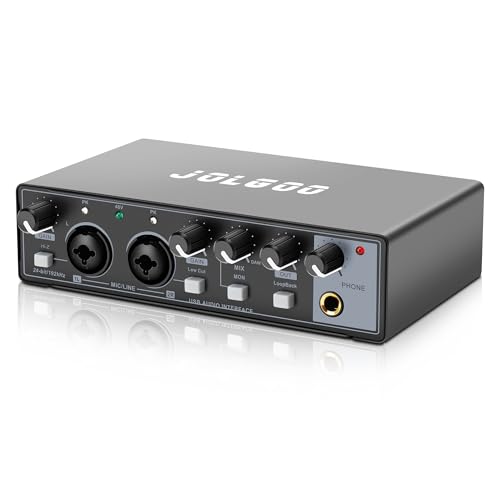
JOLGOO offers a studio-grade 24-bit/192kHz interface with dual XLR/Line inputs and +48V phantom power, plus zero-latency direct monitoring. This makes it a strong option for vocalists, guitarists, and podcasters who need detailed sound and reliable tracking. The portable USB-powered design supports on-the-go recording without external power. Best for: Musicians and podcasters seeking high fidelity and flexible input options. Limitation: May be larger than ultra-compact models, affecting portability in tight spaces.
Behringer UMC22 Audiophile 2×2

The Behringer UMC22 leverages a Midas-designed mic preamp for clear sound in a compact package. It is highly compatible with popular DAWs, making it a practical choice for beginners and hobbyists who want straightforward recording paths into their favorite software. Best for: Users who value universal DAW compatibility and a budget-friendly entry into home recording. Limitation: Limited input count and fewer advanced features than higher-end interfaces.
Buying Guide: Key Purchase Considerations
- Input/output needs: How many mics or instruments do you plan to record simultaneously?
- Resolution and latency: Do you require 24-bit/192kHz for studio-quality captures or is 16-bit/48kHz sufficient?
- Compatibility and ease of use: Are plug-and-play and broad DAW compatibility important for your setup?
- Portability vs. features: Do you need a compact unit for mobile recording or a more feature-rich model for a fixed studio?
- Monitoring options: Is zero-latency direct monitoring a must-have for your workflow?
FAQs
- What is the difference between 16-bit/48kHz and 24-bit/192kHz in practice?
– Higher bit depth and sample rate can capture more detail and dynamic range, which is beneficial for professional studios, though it requires more storage and processing power. - Do I need phantom power for microphones?
– Condenser microphones typically require 48V phantom power, while dynamic mics do not. Check your mic’s specifications before buying. - Is USB-C faster or better than USB-A for interfaces?
– USB-C can offer more modern connectivity and power delivery, but functionality depends on the interface and computer ports. Both can perform well with proper drivers. - Can I use these interfaces with mobile devices?
– Some interfaces offer compatibility with mobile devices via USB-C or USB-B adapters; verify the device’s compatibility and driver requirements. - What is direct monitoring vs. latency?
– Direct monitoring lets you hear the input signal in real time, bypassing your computer’s processing to avoid noticeable delay during recording. - Do I need an external audio interface for podcasting?
– Not always. If you only need basic voice recording with a USB mic, an interface may not be necessary, but an interface provides better preamps and more control for multiple sources.